
2026 CDO Report: Meet the Modern Data Team New survey of VP & C-level data and AI leaders confirms what’s stalling AI transformation.
What Is a Chief Data Officer in 2026? Many people working within the data industry are saying the same thing: the role of the Chief Data Officer (CDO) has changed – but how? CDO Magazine began an expert survey to find out. We recent...
The 6-Layer Operational Framework for Enterprise AI Agility What does AI agility mean? AI agility refers to how fast an AI system—and the organization behind it—can adapt to shifting data and market conditions. AI agility is all about speed and adaptability. I...
Community
Nashville Data and AI Leaders Call for Agility — Not Breakneck Speed — in the Agentic AI Era
At CDO Magazine’s Nashville Roundtable Exchange, data and AI executives explored how governance, human expertise and a clearer definition of ROI can help organizations move from AI experimentation to responsible enterprise value.

Written by: Camille Prado, Global Editor, CDO Magazine
Updated 3:05 PM EDT, October 5, 2026
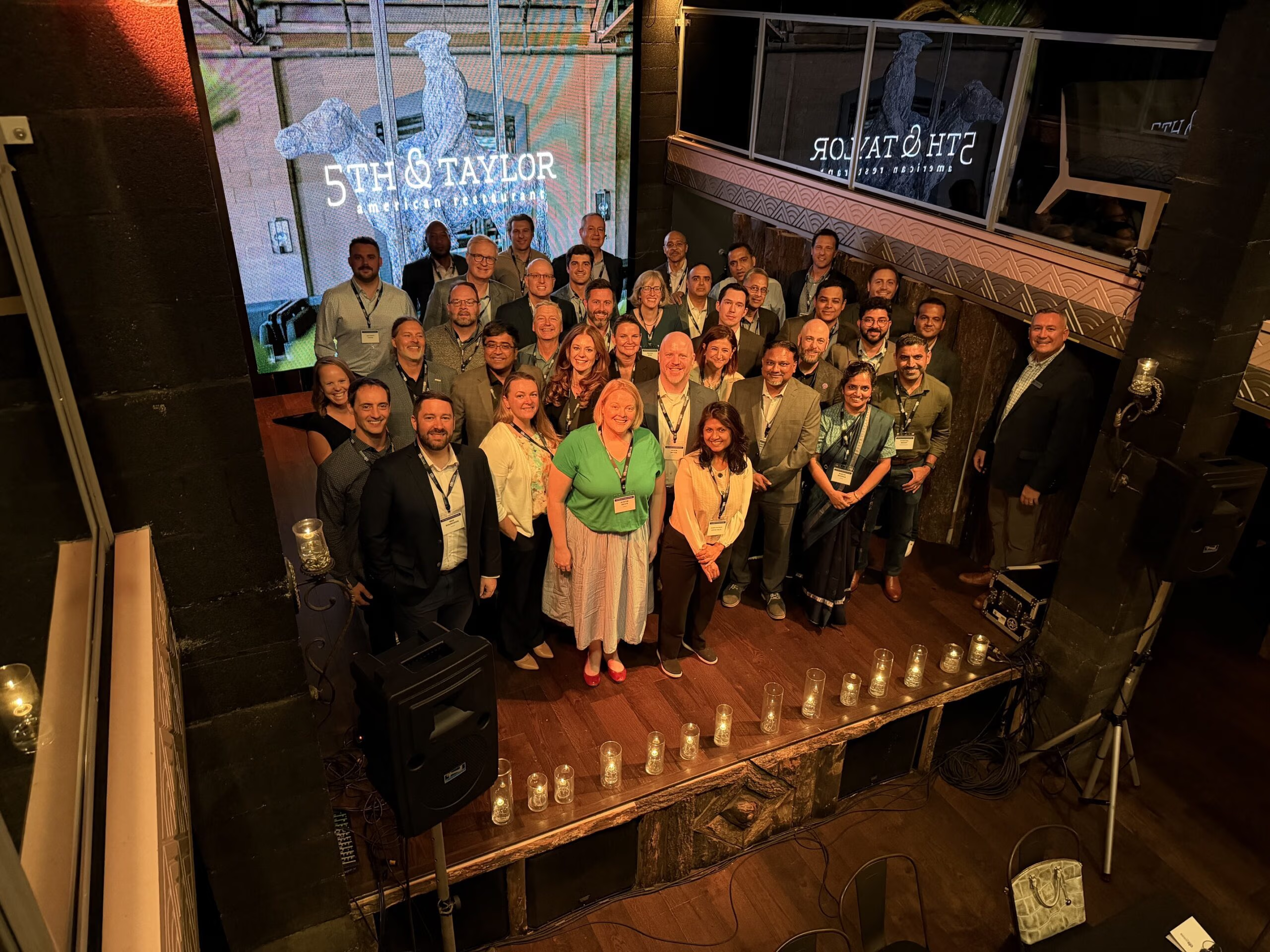
Data and AI leaders gather for the CDO Magazine Nashville Roundtable Exchange on September 30, 2026, at 5th & Taylor in Nashville.
How fast should companies move on AI?
For the data and AI leaders gathered at the CDO Magazine Nashville Roundtable Exchange on September 30, the answer was less about speed than agility.
Held at 5th & Taylor, the evening brought Nashville’s tight-knit data and technology community together to talk about the issues showing up inside their organizations as AI evolves: where companies stand in their adoption, whether governance can keep up, how agentic AI changes the risk equation and what return on AI investment should actually look like.
The conversation was co-chaired by Jason Beyer, Ralliant VP, Data + AI; Olivia Kew, Vanderbilt University Chief Data Officer; and Ashutosh Singhal, Meharry Medical College Chief Data Officer and Associate Vice President.
Asked what surprised her most about the evening, Jenna Chapman, CDO Magazine Community Director, had a simple answer: “The energy.”
That energy carried into a candid conversation about a problem many organizations now share: They need to move on AI, but moving at breakneck speed can create problems of its own.
AI governance moves to the foreground
Leaders began by considering their organizations’ AI maturity: Are they still experimenting, beginning to scale, or embedding AI into operations?
From there, attention turned to governance.
As capabilities advance and organizations confront questions around safety, oversight and accountability, leaders are assessing whether their existing governance frameworks can keep pace.
Singhal noted that the governance conversation is expanding beyond traditional data governance to AI and agentic AI.
“While data governance is still a major concern, the limelight is on AI/Agentic AI governance since safety and accountability are real and complex challenges at this moment. On the positive side, we are taking notes from lessons learned from even one unrelated domain to another — we just need to keep connected, share, and be aware of new developments.”
The group discussed model risk assessment, bias review and human-in-the-loop checkpoints, along with a harder question: Are those controls developing as quickly as AI is being deployed?
The goal is not necessarily to slow teams down. It is to solve problems with agility rather than breakneck speed.

Data and AI leaders exchange perspectives on AI maturity, governance and enterprise adoption during the CDO Magazine Nashville Roundtable Exchange.
The rise of AI agents adds another complication: visibility.
As a supporting perspective, Bill Doyle, Alation Field Account Executive, shared a question he has begun asking.
“I recently started asking my clients a question surrounding agentic sprawl and that is, ‘What agents were built in the last hour in your org? Do you know?’ More often than not, they don’t know it.”
Before companies can govern agents effectively, they first need to know what is being built and deployed across the organization.
AI ROI is an organizational question, not just a technology question
Another focus of the evening was ROI.
Leaders considered what they actually expect AI investments to produce: cost savings, revenue growth, productivity gains, faster decisions or improvements that may be harder to quantify.
Kew said realizing that value requires more than technical capability.
“It was great to see so many great data and AI activators gathered in Nashville. What really came through in the conversation is how leaders are deeply engaged in the nuanced work of integrating technical capabilities with the human side of their businesses. All the pieces — business case, process, human knowledge and skills, governance, data, and context — need to work together to unlock ROI.”
Her point puts the business case for AI in a broader context. The model or platform is only one component. Organizations also have to consider the process surrounding it, the data feeding it, the people using it and the business problem it is supposed to solve.

The Nashville Roundtable Exchange brought together leaders from across industries to compare how their organizations are approaching AI adoption, governance and value.
A place to ask the difficult questions
There was no assumption in the room that every organization is at the same point in its AI journey.
Some are experimenting. Others are scaling. And the obstacles vary depending on the company, industry and use case.
For Beyer, that makes a trusted peer community especially useful.
“Progress is never a straight line, but with AI it’s especially bumpy. And even though we all feel we are in different places, having peers in a community that you can rely upon to ask the tough questions, be vulnerable, and find actionable insights that you can take back to your own company is truly invaluable in this moment.”
That sentiment also helps explain the energy Chapman observed in the room. The value of the exchange was not in arriving at one answer to enterprise AI, but in giving leaders a place to compare what they are seeing, challenge assumptions and take useful ideas back to their organizations.
The Nashville conversation made one point especially clear: AI leadership is not a race to deploy the fastest.
For these leaders, progress means knowing when to move quickly, where stronger oversight is needed and whether the technology is solving a problem that matters.
The Nashville Roundtable Exchange brought together data, AI and technology leaders including:
- Cameron Ahler, Bridgestone VP IT, AI & Consumer Technology
- Brant Beard, NASBA CIO
- Jonathan Bell, STR/CoStar Senior Director of Data Operations
- Lorelei Bergin, SpeccX CIO
- Jason Beyer, Ralliant VP, Data + AI
- Narayan Bhusal, Delek US Holdings Sr. Director, Applications
- Shrikant Dash, Former Citi Executive Advisor — AI & Data
- Austin Davis, Asurion Data Manager, Quality & Insights
- Eric Ferguson, Wilson Bank and Trust Director, Digital Data & Analytics
- Chaitanya Garikapati, Mars Head of Data & Analytics
- Daniel Gannon, Truxton SVP, Data and Innovation
- Zach Gemignani, Juice Analytics CEO
- Laine Hiera, Barge Design Solutions Chief Digital Officer
- Amy Kauppila, InfoWorks CDAO
- Olivia Kew, Vanderbilt University Chief Data Officer
- Varughese Kochuparackal, Concord Senior Director, AI Data Strategy and Enterprise Integrations
- Anoop Lankala, Monogram Health Sr. Director, Enterprise Data Management
- Anamika Mazumdar, Lifepoint Health AVP, Data & Analytics
- Dustin O’Bryant, Community Health Systems Director, Data Analytics
- Elias Oxendine, Consulting Advisor & Fractional CISO
- Upendra Pandey, Delek US Senior Director, Data & AI
- Kuttaiah Paruvangada, AllianceBernstein Vice President & Head of Financial Data & Analytics Technology
- Voncha Reddy, Monogram Health Vice President, Data Engineering
- Patrick Schiebe, KPMG Associate Director, Analytics & Data Engineering
- Shruti Sharma, Philips Data Operations Leader
- Ashutosh Singhal, Meharry Medical College Chief Data Officer and Associate Vice President
- Stevan Townsend, Newport Healthcare CIO
- Karima Zahrir, Newport Healthcare Sr. Director of Data Analytics
- Coston Pendleton, Alation Account Executive
- Bill Doyle, Alation Field Account Executive
- Thomas Mazzaferro, Cyera Chief Data Officer
- Brian Stone, Cyera Regional Sales Director
- Troy Doles, IBM Global Director
- Elliott Pitcher, IBM Technical Leader
- Ben Bourgeois, Profisee Head of Product and Customer Marketing
- Michael Murphy, Profisee Account Executive
- Jenna George, CDO Magazine Community Director
- Corey Maxner, CDO Magazine Sr. Director – Community & Operations
CDO Magazine thanks Alation, Cyera, IBM and Profisee for supporting the Nashville Roundtable Exchange and helping bring together Nashville’s data and AI leadership community for an evening of candid peer exchange.


 Elevate Your Personal Brand