Webinar | The New PE Operating Model: How AI Executives Are Redefining Value Creation in Private Equity Discover how leading Private Equity firms are shifting from traditional cost-cutting to AI-driven operational innovation.
CDO AI Forum – Chicago – Westin Chicago River North – June 22, 2026 Join top AI and Data leaders in Chicago to explore the strategies, governance, and innovations driving enterprise performance. Connect, learn, and gain actionable insights — reserve your seat today.
CDO Magazine Announces the Top 30 Healthcare Innovators 2026 Across healthcare, AI has moved from experimentation to enterprise execution. CDO Magazine recognizes the Top 30 Healthcare Innovators 2026 who are turning that shift into measurable impact. This year...
Community
Leveraging Data Governance as an Enabler3

Written by: CDO Magazine
Updated 2:42 PM EDT, August 24, 2023
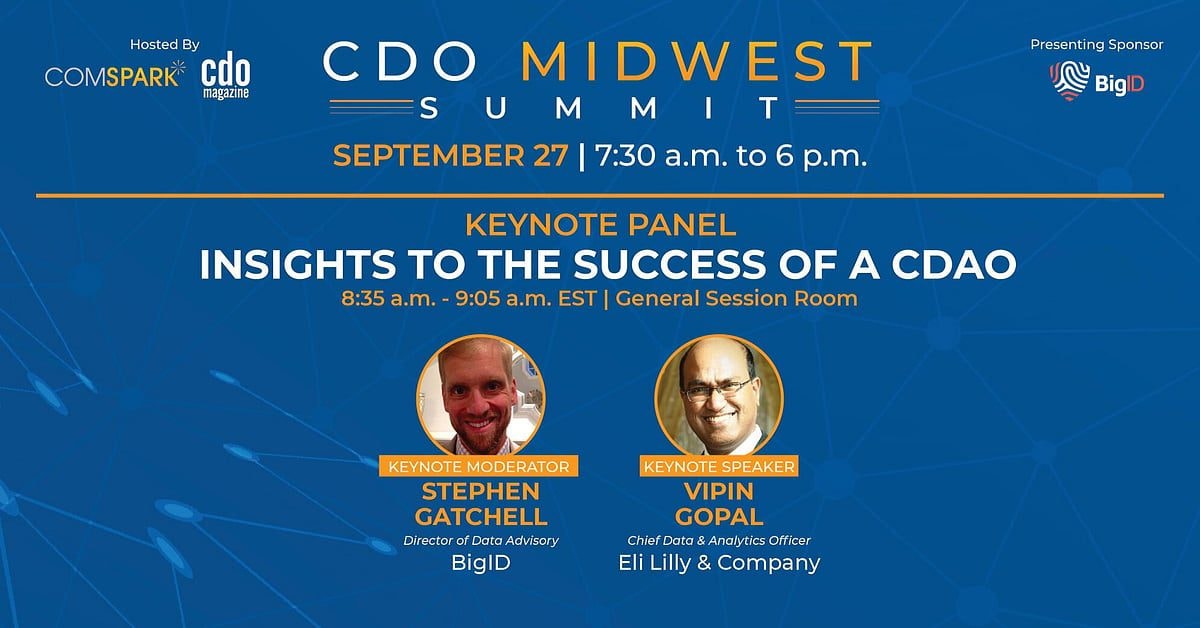
Hosted by CDO Magazine and ComSpark, the CDO Midwest Summit features the following speakers as they discuss data governance best practices to ensure organizational growth in the session “Leveraging Data Governance as an Enabler”:
-
Andy Keller, VP, Enterprise Data, Cardinal Health
-
Katherine Schafer, Director of Analytics and Data Science, Beam Benefits
-
David Wright, Chief Data Officer, Enterprise Data Management, BNY Mellon
Stephen Gatchell, Director of Data Advisory, Big ID, moderates the session.
According to Wright, data leaders must enable data use within their organizations while adhering to policies, best practices, and high-quality data.
Schafer asserts that the data management team should collaborate with the data science team to deliver the best data governance practices. She sees her data management team as enabling the data science team.
Additionally, Wright emphasizes the importance of having a solid partnership and relationship between data enablers and technology components of the organization.
Schafer suggests establishing trust among data teams and breaking down silos between different organizations. She also stresses aligning quantitative areas in the business, such as finance and analytics, to derive consistent answers for end-users.
Next, Wright states that organizations should view data as a product and data organizations should own their operational capacity to ensure the prioritization of their stakeholders. He recommends building relationships with stakeholders and engaging them to make data available to the entire enterprise.
In response, Keller suggests organizations treat data as a product and an asset.
Moreover, Schafer prioritizes end-user monitoring and operational reporting to deliver the best end-consumer experience.
Furthermore, Wright suggests that operational data created during the KYC process can become analytical data used to understand the client base, the risk appetite, and regulatory purposes.
Schafer comments that good organizational practice includes shared communication, trust, and accountability. The speaker notes that it is important to empathize with consumers’ perspectives to create buy-in from them and internal functional areas.
In conclusion, Keller states that successful organizations start by defining their structure, understanding their processes and data, and pushing ownership down to the lowest level. However, this should be done with guardrails to ensure acceleration and support and not with bureaucratic levels of governance that can stifle progress.


 Elevate Your Personal Brand