
What Is a Chief Data Officer in 2026? Many people working within the data industry are saying the same thing: the role of the Chief Data Officer (CDO) has changed – but how? CDO Magazine began an expert survey to find out. We recent...
2026 CDO Report: Meet the Modern Data Team New survey of VP & C-level data and AI leaders confirms what’s stalling AI transformation.
Generative + Agentic AI: Moving From Experimentation to Enterprise Scale Generative and agentic AI are making their way into enterprise production, bringing new questions for Chief Data Officers (CDOs) and other data and AI leaders responsible for making these technologies...
Branded Content
The AI Adoption Paradox: Why Tools Don’t Equal Transformation

Updated 8:00 AM EDT, October 19, 2026

Enterprises are purchasing AI licenses faster than they are changing how work gets done. The widening gap between software acquisition and operational execution is where ROI vanishes.
To bridge this gap, enterprise leaders must treat AI not as a standalone IT project, but as a horizontal enabler of an executive value creation program—holding every initiative accountable to a finance-validated business case before a single line of code is written or a new license deployed.
The illusion of AI value
Across corporate boardrooms, leaders operate under a costly assumption: that distributing generative AI licenses will, on its own, modernize the enterprise. Adoption dashboards look healthy—seats are provisioned, login rates rise, and teams showcase clever prompt ideas. Yet when the quarter closes, EBITDA, operating margins, and cycle times remain unchanged.
I have lived this paradox firsthand. In our own organization, after deploying roughly 3,000 enterprise AI tool seats, Pythian’s cross-functional alignment workshop revealed a stark reality: many managers were unaware they had access to the tool, while others could not articulate a clear use case. Those who tried reported inconsistent results—not because the model failed, but because it had never been integrated into the core line-of-business systems where their actual work took place.
Software distribution is not transformation. Deployment metrics measure procurement efficiency; enterprise value is realized only when core workflows are redesigned to deliver measurable financial impact.
Anchor AI to the value creation program
When initiating an enterprise AI transformation, the foundational document should not be an AI Strategy. It must be a strategic brief explicitly anchored to the executive team’s existing value creation program. For us at Aeritek, we focused on:
- EBITDA expansion and cost structure optimization
- Working capital acceleration and inventory reduction
- Operational efficiency and consolidation
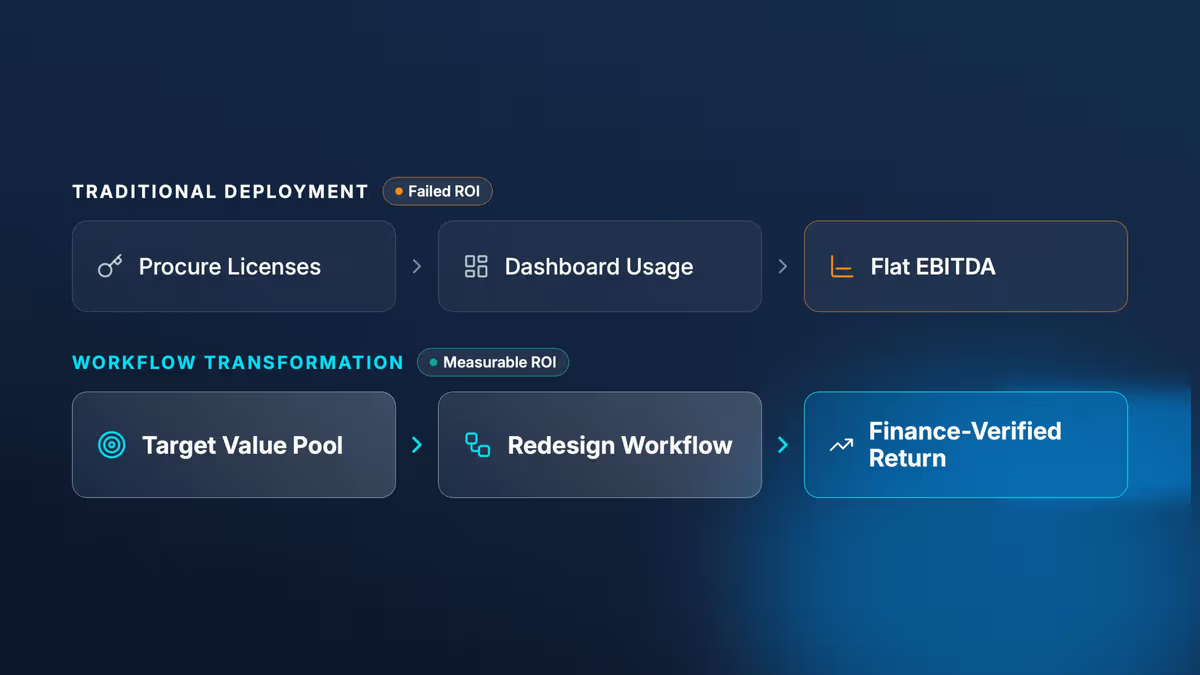
As we partnered with Pythian to define high-impact AI use cases and our implementation roadmap, it became clear that AI is a horizontal capability. To maintain operational discipline, every possible AI initiative must satisfy three mandatory conditions:
- Measurable ROI window: Pilots must demonstrate verified value on live company data and active end-users within 90 to 120 days.
- Finance-validated business case: Every process redesign must carry a clear baseline cost, explicit benefit logic, and formal Finance sign-off.
- Internal capability transfer: Dependencies on external implementation partners must systematically evolve as internal teams master the operating model.
Workflow redesign: Re-engineering operational bottlenecks
Adding more tools onto fragmented processes compounds complexity. True efficiency requires systematically re-engineering the end-to-end workflows that control enterprise velocity.
Target end-to-end processes
Point solutions automate isolated tasks (like summarizing emails), but they rarely touch structural delays across core business functions. Real returns come from rebuilding full workflows anchored to the executive value-creation plan.
To optimize investment, deploy a tiered solution architecture:
- Broad and thin: Standard enterprise-wide knowledge assistants (e.g., Google Cloud’s Gemini Enterprise) deployed across the broad employee base for daily productivity and information retrieval.
- Narrow and deep: High-impact, specialized agentic configurations or custom models (e.g., automated CFDI-compliant invoice processing in SAP, complex engineering PLM integrations) built specifically for high-differentiating, revenue-critical workflows.
Pinpoint specific friction points
Rather than spreading AI thinly across every department, leaders must pinpoint the friction points that matter. Define high-impact use cases as specific processes with explicit inputs, outputs, users, data sources, and measurable indicators. Foster a culture that encourages feedback from long-tenured employees who know exactly where operational friction lives.
Before approving custom engineering builds, run every use case through a strict evaluation matrix:
- Accuracy threshold: Does the task need to be 100% right? Safety-critical checks and regulatory compliance calculations belong in hard-coded business logic or deterministic engines, not probabilistic language models.
- Source-of-truth integrity: Is there one trusted source of truth? Connecting an autonomous agent to multiple conflicting databases will only generate automated errors at scale.
To deliver value cost-effectively, prioritize three solution paths: buy a proven tool, enable embedded platform capabilities, or build custom solutions solely for high-differentiating processes. Exhaustive roadmaps with costly custom builds for low-impact use cases are why many organizations failed to deploy AI into production this year.
Leverage the configure path first
Platforms such as Google’s Gemini Enterprise combine models, prebuilt agents, and connectors to core systems like Google Workspace, Microsoft 365, Salesforce, and SAP in one environment. Business users can assemble simple agents and engineers can build complex ones, testing redesigned workflows on real company data in weeks rather than months.
Furthermore, Google’s unified Gemini Agent introduces persistent memory, sub-agent spawning, non-human Workspace identities, and multi-model support (like Claude) to turn isolated automations into true digital coworkers.
Enforce finance sign-off and binary metrics
Every initiative carries a business case with today’s cost baseline, the logic of how AI moves the number, a target, and Finance sign-off. No baseline, no business case, no finance sign-off, no build.
Results are best reported as binary, verifiable outcomes rather than unverifiable productivity claims like “saving five minutes a day.”
Fostering culture and operating models that scale
Redesigned workflows only last if people embrace them. Technical deployment fails when teams lack the fluency, confidence, or psychological safety to change how they work every day. Building an agile, self-sustaining AI culture requires aligning four key operational pillars:
| Cultural & Operating Pillar | Core Strategy | Practical Execution |
|---|---|---|
| Data Grounding | Ground models in daily information. | Platforms like Gemini Enterprise connect to company data across sources while respecting existing user access rights, giving answers that reflect the real business rather than generic knowledge. |
| Operating Model & Roles | Bridge central governance and decentralized execution. |
|
| Capability Building | Drive continuous fluency rather than one-time training. | Deploy working guides, shared prompt libraries, and departmental champions. Upskill long-tenured employees and reassure teams that the goal is better work, not headcount reduction. |
| Proportional Governance | Treat governance as an enabler scaled to risk. | Establish a fast lane for personal productivity and formal review for customer, pricing, or production tools. Use built-in platform controls (corporate identity, agent registries, activity logs, data privacy guarantees) to provide a safe, sanctioned alternative to personal AI accounts. |
Executive action plan for lasting competitive advantage
Translating an AI vision into bottom-line performance requires a disciplined execution plan:
- Baseline systems and fluency: Prior to expanding software licensing, assess system readiness, data quality, and user fluency. Align leadership around actual environment capabilities rather than vendor promises.
- Prioritize high-impact use cases: Select two or three high-impact workflows with clear return potential rather than overcommitting capacity. Execute 90-to-120-day pilots on live data with active users. Ensure operational procedures and incentives are updated alongside the technical tooling.
- Enforce finance-backed binary metrics: Shift KPI tracking away from seat count and login frequency toward operational speed, working capital release, and direct EBITDA impact.
In conclusion: Transformation is a muscle, not a milestone
Software tools are commodities; organizational capability, workflow agility, and culture are the true moats. Competitors can buy licenses, but they cannot buy the muscle memory required to select the right workflow, redesign it, prove its value to Finance, maintain it in production, and repeat the cycle.
Leaders who stop counting licenses and start restructuring workflows will turn AI investments into a sustainable, long-term competitive advantage. Those who keep counting will simply have very good adoption dashboards.
To define high-impact use cases, establish baseline metrics, and align executive leadership around a 90-day value creation plan. What helped us win is partnering with Pythian and their AI Operating Model framework.



 Elevate Your Personal Brand


