
2026 CDO Report: Meet the Modern Data Team New survey of VP & C-level data and AI leaders confirms what’s stalling AI transformation.
Webinar | The Multiplier Effect: How Top Data Leaders Translate Infrastructure into Business Impact Hear directly from leading data executives as they share how they are navigating data strategy, AI investment, and business value in the AI era.
Understanding the ROI of Data Adoption Through a Data Product Marketplace The latest Gartner Hype Cycle for Data, Analytics and AI Leaders lists over 40 different solution areas, each of which covers multiple tools and capabilities. This shows the challenge that Chief Data...
Branded Content
The 6-Layer Operational Framework for Enterprise AI Agility

Written by: Paul Lewis | Chief Technology Officer (CTO) at Pythian
Updated 8:00 AM EDT, September 21, 2026

What does AI agility mean?
AI agility refers to how fast an AI system—and the organization behind it—can adapt to shifting data and market conditions. AI agility is all about speed and adaptability. It’s the ability of AI models—and the teams using them—to react to real-time changes in data and market trends, shrinking traditional innovation cycles down from months to weeks.
- Technologically: The ability of AI systems to instantly adapt to new data through automated MLOps pipelines.
- Strategically: An organization’s ability to leverage these systems to respond to market shifts instantly, drastically shrinking innovation timelines.
The reality of enterprise AI in 2026: How to navigate enterprise data and executive accountability
The enterprise AI landscape evolves weekly, making long-term bets on a single LLM vendor a high-risk gamble. Yet, as industry data reveals, up to 95% of enterprise AI initiatives have stalled out in pilot limbo or failed to reach production.
Why? Because most organizations treat AI as a software application to buy rather than an operational discipline to master.
Enterprise advantage isn’t about predicting which AI company wins the model race; it’s about building the architectural and operational flexibility to use whichever engine is best today, and pivot seamlessly tomorrow. That is the definition of AI agility: the ability of your technical systems—and the organization behind them—to react instantly to changing data, market conditions, and model breakthroughs, shrinking innovation cycles from months down to days.
AI agility is an operational discipline, not a model choice
True competitive advantage won’t come from choosing the single winning model today—it will come from building an agile, model-agnostic infrastructure.
Technology leaders must design data architectures that allow them to swap underlying engines out in an afternoon, ensuring the business can pivot without rewriting core business logic. This requires balancing flexible cloud foundations with ubiquitous access. For instance, leveraging Google Cloud infrastructure alongside Gemini Enterprise allows organizations to ground advanced models on proprietary corporate data, while seamlessly embedding native Google Workspace AI features directly into daily employee workflows. The goal isn’t just procuring technology; it’s establishing an environment where models, agents, and productivity tools can be integrated, audited, or rotated without operational friction.
Enterprise value requires executive accountability, not just innovation
Bridging the gap between AI experimentation and scale requires a shift in mindset: the mandate is no longer asking “Can we build this?” but establishing “Who is accountable for the business outcome?”
Organizations rarely lack AI ideas; they lack governance, clear ownership, dynamic funding models, and a structured plan for the operational estate. Whether titled Head of AI, Chief AI Officer (CAIO), or AI Executive Sponsor, dedicated AI leadership must exist to turn raw technology into sustainable business value and enforce ownership across the entire application lifecycle.
Advanced AI systems must answer the enduring rules of enterprise IT
While AI introduces complex, non-deterministic capabilities like autonomous agents and dynamic reasoning, it does not rewrite the fundamental rules of enterprise risk and operation. Every AI solution still demands a validated business case, secure infrastructure, data stewardship, ongoing maintenance, and clear incident response.
AI leaders must sit between two operational forces:
- Eliminating Bad Friction: Removing redundant tasks, manual rekeying, slow knowledge retrieval, and process drag that consume time without improving quality.
- Preserving Useful Friction: Redesigning—rather than destroying—essential guardrails such as security architecture reviews, data stewardship, legal compliance, and human-in-the-loop oversight for high-risk decisions.
To establish this balance across your enterprise, your organization must execute across six core operational layers:
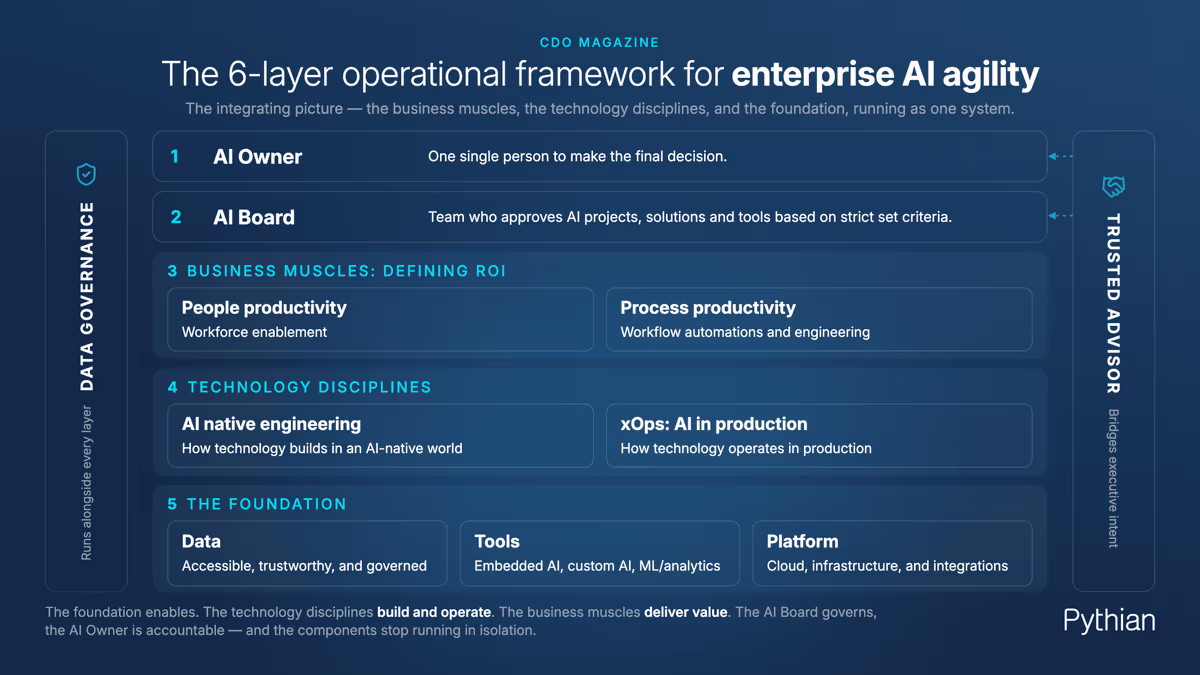
The AI Operating Model: How to deliver real business value with AI 
Step 1. Data Governance: Eliminate the single point of failure
Data is what holds AI together. Governance runs alongside every layer of your business data to ensure clean, trustworthy outputs. Everything above the foundation is scaffolding. AI committees get renamed, teams get restructured, executive sponsors change jobs. When the scaffolding comes down, data governance is what’s still standing—and if it is never built, your ability to deploy at speed, optimize proactively, and manage your AI models will crumble.
“Data is the operating constraint, not the blocker.”
— Jeff DeVerter, Field CTO, Pythian
Reading step one you might be thinking: so you’re saying “go slow to move fast”? It sounds counterintuitive in an article about speed, however this is the single point of failure we have seen across hundreds of enterprises as they navigate and deploy AI—the reason 95% of AI projects failed to reach production is a lack of focus on data governance right out of the gate.
Address your data challenge head on
In 2026, businesses are realizing they cannot ignore their decade-long data problem. The businesses who understand governance is a core part of their AI lifecycle actually ship more (and more impactful) AI solutions—simply because they stop re-arguing the same compliance and safety questions every quarter. This is established upfront as a standard to streamline across every other layer that AI will impact—because it will impact every aspect of your business.
“Data governance does not need to be a long, exhaustive process. When you solve ownership and trust upfront, you stop hitting friction at the finish line and start shipping AI at scale.”
— Karen Pfeifer, Field Chief AI Officer (CAIO), Pythian
Answer these 3 data governance questions to turn bottlenecks into accelerators:
- Is there a standardized intake path? You need a clear pipeline (Request -> Review -> Approve or Deny) so teams know exactly how to move an idea from concept to production without relying on back-channel approvals.
- Is the policy universal? Governance only works if it applies everywhere. Is your framework binding on the executive-sponsored, founder-led specific project, or do fast-tracks create hidden technical and regulatory debt?
- Are ownership boundaries clear? “The team” cannot own risk. You need named, accountable owners across Legal, Privacy, and Security who are embedded directly in the review loop.
When these boundaries are defined upfront, product and engineering teams can build with confidence, knowing the guardrails are already in place.

Step 2. AI Ownership: Establish a single executive sponsor to drive velocity
To build for speed, you must start at the top with a single point of accountability. Not a committee. Not the leadership team. One named Executive Sponsor. This individual is the primary engine for momentum. When AI strategy is diluted across a steering group, hard decisions stall out waiting for the next available calendar slot.
“When this box holds a group instead of a person, every hard trade-off becomes a scheduling problem.”
— Ernest Solomon, Field Chief Technology & Security Officer (CISO), Pythian
Governance provides the guardrails, but the single AI owner provides the velocity needed for AI agility. Without a single, empowered decision-maker driving the operating model, even the best data foundation will stall at the starting line.
| Key Responsibility | Strategic Impact |
|---|---|
| Writes the check and allocates resources | Owns the financial investment and ensures funding follows ROI, not hype. |
| Sets strategy and priorities | Defines what AI will—and will not—solve for the enterprise, protecting teams from scope creep. |
| Makes the hard trade-offs | Rapidly resolves friction between speed, risk, security, and budget when cross-functional teams hit a wall. |
| Answers for outcomes | Holds ultimate accountability for deployment, adoption, and business impact—not just pilot launches. |

Step 3. AI Board: Build a cross-functional governing council to eliminate redundant spend
While a single AI owner drives the vision, a dedicated AI Board approves the key decisions, protects the operating model from organizational inertia, and resolves cross-functional handoffs.
This group isn’t meant to be another layer of red tape; it exists to eliminate two specific, high-cost failure modes:
- Redundant spend: Four different business units buying four overlapping, unvetted AI tools.
- Endless stall: The dangerous limbo where every proposal is technically “under review,” but none are actually moving into production.
What the AI Board does:
- Gates investment and funding: Approves resourcing and capital allocation based on real business impact, not pet-project momentum.
- Streamlines cross-team handoffs: Clears friction between product, security, legal, and engineering so deployments don’t grind to a halt.
- Provides active oversight: They don’t just sign off on a project and walk away—they track execution, enforce standards, and ensure the business actually realizes value.
If your AI owner is the accelerator, the AI Board is the navigation system—keeping teams moving at high speed without driving off a cliff.
Ask these 3 strategic questions to define your AI Board:
- Who can say no to an AI project—and make it stick?
- Is there one prioritized list of AI use cases, or one list per department?
- Does risk sit with this group, or alongside it with InfoSec, Legal, and Privacy?

Step 4. ROI Metrics: Evaluate business needs against people and process functions
This is where value actually gets delivered. Enterprise ROI from AI splits into two distinct operational functions: people productivity and process productivity. They have different missions, require different metrics, and demand different skill sets.

People Productivity |

Process Productivity |
|
|---|---|---|
| Dimension | Broad and shallow AI use cases | Narrow and deep AI use cases |
|
Mission |
Empower individuals | Redesign workflow pipelines |

Focus |
Saving time and cutting costs | Eliminating full process steps |

Metric |
Adoption and user sentiment | Cycle time reduction and cost per unit |

Ownership |
IT Training and HR vs. AI Experts (Workshops) | Enterprise Engineering / Domain Technical Leads |
Most organizations default to People Productivity because it’s low-friction and non-threatening. It’s also the hardest value to defend when finance reviews budget line items. The most common enterprise failure isn’t choosing one over the other—it’s letting the two blur together until they share the same low-impact AI use case with no clear KPIs. If you can’t state whether a person or process owns a capability in one sentence, they’ve blurred.
Answer these 3 strategic questions to prevent metric blur:
- Do they have distinct one-line identities?
- People Productivity: “Give every employee a digital assistant to speed up everyday tasks.”
- Process Productivity: “Re-engineer operational workflows to eliminate manual handoffs and cut cycle times from days to seconds.”
- Where does “People” work escalate when it needs real code? When a grass-roots experiment (like a custom prompt or lightweight desktop bot) shows high potential but requires core API integration, custom data pipelines, or fine-tuned infrastructure, it must hand off to Process Engineering. Your AI Board establishes the threshold: Prompt hacks stay within the people AI bucket; core system changes escalate to central software engineering.
- Who owns a capability that crosses every domain? When an AI utility (like automated document parsing or semantic enterprise search) crosses every business unit, the Central AI Platform Team owns the platform, while Domain Leads own the operational logic. The core infrastructure is built once centrally, but business units configure and maintain their specific rules—ensuring you scale technology without diluting domain accountability.
Step 5. Technology disciplines: Combine AI-native engineering with robust XOps disciplines
When enterprise AI initiatives stall out post-launch, it is always a failure of execution mechanics. Moving from pilot to scale requires two distinct, non-negotiable disciplines: how technology builds and how technology operates.

AI-Native Engineering (How you build): The traditional Software Development Life Cycle (SDLC) is built for deterministic code. AI-native engineering rewrites the build phase entirely—designing systems around probabilistic outputs, dynamic context windows, multi-agent orchestration, and real-time retrieval.

XOps (How you run it in production): Shipping the model isn’t the finish line—it’s baseline zero. XOps (MLOps, DataOps, LLMOps) owns everything that happens after go-live: tracking model drift, data drift, prompt performance, runtime exceptions, and escalating compute costs.
“AI will not fail—it will decay. Which is worse, because nobody notices in time.”
— Jeff DeVerter, Field CTO, Pythian
Answer these 3 operational realities to keep your stack from decaying under the hood:
- Who owns an AI system the day after it ships?
The product team owns business outcomes, but the XOps Platform Team owns systemic health. Day-two ownership cannot live with the innovation squad that built the prototype; it must transition into an operational framework built for continuous monitoring. - When a model quietly degrades, whose pager goes off?
XOps Engineering. Model degradation isn’t an application crash—it’s a quiet failure where the system outputs plausible nonsense. You need automated telemetry that pages dedicated reliability engineers when latency spikes, retrieval accuracy drops, or token costs breach baseline thresholds. - Is ‘we built it’ the same team as ‘we run it’?
No. Treating build and run as the same function leads to burnout and neglected infrastructure. Build teams focus on rapid iteration and feature delivery; XOps teams focus on resilience, compliance, security, and cost-governance at scale.

Step 6. Data, Tools and Platforms: Build a frictionless technical foundation below the stack
This is the bottom of the stack—the foundational layer every seat above it rests on. It is non-negotiable. Everything sits on data, tools and platforms. If this layer is weak, every role above it stops innovating and starts doing damage control.

Fuel: Accessible, trustworthy, governed data
If data lives in unmapped silos or lacks provenance, your models are building on sand.

Interface: Tools people actually use
Standardized, vetted toolchains that stop shadow IT without suffocating developer speed.

Engine: The Platform
The underlying infrastructure where compute, deployment pipelines, security policies, and monitoring run smoothly.
“Every impressive AI demo that never reached production died here. Not because the model was wrong—because the data wasn’t reachable, wasn’t trusted, or nobody owned it.”
— Karen Pfeifer, Field Chief AI Officer (CAIO), Pythian
Test your foundational readiness with these 3 questions:
- Can a builder get to the data they need without asking a favor?
If getting data access requires personal network leverage or endless tickets, your platform is broken. Data access must be API-driven, cataloged, and role-permissioned automatically. - Is there one clear answer to “Which tool do we use for this?”
Choice is good; ambiguity is expensive. Your architecture stack must provide unambiguous default choices for vector stores, orchestration, and LLM providers so teams don’t rebuild the wheel every time. - Does someone own data quality as a full-time job, not a side project?
Data hygiene cannot be a secondary task. You need dedicated data stewards whose sole metric is the freshness, accuracy, and lineage of the enterprise data assets feeding your AI systems.
Conclusion: Agility is an operational habit, not a tool purchased
The winner of the enterprise AI race won’t be the company with the flashiest pilot—it will be the organization that turns adaptation into a repeatable habit. AI agility isn’t bought off the shelf. It isn’t unlocked by subscribing to a newer foundational model or running another series of internal innovation hackathons.
AI agility is an operating model—a continuous cycle, what happens when you align all six layers of your enterprise stack:
- Governed Data that provides a clean, trusted foundation.
- A Single AI Owner who makes rapid, unambiguous trade-offs.
- An AI Board that stops redundant spend and eliminates project limbo.
- Distinct Productivity Metrics that separate quick wins from core process transformations.
- Robust XOps Disciplines that keep production models from quietly decaying.
- Accessible Platforms that let developers build without asking for favors.
When these components lock into place, your organization stops re-arguing compliance every quarter, stops watching 95% of pilots stall out before production, and stops worrying about which model provider wins the next benchmark race.
By building for operational flexibility today, you give your enterprise the freedom to pivot seamlessly tomorrow—compressing innovation cycles from years down to weeks, and turning AI from a speculative bet into your primary competitive advantage.
Who is Pythian?
Pythian is a leading global data and AI consultancy with nearly three decades of experience. The firm modernizes and manages enterprise data estates, helping organizations deploy AI into production. Working closely with Google Cloud, Oracle, AWS, Microsoft, and other technology partners, Pythian combines deep technical expertise with a pragmatic, results-focused approach.
Learn more at www.pythian.com



 Elevate Your Personal Brand