
2026 CDO Report: Meet the Modern Data Team New survey of VP & C-level data and AI leaders confirms what’s stalling AI transformation.
What Is a Chief Data Officer in 2026? Many people working within the data industry are saying the same thing: the role of the Chief Data Officer (CDO) has changed – but how? CDO Magazine began an expert survey to find out. We recent...
The 6-Layer Operational Framework for Enterprise AI Agility What does AI agility mean? AI agility refers to how fast an AI system—and the organization behind it—can adapt to shifting data and market conditions. AI agility is all about speed and adaptability. I...
Branded Content
Analytics Harness: The Missing Layer in Your AI-Powered Data Stack

Written by: Kapil Chhabra | Co-founder and Chief Product Officer of WisdomAI
Updated 8:00 AM EDT, October 5, 2026

To adopt, or not to adopt AI analytics? That’s no longer the question. According to our survey of enterprise VP and C-suite data leaders, 93% are already using or exploring AI for analytics, and more than half have at least one use case in production.
But accuracy is still a barrier to scale. Less than 20% of data leaders say they’re fully confident in what their AI tells them, and only 7% have scaled AI analytics across their organization.
As frontier models from Anthropic, OpenAI, and elsewhere continue getting more capable, it’s exposing an uncomfortable fact: we can no longer blame AI models for analytics inaccuracy.
Getting an accurate answer requires the right context. Getting the same accurate answer every time requires something else entirely: a specialized Analytics Harness built to navigate the complexity of enterprise data environments.
Context is a partial solution to a complex problem
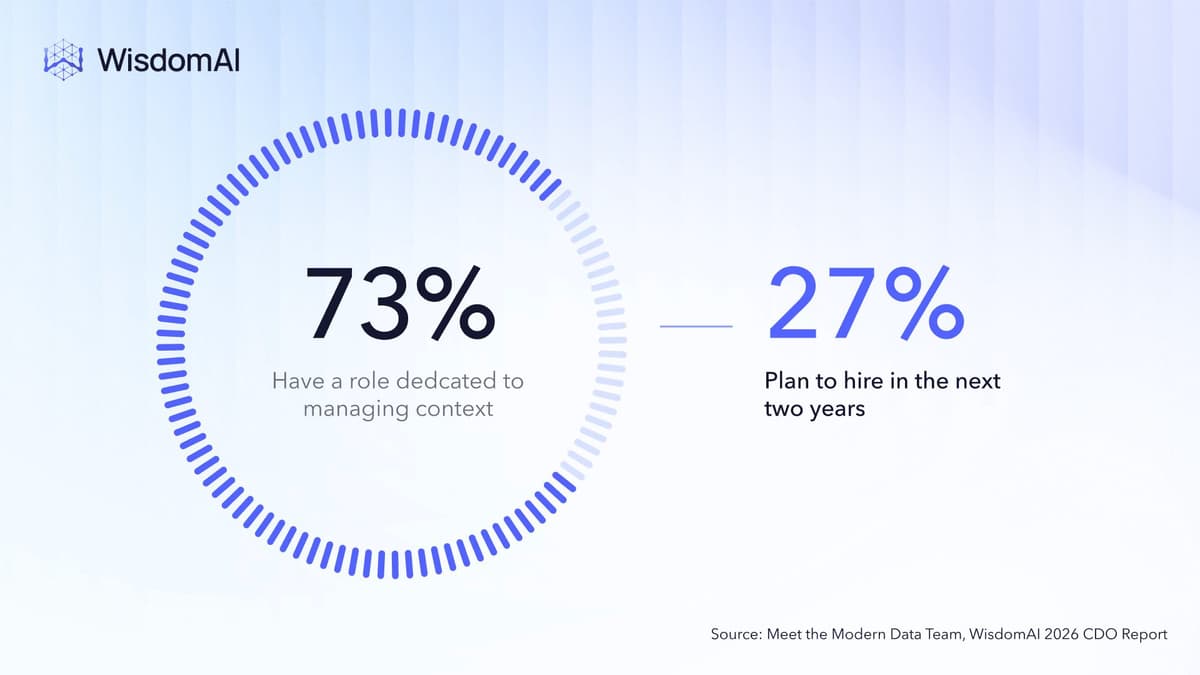
Leaders have encountered AI analytics’ accuracy problem enough times to start investing in a fix. In fact, 94% plan to change the way they store and manage AI context over the next 18 months. What’s more, every single survey respondent either has or plans to hire context-related roles within the next two years.
And yet, 60% are still working to increase trust with cleaner data. Data leaders started chasing data cleanliness projects long before generative AI entered the conversation. But in reality, perfectly clean data is a moving target few have managed to hit, let alone sustain.
In this new age of analytics, AI readiness is not the same as data cleanliness. Context offers a faster, more direct path to trust.
The leaders investing in context storage and dedicated engineers are on the right track. But those who realize they need to treat their context like a development lifecycle, the same way they treat any other production asset or enterprise IP, are the furthest along.
Here’s what production-grade context looks like in practice:
- Portable: Context lives in an open or well-documented format that another tool can read. It isn’t locked inside a single vendor’s product.
- Inspectable: A human and an agent can access and understand what the context means and where it originated from.
- Versioned: Changes are reviewable, reversible, and attributable.
- Additive: An existing catalog, semantic layer, or dbt project is a source to build from, not something to rewrite from scratch.
Even with all this in place, the Context Development Lifecycle (CDLC) alone can’t solve your AI trust problem. As more and more vendors position Context as the catch-all solution, it’s quickly becoming one of AI’s most misunderstood words.
Here’s the reality check: Context doesn’t force an AI model to select the right definition for the right question, apply it the same way twice, or check that the answer respects who’s asking. That’s a different job done by a separate piece of software. That is the Analytics Harness.
What a specialized Analytics Harness actually does
Anthropic calls its Agent SDK the harness that powers Claude Code. In the data space, Snowflake describes a harness as the operating system wrapped around an AI model. Databricks reduces it to an equation: agent = model + harness.
I define the Analytics Harness as the software logic that sits between data questions and reliable answers. It’s responsible for the analytics-specific tasks a general-purpose model is not designed to complete on its own.
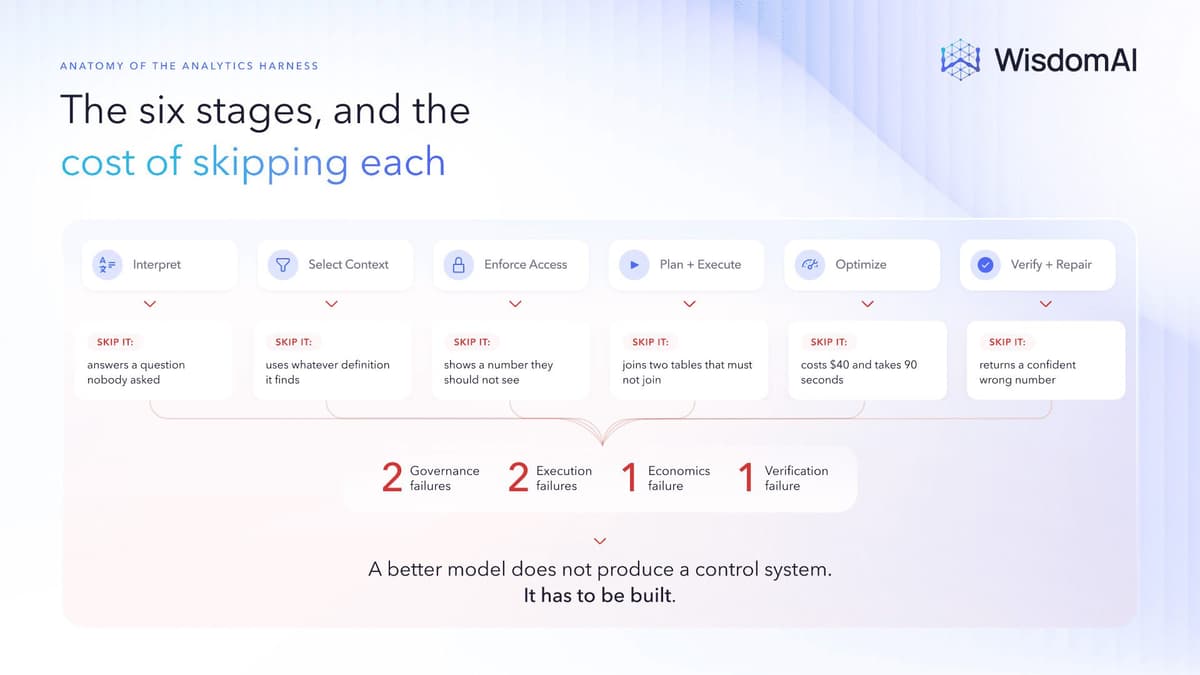
When a user prompts a data question, the Analytics Harness:
- Interprets what’s actually being asked, and builds an optimal plan for it
- Selects the relevant context to share in the model’s context window
- Enforces governance and security access, so two people with different permissions get appropriately different answers with a natural-language explanation (e.g., a regional manager sees their region’s revenue while a VP sees company-wide revenue)
- Plans and executes the most efficient path across every data source, controlling cost and latency for the workload
- Verifies the result and repairs any errors before delivering an answer
Every item on that list is control work. Without it, a model will brute force its way to a reasonably probable answer, resulting in inaccurate answers, unpredictable token costs, and mismanaged data governance and security.
Real-world example: what breaks without a harness
That is all to say: without the guardrails of a harness, models have too much latitude. Here’s how this plays out in the real world. Take something as common as a quarterly revenue question:
HubSpot shows pipeline generated, Salesforce shows net new revenue from closed/won deals, and NetSuite shows ARR and spend. All three numbers are correct, but they all answer a different question, or at least part of a question.
How the Analytics Harness corrects model failures
Left to its own devices, a model can’t infer your meaning. So it picks one, delivers it with confidence, and moves on. And without the Analytics Harness to supply the relevant context, you cannot verify or trace the reasoning behind that answer.
That’s the first job a harness has to do: interpret the question and select the context that actually applies. Without that step, a model’s best guess gets treated as an authoritative answer.
The second problem is access. A regional manager and a VP can ask the same revenue question and each should get a different answer: one scoped to their region and the other showing all company data, including data the manager was never meant to see. Enforcing that boundary the moment a question comes in is the second job for the harness.
The third problem is verification. Without a specialized data harness, there’s no warning that the definition the model used was ambiguous. Catching that before the answer is sent to the user is the third job for the harness, and it’s the one most stacks skip entirely.
The fourth problem is cost. Left unmanaged, a model will burn unnecessary tokens interpreting the question and searching for context. Each long-tail or dead-end query path tacks on unnecessary warehouse compute charges. Controlling that spend before it multiplies is the fourth job for the harness.
None of these are model flaws or reasoning problems, nor can they be solved by context alone. The Analytics Harness is the only thing capable of ensuring a general-purpose model can accurately, efficiently, and consistently execute a specialized analytics task.
What this means for CDOs
Here’s a quick test I’ve adapted from Ian Macomber at Ramp:
Take five metrics from your last board deck and ask each one through every interface your company uses — the coding agent, chat assistant, BI tool, and whatever sits in Slack. Count the distinct answers.
One answer per metric means you have something real. Two indicates a consistency problem. Three tells you you’ve got a serious breakdown between your data and your model.
If you’re seeing it here, it’s very likely that your business users are experiencing the same thing in their day-to-day workflows. Even worse, they don’t know the problem exists. There is no error message, and the answers seem plausible enough. So the insights quietly go unchecked until they are called out. That’s when trust diminishes.
Gartner predicts that over 40% of agentic AI projects will be canceled by the end of 2027 due to rising costs, unclear business value, and inadequate risk controls. Context alone isn’t enough to close this entire gap, but there is a viable solution.
By pairing a managed Context Layer with a specialized Analytics Harness, you can architect accurate, consistent, and explainable AI-generated insights, without security risks or uncontrolled costs.
Our recent benchmark study comparing WisdomAI to Claude Code proves it.


 Elevate Your Personal Brand