
What Is a Chief Data Officer in 2026? Many people working within the data industry are saying the same thing: the role of the Chief Data Officer (CDO) has changed – but how? CDO Magazine began an expert survey to find out. We recent...
2026 CDO Report: Meet the Modern Data Team New survey of VP & C-level data and AI leaders confirms what’s stalling AI transformation.
Generative + Agentic AI: Moving From Experimentation to Enterprise Scale Generative and agentic AI are making their way into enterprise production, bringing new questions for Chief Data Officers (CDOs) and other data and AI leaders responsible for making these technologies...
AI Governance
How To Measure AI Governance Success Through Metrics in the Era of Agentic AI

Written by: Mansi Agarwal | Global Head of Analytics and AI at Carrier
Updated 8:58 AM EDT, May 19, 2026

For most of the last century, corporate governance has been treated as plumbing. Necessary, rarely admired, noticed only when it fails.
In the age of agentic AI, that posture is no longer tenable. Every enterprise is a trust engine. Governance is how that trust is safeguarded. In years gone by, authority was obviously vested in identifiable humans. Mistakes were attributable.
But now, as agentic AI breaks that assumption, focusing on setting the goals for AI governance success is one of the most important things an organization can do.
This means setting new metrics tailored to your AI governance strategy to measure whether it is actually working and fit for the purposes needed.
How to build AI Governance metrics and KPIs
AI governance pertains to system behavior, not the documents we’re used to. Policies in PDFs cannot govern actors operating at machine speed.
They must be encoded directly into systems: least-privilege access, continuous observability, lifecycle controls, escalation paths, and immutable logging. This is not bureaucracy. It is what makes deployment safe, and therefore scalable.
Laying the guardrails for any rapidly evolving system is simultaneously an exercise in control and allowance for flexibility. While AI use cases are only limited by imagination, tolerances need to be strict, especially with proprietary or sensitive financial data.
To get it right, first build a framework for success. This could be from the ground up, if adoption of these systems is nascent, or adapting current systems, as outlined in this guide to AI governance frameworks.
1. Establish portfolio visibility and governance first
Before scaling anything, organizations need a clear view of what already exists. Every agent deployed in the enterprise should be registered as a Digital Agent on Record (DAR), an agent with a formal identity inside the organization’s governance systems.
The registry assigns each agent:
- A unique identifier
- A date of creation (its “birth date”)
- A business owner who serves as its accountable manager
- A risk classification tier
- A defined scope of authority specifying which tools, data, and systems it may access
- A reporting line that maps to an existing human chain of command.
Version history tracks its evolution the way a personnel file tracks role changes. Decommission dates are recorded like offboarding. Visibility status (active, suspended, under review or retired) is maintained in real time.
The registry becomes the single source of truth that answers foundational governance questions:
- How many agents are operating?
- Who authorized each one?
- What can they do?
- What have they done?
- Who is accountable when something goes wrong?
2. Identify and test use cases before scaling
The pressure to scale AI fast leads organizations to deploy broadly before understanding where agents actually work. The opposite approach succeeds far more often.
Start with use cases where the workflow is well understood, the cost of failure is bounded, and partial automation still delivers meaningful value.
Evaluate agents not only on task performance but on behavior over time, edge-case handling, and interaction with real enterprise data.
Scale only after both performance and governance hold under real conditions.
3. Build agents that operate within real data complexity
Most agentic failures can be traced to the environment and not the model itself. Typical issues include:
- Fragmented data
- Inconsistent definitions
- Missing lineage
- Uncontrolled retrieval
Deploy agents in governed data sources, enforcing least-privilege access by default and maintaining traceability across every step.
The governance layer is what bridges the gap between demonstration and deployment.
4. Keep humans accountable for agent decisions
While agents execute decisions, accountability will always stay with people. The most important governance shift underway is explicitly mapping where human responsibility sits in every autonomous workflow.
Each agent needs:
- A named business owner – accountable for its outcomes
- Defined boundaries – for what it can and cannot decide
- Clear escalation paths – triggered when uncertainty or risk thresholds are crossed.
This does not slow systems down but rather ensures that when something fails, the organization responds with clarity rather than confusion.
5. Measure outcomes delivered, not system uptime
This is where we begin looking at AI governance success metrics, to track availability and performance. Firstly, remember that agentic systems need a lens of outcomes:
- Did the agent complete the task successfully?
- Was the result correct, compliant, and efficient?
- Did it measurably reduce cost, time, or manual effort?
These outcome metrics must be tracked alongside governance signals of policy compliance rates, human intervention frequency, and behavioral drift indicators.
The combination determines whether an agent is genuinely delivering value or merely operating.
An agent that maintains perfect uptime but routinely escalates, violates policy boundaries, or produces inconsistent results is not reliable.
It is a source of hidden cost and is essentially an operational overhead disguised as automation.
A Balanced Scorecard for the AI Enterprise
Legacy AI metrics – accuracy, precision, recall – were designed for stateless models producing single outputs. Agentic systems demand a fundamentally different measurement architecture.
The following AI governance metric framework organizes AI governance KPIs into five categories:
1. Does the agent do what it is supposed to do?
Not in a lab but in real workflows, with real data, under real conditions.
These are the first metrics, tracking:
- Goal accuracy
- Plan adherence
- Hallucination rates (continuously, not just at launch).
Tracking these metrics alone is not enough. To do it effectively organizations must implement a multi-layered observability strategy combining:
- Telemetry
- LLM-as-a-judge evaluators
- Statistical analysis.
However, there is little need to build these capabilities in-house. There are mature agent observability platforms already available to track these metrics.
The thresholds for these metrics are also converging rapidly. Systems achieving goal accuracy above 85%, with hallucination rates low enough to be operationally negligible, are increasingly being deployed in customer-facing environments.
These thresholds should be defined collaboratively by business owners, AI engineering teams, and risk functions, based on the agent’s risk tier, domain sensitivity, and the potential cost of failure.
Organizations must establish structured operational boundaries. SEPARATEHigh-risk processes, such as finance or healthcare, should require human-in-the-loop validation, while low-risk, well-defined tasks may operate autonomously under controlled conditions.
Importantly, the system should not receive the benefit of the doubt. Any signs of drift, unreliable behavior, or policy violations should automatically trigger human review and, where necessary, rollback procedures.
2. How much work can AI do without needing intervention?
The metrics to watch here are all around the decay of human-in-the-loop dependency.
- Human intervention rates
- Escalation frequency
- Autonomous resolution
Monitoring these will tell data leaders whether the system is maturing or quietly breaking.
Most organizations still measure usage. That is the wrong lens. What matters is how much work the agent can complete without intervention.
Over time, intervention should decline. If it rises, the organization’s guardrails are failing.
3. How well does AI comply with policy boundaries?
Next, data leaders need to know whether the system is staying within the organization’s boundaries, even if they’re not explicitly defined. These are the metrics that allow that to be policed:
- Policy violation rates
- Goal alignment
- Audit outcomes
These tell CDOs and data leaders whether the system is staying within the organization’s boundaries, whether explicitly defined or not.
In high-risk domains, the tolerance is zero. Elsewhere, thresholds can be tiered, but the signal remains the same.
Violations that persist across model updates are not model issues. They are structural governance gaps.
4. How much business value is delivered per agent?
Agents are deployed to deliver value. That value has to be measured in terms the business understands:
- Cost per successful task
- Value generated per agent
- Time saved
But value must be paired with success rates. A low-cost agent that fails half the time is expensive in disguise. The governance signal here is straightforward: ROI without trust metrics is incomplete.
Value, trust, and adoption have to be tracked together, or the picture is distorted.
5. Is the AI agent drifting?
Agents rarely fail in a single moment. They degrade over time, so monitoring this signal is key. Set up tracking for:
- Intent drift
- Consistency scores
- Emergent behavior patterns
The right approach is not point-in-time evaluation, but baseline tracking over 30 to 60 day windows, looking for sustained deviation.
Building AI governance to detect patterns, not just incidents, will avoid costly issues down the line that data leaders could have spotted earlier.
The following table outlines the core KPI categories, benchmark thresholds, governance signals, and ownership structures organizations can use to measure and manage autonomous AI systems at scale.
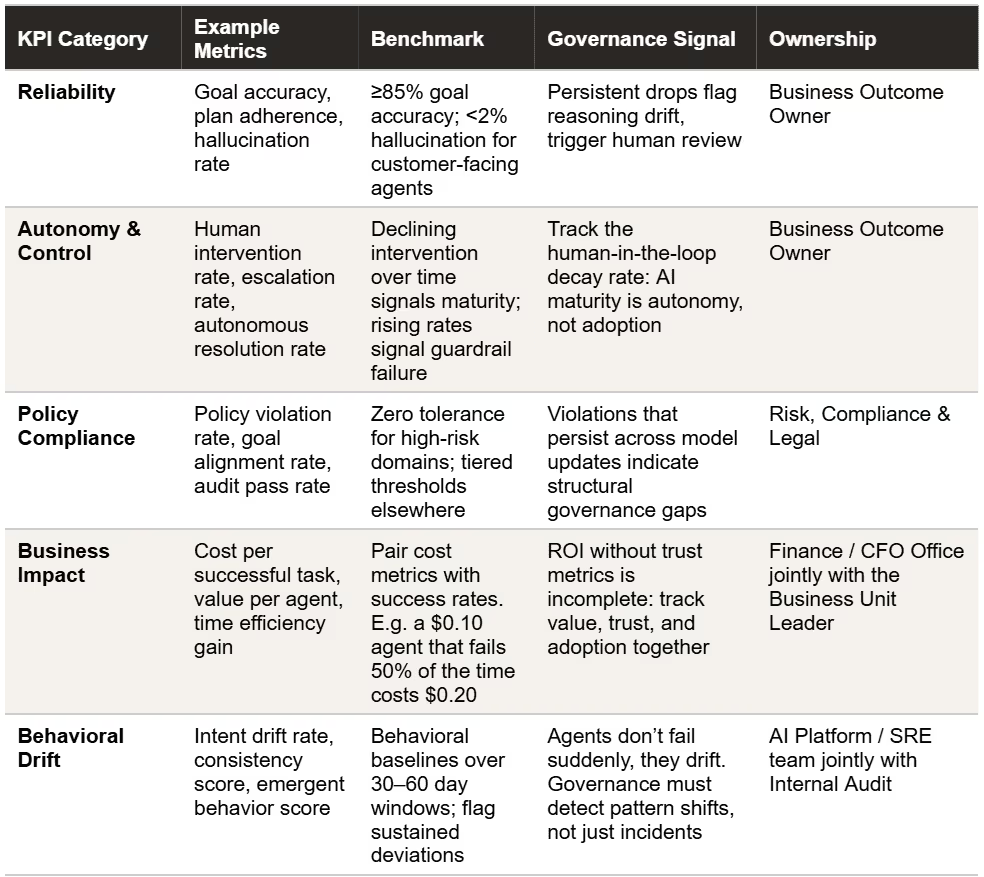
Figure: AI Agent Governance: KPIs, Signals, and Ownership
6. Is a human in charge?
This bears repeating: the consolidated AI governance KPIs must sit with a single accountable entity — with clear AI Governance roles (or a governance committee) chaired by a Chief AI Officer or equivalent executive with cross-functional authority.
Without this, each function optimizes its own metrics in isolation: engineering watches reliability, compliance tracks violations, finance measures ROI, and nobody sees the systemic picture.
Only a cross-cutting owner can detect divergence and intervene before governance debt compounds into organizational liability.
Additionally, every agent operating in the enterprise needs a named human counterpart who is accountable for its decisions.
Governance requires analog representations of digital actors: people who own what the agents do, the way managers own what their teams do.
What to do next: rework the boring thing
If CDOs and data leaders want to make a big impact in their organization, focusing on setting the goals for AI governance success is one of the most important things they can do.
The paradox is that the most ignored discipline in corporate life has become the one on which competitive advantage will turn.
Those that rethink governance as the enabling infrastructure of autonomy will be the ones that actually scale.
It means:
- Boards asking governance questions alongside strategy
- Investing in governance-as-code alongside agents
- Treating observability, accountability, and controllability as critical product requirements rather than compliance checkboxes
- Recognizing that the people who design these systems are no longer support staff. They are architects of the next operating model.
The emerging role of the AI Governance Engineer reflects this shift. These practitioners are not simply writing policy. They are building the measurement systems that allow organizations to observe, evaluate, and control agentic behavior at scale.
Their mandate is to translate governance into operational signals: reliability thresholds, intervention triggers, policy compliance rates, drift detection, traceability, and audit-ready evidence that can be acted on in real time.
Agentic AI promises organizations that are faster, more adaptive, and capable of operating at scales human coordination alone cannot sustain.
But that promise depends on whether enterprises can measure trust as rigorously as they measure performance. In the end, governance metrics are not reporting artifacts.
They are the control layer that determines whether autonomous systems remain reliable, accountable, and safe as they scale.
About the author:
Mansi Agarwal is currently the Global Head of Analytics and AI at Carrier, where she drives digital transformation by translating advanced technologies and data into measurable business outcomes. A proven leader in building world-class teams and scaling AI solutions across enterprises, she brings a distinctly human-centered approach to AI leadership—one grounded in holistic transformation across technology, people, and culture. Her two decades of experience from Nike, REI, and Infosys demonstrate a consistent ability to reshape business functions through data-driven innovation while fostering organizational alignment and change. Named one of CDO Magazine’s Global Data Power Women 2026, Mansi is recognized as a thought leader and sought-after keynote speaker.


 Elevate Your Personal Brand