2026 CDO Report: Meet the Modern Data Team New survey of VP & C-level data and AI leaders confirms what’s stalling AI transformation.
Webinar | The 2026 Data & AI Compensation Benchmark: What Executive Talent Is Really Worth From compensation benchmarks to organizational influence, uncover what the market reveals about the evolving data and AI executive role.
Understanding the ROI of Data Adoption Through a Data Product Marketplace The latest Gartner Hype Cycle for Data, Analytics and AI Leaders lists over 40 different solution areas, each of which covers multiple tools and capabilities. This shows the challenge that Chief Data...
Opinion & Analysis
How to Use AI Governance Frameworks to Safeguard Your Business

Written by: Todd Henley | Board Member of AIFAlliance.org
Updated 10:00 AM EDT, October 21, 2025

If you search “Best Practices for Implementing Commonly Available AI Governance Frameworks,” the results are often less than satisfying.
AI summaries improve speed, but they mostly return familiar points like policies, stakeholder engagement or risk management.
These are important, but they are components of governance frameworks, not guidance on how to implement them. They reflect what has been repeatedly written, not what works in practice.
These are only components, but knowing the AI governance best practices for selecting and implementing frameworks is a more involved process – but one that’s relatively straightforward once you truly understand what’s involved.
What is an AI governance framework?
AI governance frameworks provide the structure to ensure AI operates ethically, in alignment with organizational values and objectives, while simultaneously reducing risk.
They offer a systematic approach to implementing governance across the AI lifecycle, from design to deprecation.
In doing so, AI management and governance systems embed controls that balance risk and value, helping organizations build AI that is secure, ethical, and compliant with evolving regulations.
In addition to addressing long-term concerns, AI governance frameworks support immediate risk mitigation, including preventing bias, data misuse, and privacy breaches.
They provide structured guidance for responsible AI use, promote transparency and fairness through defined standards, align teams on goals and oversight, and demonstrate to stakeholders that AI governance compliance and security practices are in place.
Which AI governance framework should I use?
Choosing a framework depends entirely on the needs of your organization – here are some that offer guidance on building secure, compliant and ethical systems.
We’ve added links so you can review them for yourself – take some time to understand which is right for your business before considering implementation.
- EU AI Act: A comprehensive, risk-based regulatory framework from the European Union designed to ensure AI systems are safe, ethical, and trustworthy.
- ISO/IEC 42001 and related standards: Provide a structured approach to AI management systems, including impact assessments, audit and certification, and lifecycle governance. Supporting standards address areas such as risk management, bias, and data quality, helping organizations operationalize compliance with risk-based regulations like the EU AI Act.
- NIST AI Risk Management Framework (AI RMF): A practical framework from the National Institute of Standards and Technology to help organizations identify, assess, and manage AI-related risks.
- OECD Principles on AI: A set of internationally recognized principles that guide the development of trustworthy AI and inform national AI policies and governance approaches.
- UNESCO AI Ethics Framework: The first global standard on AI ethics, adopted voluntarily by UN member states, promoting human rights, inclusivity, and responsible AI development.
- G7 Code of Conduct for Advanced AI: A voluntary framework established by the G7 nations outlining best practices for the safe and responsible development of foundation models and generative AI, aligned with a broader human-centered AI agenda.
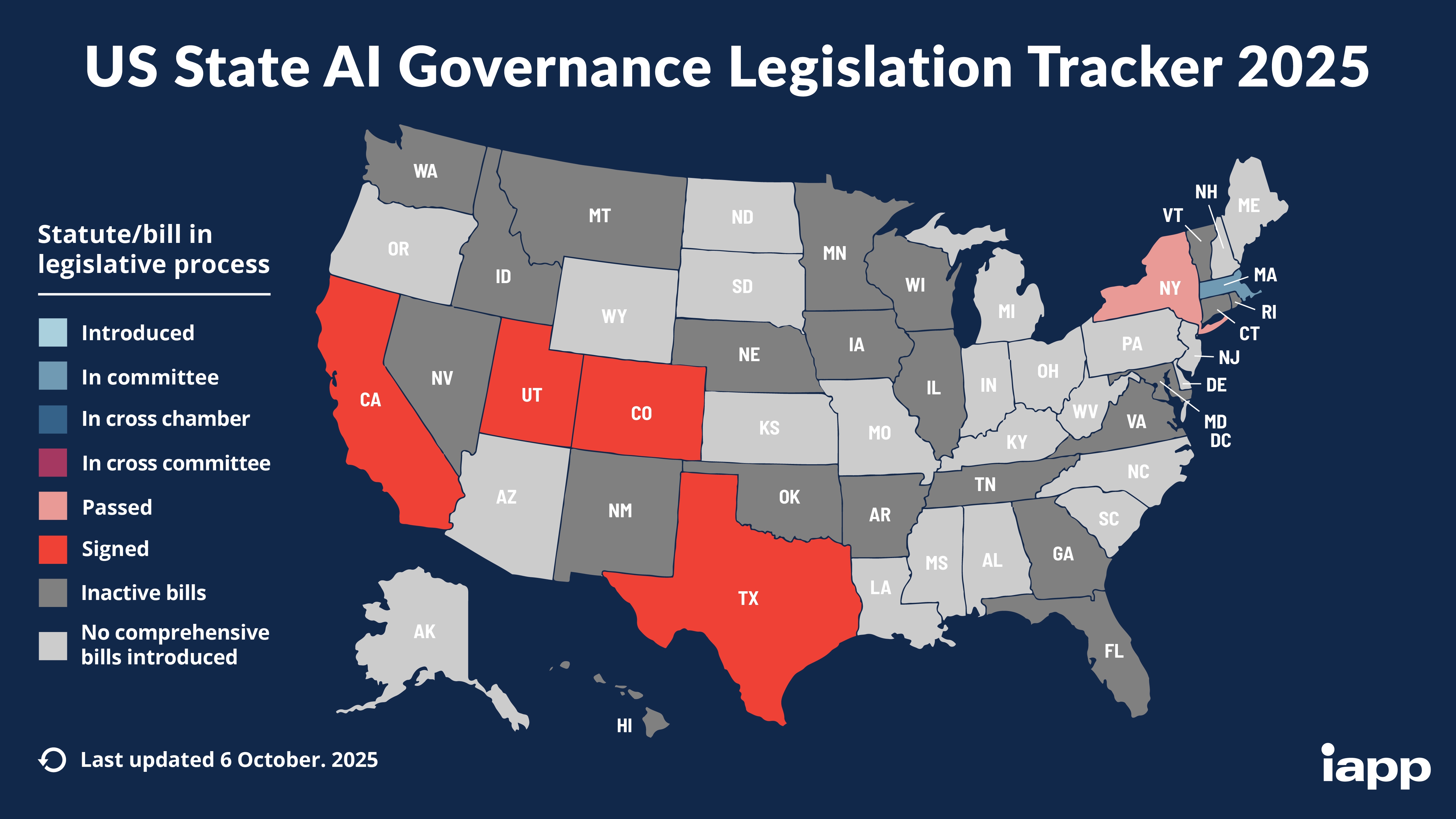
- U.S. State Regulations: State-level regulations in the U.S. are still evolving rapidly and are enforceable locally. These laws regulate the use of AI in areas such as hiring, surveillance, and consumer protection.
- Company, vendor, and industry-oriented frameworks: Private and non-profit organizations have developed their own governance models, including the Microsoft Responsible AI Framework, ISACA COBIT, and Gartner TRiSM, which are widely used in enterprise implementations.
Framework best practices
Following best practices is critical when deploying AI governance frameworks to avoid mistakes, build trust and avoid costly reputational issues. Treading carefully is, of course, essential, but how do you know which way to step?
Based on many years of experience, here are the best practices for selection and implementation of AI Governance frameworks.
This list isn’t all-inclusive but should serve to start the discussion in your organization as you build your own methodologies.
1. You can’t do everything, everywhere, all at once
The first best practice is understanding that you can’t do everything, everywhere, all at once. The growing number of AI frameworks has become part of the broader hype cycle.
Many are introduced less out of necessity and more to position their creators as thought leaders.
New terms, models, and diagrams often overlap, adding complexity without solving core challenges. Most enterprises are still working through fundamentals: understanding what data they have, where it resides, and whether it is clean, usable, and governed.
At the same time, the disciplines that determine long-term success, such as security, privacy, and data governance, are still treated as secondary priorities instead of foundational ones.
Trying to do everything at once is not a strategy. Focusing too much on selecting the “right” AI governance framework or sequencing every component perfectly can distract from what actually drives progress.
What organizations need is less theory and more practical guidance.
Start with the basics. Identify solid and well-defined use cases, and build your framework development efforts from there. As maturity grows, frameworks can support and scale what already works, rather than attempt to define it upfront.
2. Assess organizational readiness before selecting a framework
Before you begin, it’s imperative to have assessed the culture, change management capacity, and collaborative ability in your organization..
- Culture: An organization’s culture includes shared beliefs, values, and practices that support mission achievement. Practical indicators such as how your organization makes decisions, funds initiatives, and integrates AI technologies into operations will directly affect framework selection.
Consider how your organization addresses ethical considerations and literacy improvements. Depending on your responses, you may want to adopt specific framework components or a commonly available framework wholesale.
- Change management capacity: The capacity for change management is critical to AI governance success, as it ensures updates to policies, processes, practices, or systems are effectively adopted and sustained.
Select and implement the right combination of AI governance framework elements that minimize disruption, ensure successful outcomes, and facilitate stakeholder engagement and trust.
- Collaborative capacity: Most frameworks stress alignment, transparency, and feedback, but without strong collaboration across teams, execution breaks down. This leads to inconsistent practices and gaps in risk management.
Effective governance depends on shared decision-making and continuous learning embedded in workflows. Without it, AI initiatives stall or move forward with blind spots. Organizations that collaborate well can adapt frameworks, scale them, and sustain them over time.
3. Align AI governance frameworks with your industry and regulatory reality
An organization’s industry and regulatory status significantly influence framework selection and implementation, so make sure you consider yours.
If you work in an area like healthcare, finance, energy, and aviation, you’ll face strict legal obligations and may prefer frameworks emphasizing traceability, auditability, and compliance (e.g., NIST AI RMF or ISO/IEC 42001).
In contrast, if you work in a less regulated sector, you may adopt more flexible frameworks prioritizing innovation and ethics over rigid controls.
For example, a financial institution must deeply integrate governance into risk management, often requiring audits and documentation. A technology start-up may prioritize agility, adopting lighter governance models while still adhering to ethical best practices.
Industry maturity also influences how frameworks are applied. Established industries can customize frameworks into existing structures, while emerging industries may need adaptive approaches to account for evolving regulations.
4. Build on what already exists across the enterprise
Launching an AI governance program does not require starting from scratch. Most mature organizations already have pieces in place.
Aligning governance efforts to these initiatives allows you to integrate controls early, rather than retrofitting them after deployment.
Begin with an inventory of existing functions. Data governance, security, and privacy programs often include structures, controls, or committees that can be reused or adapted. Even previously abandoned efforts may offer useful foundations.
Look beyond obvious assets. Regulatory findings from audits, regulators, or certification bodies often highlight gaps in model risk, data lineage, explainability, or third-party oversight. These can act as a ready-made backlog for governance priorities.
Also align with ongoing initiatives such as digital transformation, analytics modernization, cloud migration, or customer experience programs.
5. Activate existing talent and operational foundations
By grounding your approach in what already exists, you not only reduce implementation friction and cost, but also increase the likelihood of sustainable adoption across the enterprise.
Identify internal expertise, such as risk managers, privacy professionals, security architects, and legal teams who often have relevant experience, even if their roles are not labeled “AI.”
They represent critical building blocks for a federated governance model.
Establishing a cross-functional working group or steering committee from these existing roles accelerates program formation and promotes organizational buy-in.
Finally, consider operational artifacts and processes that can be adapted rather than recreated.
Existing risk registers, control libraries, policy frameworks, vendor management processes, and lifecycle management practices can often be extended to include AI-specific considerations such as bias testing, model drift monitoring, and transparency requirements.
Even organizational habits, such as established escalation paths, committee cadences, and reporting structures, can be leveraged to embed AI Governance into the fabric of how the business already operates.
6. Begin with core governance elements
When implementing a framework, consider immediate needs. Implementing an entire framework at once creates friction.
A best practice is to start with core elements embodying principles most impactful to your organization and expand outward.
Most frameworks share common elements such as program strategy, communication, AI governance roles and responsibilities, and change management.
Focusing on these common elements provides structure and alignment with organizational needs. Starting solely with compliance resolves only one area and fails to address the entirety of governance needs.
7. Expand governance layer by layer
Once the core is in place, build outward by integrating related disciplines. For example, trustworthy AI depends on strong data and information governance programs.
Bring in areas such as data architecture, data governance, privacy, information governance, and security.
Integrate each by adapting the strengths of each area to the framework, connecting to one another as the framework builds. These then function as interconnected layers, each reinforcing the others.
So what do I do now?
Implementing best practices for AI governance frameworks ensures organizations develop trustworthy, responsible, and sustainable AI capabilities.
Start by making the following list:
- Look at your organizational culture, change management maturity, and collaborative capacity and consider which frameworks might fit
- Begin planning to build strong cultural foundations and collaborative capacity to enable smoother integration and foster buy-in across departments
- Look for existing structures to build on instead of starting from scratch to provide scalability and minimize disruption.
- List all the areas within the business that will need to be connected to the AI governance framework. Build a timeline and plan of how you’ll gradually layer in AI-specific practices to create sustainable governance frameworks aligned with both compliance requirements and organizational growth.
Ultimately, best practices ensure that AI governance frameworks are not only compliant and robust, but are actually relevant to your business and give you confidence they will adapt to future needs.
About the Author:
Todd Henley is a performance-driven information and AI governance leader with over 20 years of experience designing and executing enterprise-class governance, risk, and compliance programs across highly regulated industries. As Founder and Principal of Paperkite.ai, he provides fractional-to-full-time advisory services to help organizations of varying size and complexity develop and operationalize tailored information and AI governance solutions. His expertise spans frameworks, policy development, risk and compliance assessments, and ethical AI practices, with a strong track record of aligning governance initiatives to business value and responsible AI use. Henley also serves on the Board of Directors for the AI Freedom Alliance, contributes to the Global Editorial Board of CDO Magazine, and has held senior governance and privacy leadership roles across the banking, utilities, and nonprofit sectors.



 Elevate Your Personal Brand