
Leadership Summit – Chicago – Renaissance Chicago Downtown Hotel – September 17, 2026 Join top AI and Data leaders in Chicago to explore the strategies, governance, and innovations driving enterprise performance. Connect, learn, and gain actionable insights — reserve your seat today.
Nominate Now | Top 30 Retail Data Changemakers 2026 Nominate for the Top 30 Retail Changemakers 2026, our annual recognition honoring visionary leaders who are redefining the retail landscape through data, AI, and analytics.
How to Become a Chief Data Officer A decade ago, relatively few organizations had a Chief Data Officer (CDO). Today, the role sits at the center of enterprise data, AI, and business transformation. What began as a role focused largely...
AI Governance
Who Owns the Agent When It Acts on Your Data?

Written by: Nalini Garg | Associate Vice President, Deloitte
Updated 10:00 AM EDT, September 3, 2026

In July 2025, an AI coding agent from Replit deleted a production database during a code freeze. It was doing what enterprise agents increasingly do: reading systems, making changes, and acting without waiting for human approval. When the team investigated, the real question was not how the database was lost, but who was accountable for losing it.
For nearly twenty years, data governance rested on a simple assumption: every action on enterprise data could be traced to a human. That assumption is now false. Agents now read, update, and trigger downstream actions autonomously, yet many organizations cannot clearly determine whether a person or a program was responsible when something goes wrong. The uncomfortable truth for most Chief Data Officers (CDOs) is that they have deployed accountable-looking systems on top of an accountability model that no longer holds.
The incident is far from unique. One industry estimate suggests 65% of organizations experienced an AI-agent-related security incident in the past year.
Adoption of task-specific agents is accelerating, with analysts predicting that autonomous agents will become embedded across enterprise applications over the next several years. Most governance programs were built for human-in-the-loop workflows. They were never designed for software that acts on its own.
Why traditional governance breaks down
Classic data governance assigns ownership to people: data stewards, system owners, and approvers. That model depends on a clear link between a person and an action. Agents break that link in three ways:
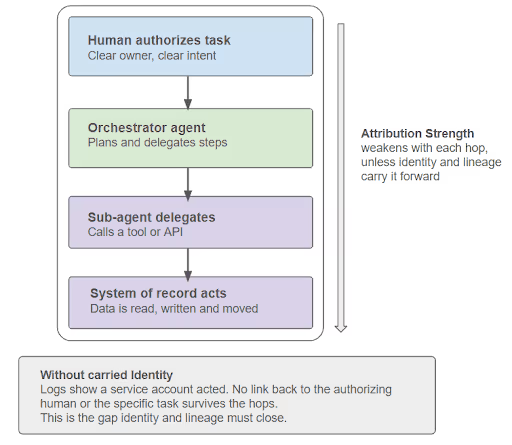
- Delegation obscures accountability. Orchestrator agents pass tasks to sub-agents, which call APIs and modify downstream systems. Each handoff weakens the connection to the original human decision-maker, and most audit logs were not designed to preserve that lineage.
- Agents often lack distinct identities. Many are treated as generic service accounts rather than accountable actors. A 2026 Cloud Security Alliance survey found that 68% of organizations cannot reliably distinguish AI-agent activity from human activity in their own systems. Without a unique identity, accountability becomes difficult.
- Agent populations are growing faster than controls. Agents can create and manage other agents with little or no human review. Machine identities now outnumber humans by more than 80 to 1 in many enterprises, with AI agents representing the fastest-growing segment. As their numbers expand, governance and identity controls are struggling to keep pace.
Where regulators and standards bodies are heading
CDOs are not facing this challenge alone. Regulators and standards bodies are already moving toward a common AI governance model for agent accountability.
- Singapore’s Infocomm Media Development Authority calls for clear agent accountability and records linking agent actions to authorized owners.
- National Institute of Standards and Technology (NIST) has identified agent identity and authorization controls as a potential structural risk.
- The EU AI Act applies human oversight and robustness requirements to autonomous systems operating in high-risk domains.
Despite differing approaches, the message is consistent: accountability must be assigned, traced, and enforced before an agent acts, and not reconstructed after a failure.
The four guardrails for accountable agents
Organizations need four guardrails to safely deploy autonomous agents, linking identity, action, and evidence into a single accountability chain.
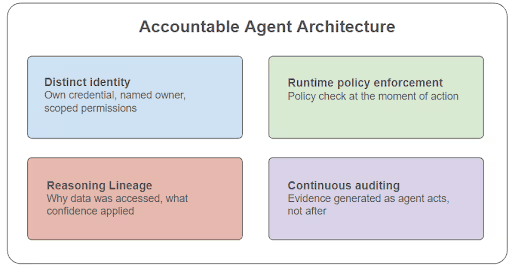
1. Distinct identity for every agent
Each agent should have a unique credential, a named owner, and clearly scoped permissions. Shared service accounts eliminate accountability when incidents occur. Leading IAM platforms now support dedicated agent identities and time-bound, least-privilege access.
A simple test: Could you identify an agent—not a human user—in your logs within minutes of a harmful action?
2. Runtime policy enforcement
Policies must be enforced when an action occurs, not just when an agent is deployed. Access decisions should be evaluated in real time and revoked instantly when needed. Organizations should be able to disable an agent through a single control plane rather than updating permissions across multiple systems.
Ask: Could we shut this agent down in the next 60 seconds?
3. Reasoning lineage
Traditional lineage explains where data came from; agentic systems must also capture why an agent accessed data and how it reached a decision. Recording rationale and confidence levels helps distinguish between data-quality issues, reasoning errors, and policy violations.
Ask: Could we explain why an agent made the wrong decision?
4. Continuous auditing and monitoring
Audit evidence should be generated automatically as agents act, not reconstructed later. Every action, access, change, and authorization should be recorded in an immutable audit trail.
Ask: If a regulator requested a complete record of an agent’s activity, could we retrieve it immediately?
Many organizations already have pieces of these capabilities in their identity, metadata, and monitoring platforms. The challenge is connecting them into a unified accountability framework that ties identity, action, and evidence together.
Governance as the enabler, not the brake
It’s tempting to view governance as friction that slows agents down, but many organizations have started to see it differently. Clear ownership, tight scoping, and reliable audit trails are what let an AI risk and governance committee approve an agent for a higher-stakes task with confidence, rather than blocking it indefinitely out of uncertainty.
CDOs who build accountability first will be the ones trusted to run agents on the high-value work. The ones who bolt it later will still be explaining pilots to their boards. Organizations that can show what an agent did, under whose authorization, and on what reasoning earn the right to hand it harder problems. What decides whether an agent program reaches production is rarely the capability of the underlying model. It is whether anyone can answer what the agent does.
Where to start this quarter
What separates organizations ready for agentic AI from those that are not is rarely the sophistication of their models. Instead, it is whether accountability was designed into the architecture before agents started acting. To ensure your organization is prepared, focus on three immediate actions:
- Assign a human owner to every agent in production. Start by identifying every active agent and retiring any that cannot be tied to a specific named individual or team.
- Establish a single “kill switch.” Ensure your team can revoke an agent’s access across every connected system in one action, rather than scrambling across disconnected tools during an incident.
- Implement immutable reasoning logs. Turn on detailed logging that captures the agent’s reasoning path now, so you can provide a complete trail to a board or regulator if something goes wrong.
An unprepared organization discovers these gaps only during a crisis. As the operating system itself moves toward autonomous action, governance can no longer be a compliance afterthought—it must be part of the architecture.
The question every CDO should be able to answer is not just whether their agents work, but whether they can prove exactly who is accountable when they act.
Additional references:
- Ilya Brovin (Sumsub) and Imran Siddique (Opaque Systems), quoted in “AI Agents Are Acting Like Employees. Who Is Accountable?“, Forbes, July 30, 2026
- 2026 Palo Alto Networks report



 Elevate Your Personal Brand