
What Is a Chief Data Officer in 2026? Many people working within the data industry are saying the same thing: the role of the Chief Data Officer (CDO) has changed – but how? CDO Magazine began an expert survey to find out. We recent...
2026 CDO Report: Meet the Modern Data Team New survey of VP & C-level data and AI leaders confirms what’s stalling AI transformation.
Generative + Agentic AI: Moving From Experimentation to Enterprise Scale Generative and agentic AI are making their way into enterprise production, bringing new questions for Chief Data Officers (CDOs) and other data and AI leaders responsible for making these technologies...
Opinion & Analysis
If Data Is Like Oil, Why Aren’t CDOs Managing It Like Oil and Gas Companies?

Written by: Adil Ahmed | Data & AI Executive
Updated 12:31 PM EDT, June 11, 2026

“Data is the new oil.” — Clive Humby, British mathematician and entrepreneur
The oil and gas industry spent more than a century building a disciplined value chain: upstream, midstream, and downstream. That same three-part structure, applied to data, gives CDOs a more rigorous operating model than any vague directive to “be data-driven.”
Many organizations treated data like oil in the ground: valuable in theory but underutilized in practice. They invested heavily in collection and storage. Few built a robust refinery.
Upstream: Know what you have and where it lives
In oil and gas, upstream means exploration and production. Before a company drills, it surveys the geology. It identifies viable fields, estimates reserves, and secures access rights. The data equivalent is mapping your data estate.
The core upstream questions are:
- Which systems and processes generate reliable data?
- Who controls access, and under what rules?
- Which sources are trustworthy enough to serve as feedstock?
- What platforms need to be connected to unlock access?
Upstream activities include data cataloging, lineage mapping, source system assessment, and access governance. None of it is glamorous. But every data leader who has inherited a broken analytics program knows exactly where the upstream work was skipped.
Example: A new analytics initiative launches and the team pulls data from three source systems. Three weeks in, they discover each system defines the same metric differently. Customer count in the CRM does not match customer count in the ERP. The upstream work was never done. The team is now doing data archaeology instead of building.
Diagnostic: If your data team spends more time arguing about which source to trust than building, your upstream is broken. The organization has been drilling blind.
Midstream: Build the refinery
In oil and gas, midstream is where hydrocarbons are separated by chemical profile, transported, and routed to the right processing facility. The product does not become useful until it reaches the refinery matched to its composition.
The data equivalent is the pipeline and processing architecture. The medallion model maps directly onto this stage:
- Bronze: Raw ingestion from source systems. Unprocessed, preserved as a historical record. Not yet fit for most business use.
- Silver: Cleaned, standardized, deduplicated, and joined data. Domain analysts and data scientists can work at this layer. Refined enough for serious analytical work.
- Gold: Aggregated, business-ready data products. KPIs and curated datasets optimized for specific use cases. Ready to drive decisions without further processing.
The midstream function requires intentional governance. Data contracts define what producers owe consumers. Quality checks enforce standards at every transition point. Without this infrastructure, data lakes become data swamps: raw material extracted but never refined, accumulating costs and generating little value.
Example: A data engineering team builds ingestion pipelines from a dozen source systems, lands everything in a lakehouse, and declares the midstream done. Two years later, the Gold layer was never built. Analysts are pulling from the Bronze layer, cleaning data manually on every project, and producing KPIs that contradict each other in executive meetings.
Diagnostic: If analysts are rebuilding the same data cleaning logic on every new project, you have pipelines but no refinery. The midstream work has not been done adequately. The refinery was never finished.
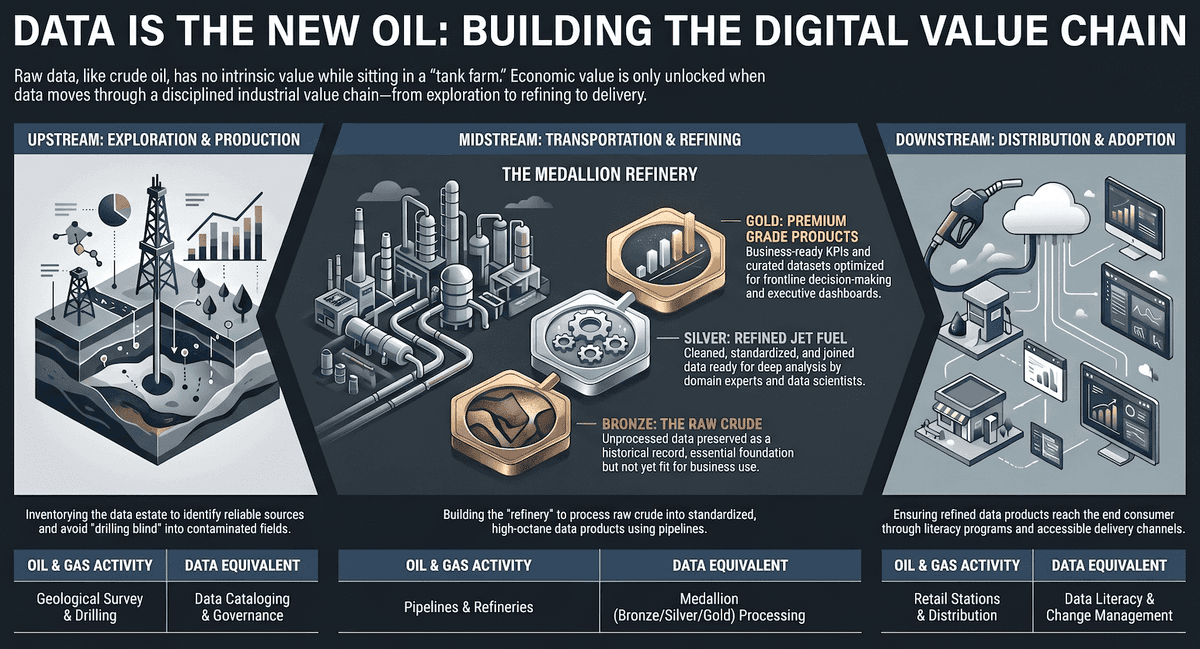
Infographic: Running the data function as a hydrocarbon value chain
Downstream: Get the product to the consumer
In oil and gas, downstream is where refined product reaches the end user through distribution networks, wholesale markets, and retail channels. A technically excellent product sitting in a full refinery with no pipeline to market creates no value.
This is the phase data organizations most consistently neglect. A Gold-layer dashboard that no one knows about, no one trusts, and no one uses is the operational equivalent of a stranded refinery.
Downstream in data means:
- Making data products discoverable and accessible across the organization
- Building data literacy so users understand what a metric measures and how to act on it
- Matching the product to the consumer: an analyst may work directly with enriched datasets, while a frontline manager needs three numbers and a clear threshold for action
- Driving change management so data products get embedded in decision-making and performance management routines, not just launched and forgotten
Example: A supply chain analytics team spends six months building a Gold-layer inventory performance dashboard. It is technically excellent. Three months later, usage metrics show the dashboard is opened twice. No literacy program was run. No one mapped the data product to the decisions it was meant to support. The data reached the refinery. It never reached the driver.
Diagnostic: If your dashboards have high build cost and low adoption, you have a downstream problem. The data reached the refinery. It never reached the driver.
Making data strategy apparent to the C-Suite
One of the persistent challenges for CDOs is translating data strategy into language that resonates with non-data executives. A CFO, COO, or CEO in an industrial company does not naturally think in terms of data lakes, medallion layers, or governance frameworks. They do, however, understand supply chains.
The upstream-midstream-downstream value chain model provides exactly this bridge. Mapping your data function onto a framework that industrial leaders already use to think about physical operations makes the strategy immediately legible. It reframes data as a managed industrial asset, subject to the same discipline as any other production system, rather than an IT abstraction.
In practice, I have used this framework to open budget conversations with an executive who had limited patience for data architecture discussions.
When I replaced “we need to invest in our data lakehouse” with “our midstream refinery is incomplete; we are extracting the crude but we have limited processing infrastructure,” the conversation shifted. The analogy gave him a mental model he already understood. The investment case became a supply chain problem, not an IT request.
Used as a visual communication tool in executive conversations, the value chain infographic gives CDOs a one-page structure for discussing where investment is needed, where the program is mature, and where the breakdowns are occurring.
It shifts the conversation from technology procurement to operational capability building. That is a conversation most CXOs are far better equipped to engage with.
The question every CDO should be able to answer
The Economist declared in 2017 that data had become the world’s most valuable resource. The declaration rings true in the consumer world. Whether the C-suite within enterprises view and treat data as a strategic asset is open for debate.
The companies winning on data are not necessarily those with the most of it. They are the ones that have built the full value chain: disciplined upstream governance, efficient midstream processing, and deliberate downstream delivery.
They treat data products with the same rigor they apply to physical products. Which means, understand consumer requirements and value outcomes. High quality data products. Clear distribution channels and effective change management.
Most data organizations can name their tools. Fewer can draw their value chain and identify precisely where it breaks down. That gap is the CDO’s primary problem, and closing it starts with being honest about which stream is failing.
Humby was right in 2006. The full value of that insight was never just about the drilling. It was just as much about building the refinery and the downstream distribution network.



 Elevate Your Personal Brand