
What Is a Chief Data Officer in 2026? Many people working within the data industry are saying the same thing: the role of the Chief Data Officer (CDO) has changed – but how? CDO Magazine began an expert survey to find out. We recent...
Generative + Agentic AI: Moving From Experimentation to Enterprise Scale Generative and agentic AI are making their way into enterprise production, bringing new questions for Chief Data Officers (CDOs) and other data and AI leaders responsible for making these technologies...
Webinar | The Agentic Mindset Shift: How to Onboard an Agentic Data Team Three sessions, real playbooks, proven results you can replicate.
Opinion & Analysis
How the 5-Point VECTR Framework Fills the Culture Gap in Traditional Data Maturity and AI Maturity Models


Written by: Karan Dhawal | Chief Data Analytics & AI Leader, Gokula Mishra | Strategic Advisor AI, GenAI, & Data Analytics
Updated 10:00 AM EDT, July 9, 2026

Traditional enterprise data maturity models have helped organizations strengthen governance, architecture, security, metadata, and data quality. Those capabilities remain essential.
As organizations scale AI across the enterprise, however, many are discovering that technical maturity alone does not guarantee business value.
Ultimately, successful data and AI initiatives depend as much on people as they do on technology. Employees must trust data, understand how to use it, ask better questions, and feel confident making data-driven decisions. Without those behaviors, even the most sophisticated technology investments struggle to deliver lasting impact.
As we write in A Leader’s Guide to Data & AI Culture:
“The companies that win the AI era will not be those with the most models. They will be the ones where every employee—from the boardroom to the shop floor—trusts the data, asks the right questions, and is brave enough to act on the answer.”
This realization led us to develop the VECTR Framework, a complementary maturity model designed to help organizations measure and strengthen the cultural dimensions of enterprise data and AI.
Rather than replacing existing maturity assessments, the framework helps organizations evaluate the people, behaviors, and organizational practices that enable technical capabilities to translate into measurable business value.
Why Traditional Data Maturity Models Leave a Gap
Most enterprise maturity models emphasize technical capabilities such as governance, architecture, integration, security, metadata, and data quality. While these remain foundational, culture is often treated as only a small component of overall maturity.
Yet organizations frequently discover that their greatest barriers are not technical – they’re often behavioral.
Data may be available, but employees may not trust it.
AI tools may exist, but teams may hesitate to adopt them.
Governance processes may be well-designed, yet business units may continue to make decisions based on instinct rather than evidence.
Measuring culture separately allows organizations to identify these barriers and address them intentionally rather than assuming technical maturity will naturally produce business adoption.
The VECTR Framework
The framework is built around five interconnected dimensions of Data & AI culture.
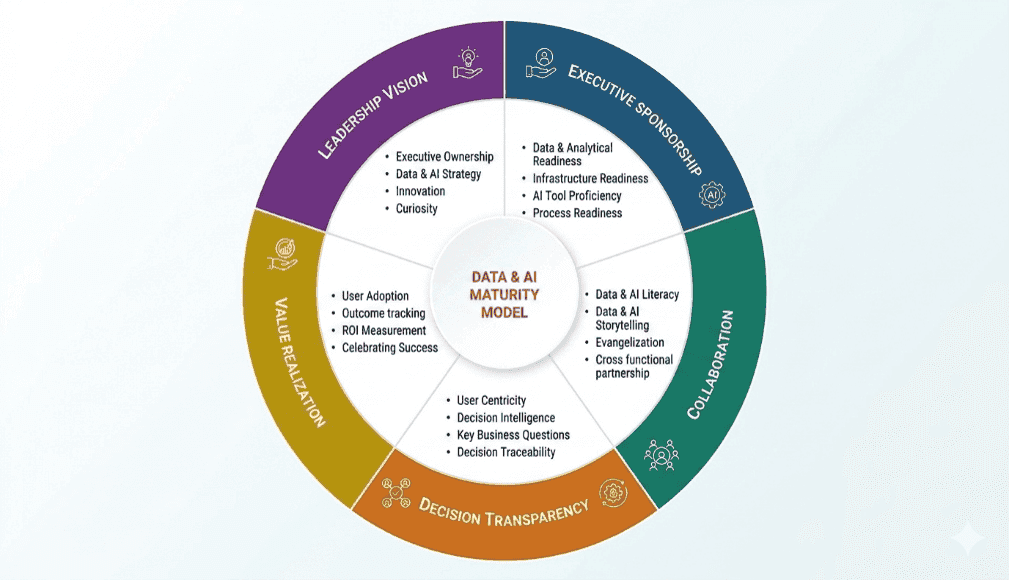
1. Leadership Vision
Strong data cultures begin with visible executive commitment. Leadership Vision examines how effectively leaders communicate the role of data and AI in achieving business objectives while encouraging curiosity, innovation, and continuous learning across the organization.
2. Executive Sponsorship
Even the strongest strategy struggles without executive sponsorship. Successful transformation requires active executive sponsorship rather than isolated champions. This dimension evaluates how leaders support enterprise-wide adoption through organizational readiness, AI literacy, infrastructure, and governance processes aligned with measurable business outcomes.
3. Communication
Communication plays an essential role in building a strong data culture. Organizations build stronger data cultures when they consistently communicate successes, share lessons learned, and reinforce the business impact of data-driven decisions. Effective storytelling helps employees understand not only what changed, but why it matters.
4. Decision Transparency
As organizations increasingly rely on AI-supported decision-making, employees and business leaders need to understand how important decisions are made. Decision Transparency helps ensure those decisions remain traceable, explainable, and connected to trusted data.
5. Value Realization
Ultimately, culture must produce business outcomes, and data and AI initiatives must demonstrate measurable business value. This dimension emphasizes adoption, outcome tracking, ROI measurement, and celebrating successful implementations that reinforce continued investment and organizational engagement.
Unlike many maturity models that allow organizations to excel in isolated categories, the VECTR Framework treats these five dimensions as interconnected capabilities.
Organizations progress together across each area, recognizing that sustainable cultural maturity requires balanced development rather than isolated excellence.
Why Gamification Matters
Understanding cultural maturity is only the first step. Organizations must also encourage the behaviors that strengthen it.
Gamification offers one practical approach by using familiar mechanisms such as challenges, recognition, badges, leaderboards, and collaborative learning to increase participation in data and AI initiatives. Rather than treating data literacy as a one-time training exercise, organizations can reinforce continuous learning and encourage employees to engage more actively with data in their everyday work.
For CDOs, gamification can help increase participation in data literacy programs, encourage responsible AI adoption, recognize teams that demonstrate strong data stewardship, and reinforce the human oversight required for emerging agentic AI capabilities.
Building a Stronger Data & AI Culture
Frameworks such as VECTR provide one way to measure and strengthen the organizational behaviors that influence adoption, accountability, transparency, and business value.
As AI continues to reshape enterprise operations, organizations that invest in technical capability and data culture will be better positioned to realize lasting value.
This article includes insights from the recently released book, A Leader’s Guide to Data & AI Culture, authored by Karan Dhawal and Gokula Mishra.


 Elevate Your Personal Brand