
What Is a Chief Data Officer in 2026? Many people working within the data industry are saying the same thing: the role of the Chief Data Officer (CDO) has changed – but how? CDO Magazine began an expert survey to find out. We recent...
Generative + Agentic AI: Moving From Experimentation to Enterprise Scale Generative and agentic AI are making their way into enterprise production, bringing new questions for Chief Data Officers (CDOs) and other data and AI leaders responsible for making these technologies...
Webinar | The Agentic Mindset Shift: How to Onboard an Agentic Data Team Three sessions, real playbooks, proven results you can replicate.
Opinion & Analysis
How Banks Can Scale AI in Fraud and Credit Decisioning Without Losing Governance
A commentary on fraud and credit decisioning, governance, and operating-model maturity in banking.

Written by: Deepu Komati | Lead Engineer at HCL America Inc.
Updated 11:37 AM EDT, May 12, 2026

Many banks still talk about AI in terms of individual use cases: fraud, lending, service, compliance, and personalization. That framing is too simplistic for where the industry is today. The tougher question is whether an institution can reform its decision systems so that data, models, policy, human judgment, and governance fit together as a suite under real operating pressure.
And in practice, two areas reveal whether the redesign is real: fraud decisioning and credit decisioning. They lie at the intersection of customer trust, financial risk, regulatory scrutiny, and operational complexity.
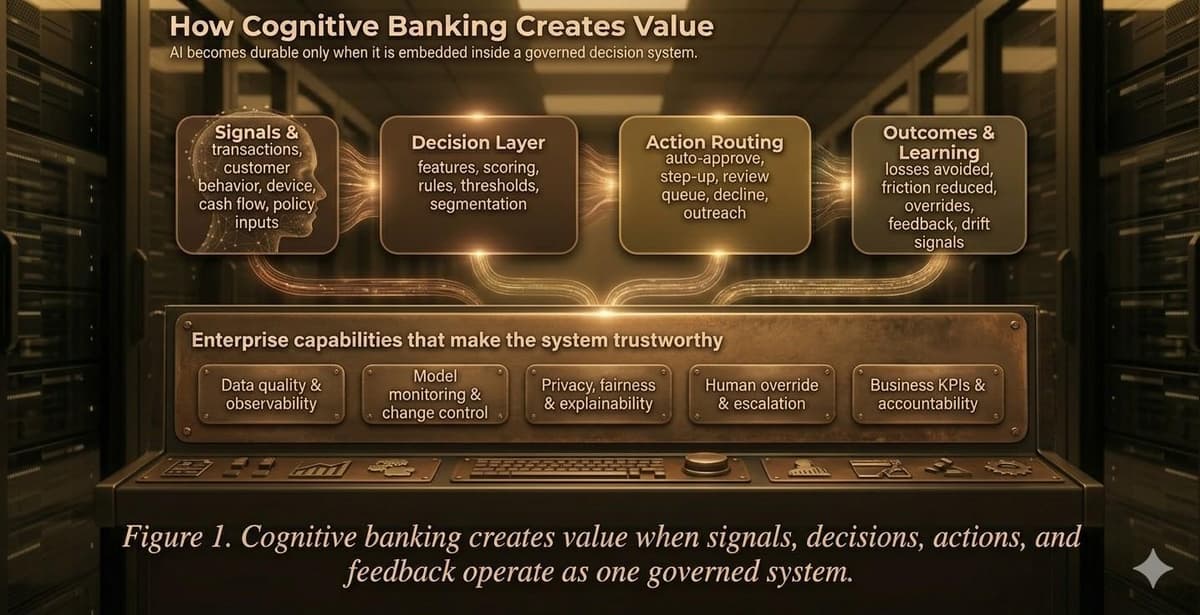
The reason I believe cognitive banking is meaningful lies in how AI is built into these high-stakes workflows in a quantifiable, explainable, and governable manner.
Why banks struggle to scale AI decision systems
Banks are not starved for AI ideas. They suffer from fragmentation. One team creates a fraud model. Another is using alternative data that pilots use for underwriting. One-third automates elements of customer service.
While each initiative may have its merits as a stand-alone, the institution is still left with imperfect results: solid model performance during testing, limited value in production, and ongoing negotiation between disparate teams — data teams vs risk teams, operations, and business owners.
That is not the model, which is why it is not the right unit of analysis. It is the decision system.
A decision system is more than a scoring engine. It includes the quality and timeliness of data inputs, the policy logic attached to model outputs, escalation and review workflows, evidence retention for governance and auditability, and the feedback loops that continuously improve future decisions. Regulators have long made clear that model use in banking needs sound governance, validation, monitoring, and controls. The Federal Reserve’s SR 11-7 remains the reference point for this broader view of model risk management.
The institutions that generate lasting value are typically not those with the shiniest AI narrative. They realize a simple truth: A model can be technically impressive and yet make the business worse if it’s housed in a weak operating structure.
Fraud detection is the first real test of cognitive banking
Fraud is often the first place legacy decision systems fail spectacularly. Static rules, thresholds, and alert queues still exist, but they are not enough. Payments fraud is becoming more automated and higher stakes, with AI being used by bad actors to scale tactics like fake merchants, account compromise, and scam operations. Mastercard’s recent fraud coverage described this migration: bad actors using AI and off-the-shelf fraud tools to industrialize attack vectors.
And that is why fraud is such a critical proving ground. It drives institutions from siloed detection logic into context-based decisioning.
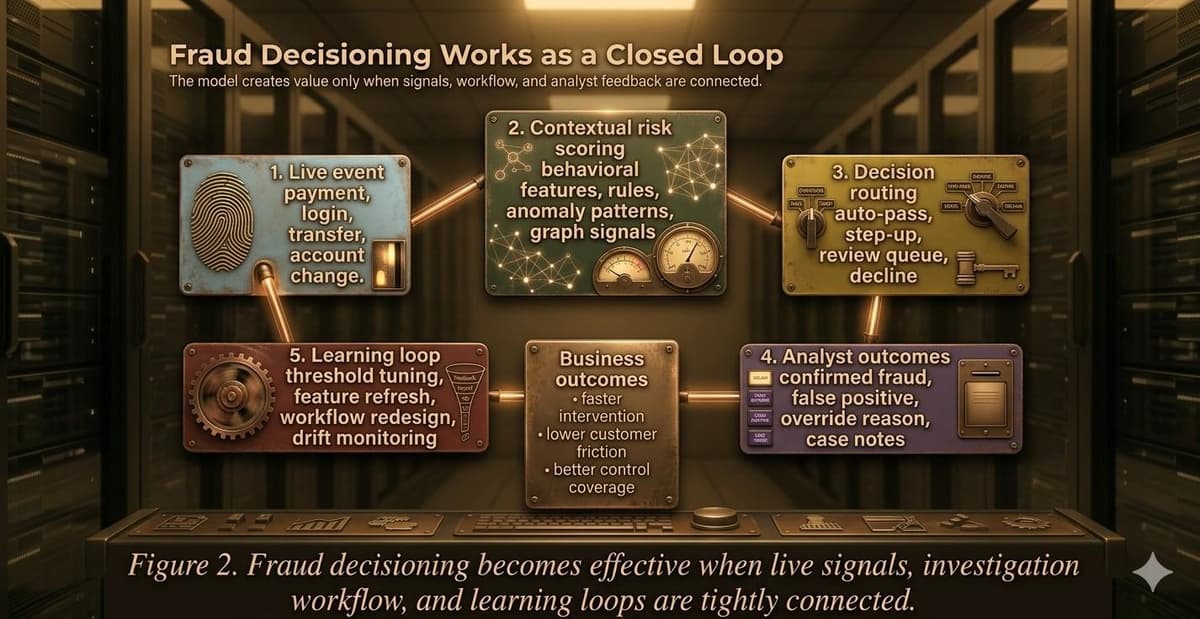
A more sophisticated fraud stack doesn’t just ask if a transaction crosses a threshold. It asks, “Does how we act around the event change the meaning of it?” Everything matters, from device switches to transaction speed, linked accounts, suspicious session behavior, new customer activity, and historical job findings.
Capital One’s applied AI work also comes in handy here. It emphasizes graph machine learning for fraud and anomaly detection, as well as explainable AI not only separately but as these capabilities that all tie together. That’s a more realistic picture of how modern fraud controls function in the real world.
But the deeper lesson for practitioners is this: better detection doesn’t necessarily lead to better decision making.
In other words, I have seen fraud programs go out and invest a lot in model precision and then underinvest in everything surrounding the model. Triage logic does not change, so case queues get longer. More alerts, but not better evidence for analysts.
Step-up workflows often lack effective segmentation, creating a more friction-heavy experience for customers. While the model may appear strong on paper, operationally, the bank automated more noise.
The stronger pattern is different. The best fraud programs seem to do three things particularly well.
- They define success in operational terms, not just model performance metrics. The focus shifts beyond statistical accuracy toward executive-level outcomes such as reducing false positives, lowering investigator handling time, shortening time to intervention, and minimizing avoidable customer friction.
- They build closed-loop learning systems. Investigation outcomes, analyst overrides, emerging fraud typologies, and downstream losses all become feedback signals that continuously inform and improve the next decision cycle.
- They align decisions to both confidence and consequence. Some events should be automatically blocked, others should trigger step-up authentication workflows, and higher-risk scenarios may require structured human review. In many cases, the real business value emerges not from the model itself, but from the intelligence embedded within that routing logic.
A helpful public example of this operating-model perspective comes from the Commonwealth Bank of Australia. In early 2026, it reported that AI had reduced customer fraud losses by more than 20% in the first half of FY2026 compared to FY2025’s equivalent period. Broader disclosures indicate roughly 40,000 suspicious-activity alerts are sent every day and thousands of AI bots are deployed to foil scammers.
The key take away is more than the headline number alone. It is that tangible results came from integrating detection, intervention, customer engagement, and operational response into a single system.
That is why fraud constitutes the first true test of cognitive banking maturity. It shows whether intelligence is truly embedded in the workflow, or just tagged onto it.
Credit decisioning is where AI becomes a strategic capability
If fraud prevention is where a bank demonstrates its ability to protect itself intelligently, credit decisioning is where it proves its ability to grow intelligently.
This is also where many AI programs become brittle, because stronger prediction is a different capability than stronger decisioning.
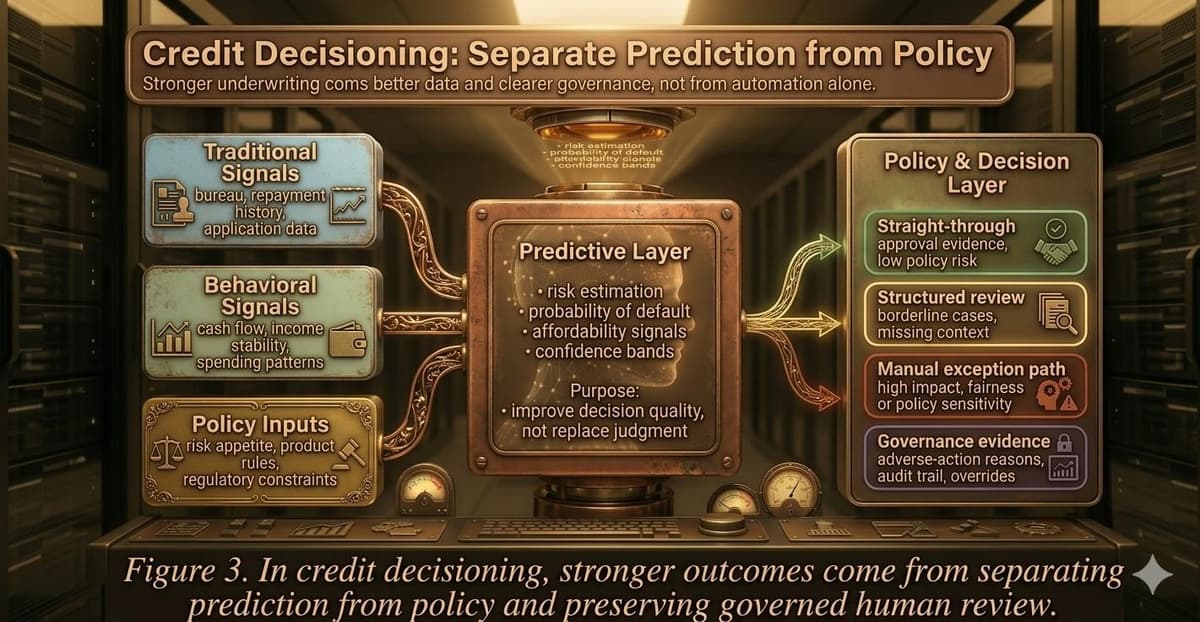
Bureau data, repayment history, and application information are still the backbone of conventional underwriting. Those signals still matter, but they tend to be incomplete. Cash-flow behavior, the consistency of income and volatility of expenses, and early warnings of financial stress can all meaningfully enhance an institution’s view of current risk.
FinRegLab’s 2025 research is particularly significant because it found that machine learning techniques and cash-flow data can substantially improve model predictiveness and expand credit access without proportionally increasing default risk. Importantly, the strongest outcomes came not from replacing traditional credit signals, but from integrating newer data sources and AI techniques alongside them.
That finding is significant because it bolsters a more sober view of AI in lending. The opportunity is not to dismiss established risk frameworks. It is to enrich them. Yet, credit is where the limits of a purely technical mindset become evident quickly. A model might yield a better separation of risk, but that still does not tell the institution what to do.
Credit decisions are nestled within a governed environment comprising adverse-action notice rules, fairness review, exception handling, documentation, and policy accountability. The CFPB has made clear that lenders using complex algorithms must still provide specific and accurate reasons for adverse action; opacity in models does not justify weak explanations.
And this is where one of the more important implementation lessons emerges: The value of AI in credit often has less to do with full automation than it does better allocation of human attention.
A good operating model matters more than the model
A good operating model separates all the decisions. More straightforward cases can advance more swiftly with less human labor. Borderline cases can be funneled to underwriters with more robust evidence and clearer guidance. Higher-sensitivity segments can stay under stricter policy and review thresholds. That is, the model advises the process without supplanting it.
Public examples increasingly follow that pattern. DBS Bank India’s Auto-Fin is an AI-based underwriting capability that accelerates MSME lending, augments the productivity of credit teams and allows for faster and uniform decisions. That is a far more credible statement of value than broad claims about AI simply approving loans. It reflects a more practical use of AI: enhancing analysis, improving workflows, and supporting decision-making without sidelining governance, oversight, or risk controls.
It is not lack of predictive lift that typically delays adoption. It is a lack of operating clarity. Teams rejoice that the model is better, only to flounder when business and compliance leaders start asking
the hard questions such as:
- Where does policy trump model output?
- Which cases require manual review?
- What evidence will be retained?
- How will fairness be monitored?
- How will adverse-action reasons be accurately generated?
If those design decisions are not taken upfront then implementation is fragile.
This is why credit decisioning is so much more than a modeling challenge. It is an operating discipline.
What usually breaks first in banking AI implementation
In my experience, the first failure point is rarely the algorithm itself. More often, it is one of the following three things:
- Fragmented ownership: The data science team owns the model, engineering owns deployment, operations owns workflow, risk owns validation, and business teams own outcomes. Decision-making is a team sport but no one owns decision quality end to end.
- Weak data discipline in production: A model is trained with hand-selected, historical data, and then fed stale or missing or structurally different data in live production. At that point, sophistication of the model is not the issue. It is whether the institution can trust the inputs in its decision process at all.
- Missing feedback loops: The teams track technical metrics but don’t learn much from the overrides and downstream losses, customer complaints, investigation results or resolution times. They are aware of the model behavior. There is not full awareness of how the decision engine works.
This is why you need to cast data quality and observability as production controls, not support functions. In sensitive workflows, a late feature or broken transformation is more than just a data error. It is a live control issue.
The ones that make it are often those that start small, with only a handful of decision-critical data products and define thresholds for quality that map to business impact which they aggressively monitor.
Weak AI governance slows scale
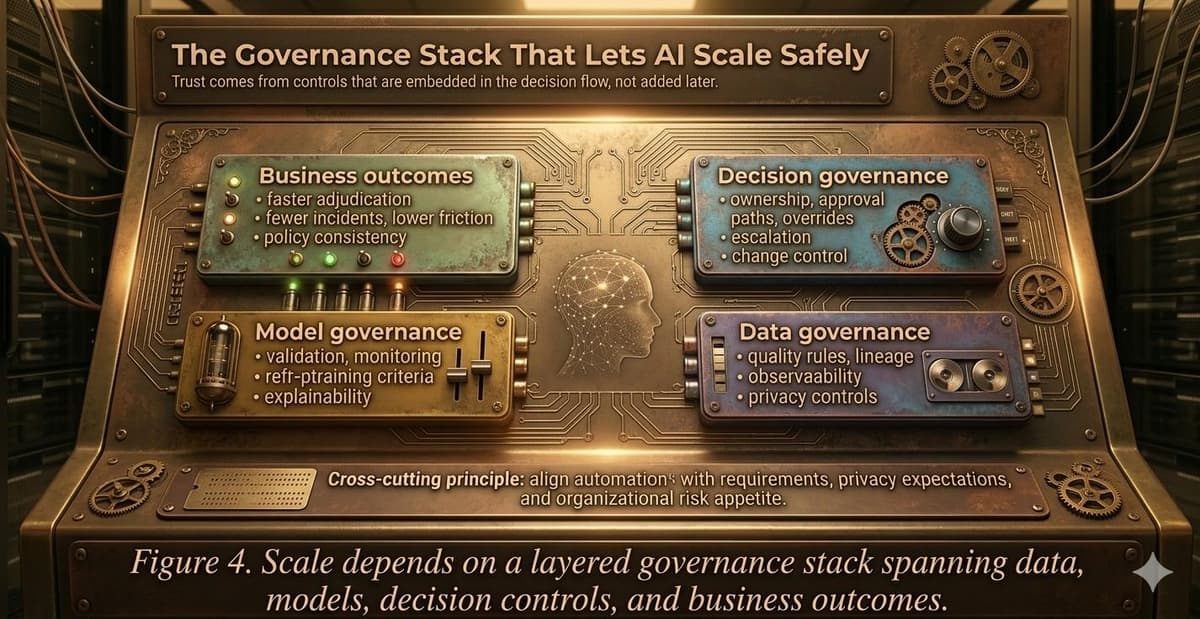
There is an overarching tendency to portray governance as the brake that slows AI down. In banking, that is backwards. Weak and inconsistent governance is what slows scale. When expectations about explainability, documentation, change control, privacy, overrides, and monitoring are not clear, every deployment becomes an argument. The same issues plague teams repeatedly. As an outcome, trust remains local and scaling remains slow.
Adding processes for their sake is not good governance. It means delineating operating boundaries in a way that you can release your teams to be confident in their actions. That is especially critical when dealing with customer data and high-impact decisions. These principles of privacy, fairness, explainability and model risk need to be embedded in the decision system from day one.
Data minimization should be clear. It should be justifiable why data use is being determined. These decision boundaries should describe what can be automated, what needs to be escalated and what must always have a human-in-the-loop.
Documentation needs to speak the terms of business, risk and audit stakeholders and not just technical teams. Institutions must show both supervisors and customers that their models are working, and the regulatory expectations that define model risk management also drive how institutions build trust with those stakeholders over time.
Trust is cumulative. It is constructed when the institution can articulate what the model does, but also how the entire decision process is governed.
A more practical agenda for scaling AI in banking
The next step, for institutions attempting to move from pilots to durable capability, is generally more narrow than an organizational AI strategy refresh. This is what a practical agenda looks like:
- Focus first on one or two high-stakes decision domains in which business value, operational friction, and governance needs are all apparent. Fraud and credit are almost always where you should start.
- Trace the entire decision lifecycle, not just that of the model. These processes include: data inputs, feature creation, model output, policy overlays, escalations/human review/overrides/feedback loops.
- Establish end-to-end ownership of decision quality.
- Define value in decision terms: less manual-review burden, fewer false positives, faster adjudication, fewer customer complaints, more consistent policy execution or stronger post-incident recovery.
- Data quality, observability and governance are part of the production system. That sort of work is less exciting than launching another pilot. It is also much more apt to create enduring value.
Key actions
- Perceive cognitive banking as a decision system problem, not a model deployment problem.
- Use fraud and credit as the two most elucidative proving grounds because they show you the actual trade-offs between speed, trust, governance and business value.
- Better prediction does not equal better decisions; operating model design, workflow segmentation and feedback loops often count for just as much.
- Keep prediction and policy distinct, so that AI guides choices but does not become an unquestionable arbiter of decisions.
- From day one, (and especially where customer impact and regulatory scrutiny is greatest) establish strong data discipline, observability, and governance built for scale.
About the author:
Deepu Komati is a data scientist and AI practitioner specializing in financial analytics, machine learning, and intelligent decision systems. His work focuses on applying advanced analytics and AI to solve complex challenges in financial services, including fraud detection, credit risk modeling, and customer behavior analysis. He has contributed to research and thought leadership in areas such as fintech innovation, AI-driven financial systems, and data-driven decision-making.
Komati is also the author of the book “AI and Machine Learning in Banking,” which explores how modern AI technologies are transforming financial institutions and enabling intelligent financial ecosystems. Through his research and writing, he aims to bridge the gap between technical innovation and business strategy, helping organizations understand how responsible AI adoption can drive the next generation of financial services.



 Elevate Your Personal Brand