
What Is a Chief Data Officer in 2026? Many people working within the data industry are saying the same thing: the role of the Chief Data Officer (CDO) has changed – but how? CDO Magazine began an expert survey to find out. We recent...
2026 CDO Report: Meet the Modern Data Team New survey of VP & C-level data and AI leaders confirms what’s stalling AI transformation.
Generative + Agentic AI: Moving From Experimentation to Enterprise Scale Generative and agentic AI are making their way into enterprise production, bringing new questions for Chief Data Officers (CDOs) and other data and AI leaders responsible for making these technologies...
Opinion & Analysis
How Adaptability Intelligence Helps Your Workforce Adopt AI for Greater Impact

Written by: Nikunsh Desai | Founder, Before the Prompt
Updated 3:59 PM EDT, June 3, 2026

Here’s a pattern I’ve watched play out more than once. A large enterprise rolls out an AI copilot across a business unit. Adoption metrics look excellent in the first quarter: license activation, daily active users, and positive survey sentiment. The deployment is declared a success.
Six months in, the operating committee asks the obvious question: Where is the productivity gain? The honest answer is that nobody can find it in the numbers.
The data backs up the pattern. An ActivTrak study of over 10,000 users found that time spent on daily tasks actually increased by up to 346% after AI adoption. Harvard researchers have documented what they call “AI brain fry”, or cognitive fog among workers following intensive AI use. The tools got deployed, the dashboards lit up, and the work somehow got heavier.
After more than a decade leading data and AI strategy across financial services and professional services firms, I’ve come to a consistent conclusion: this is not a technology problem. It is a human readiness problem. And the missing layer in most AI strategies is what I call Adaptability Intelligence.
Why one-size-fits-all training fails
Most enterprises treat AI readiness as a uniform training exercise. Every employee receives the same onboarding deck. Adoption is measured by tool usage, not by the quality of decisions it enables.
This ignores a reality I’ve observed across every transformation program I’ve been close to: adaptability looks fundamentally different at each career stage.
Early-career professionals bring technical fluency. Mid-career professionals bring domain judgment. Senior professionals bring institutional context. When training fails to account for this, early-career employees burn out on tool overload while senior professionals quietly disengage. This is because nobody has connected AI to the expertise they’ve spent twenty years building.
Introducing adaptability intelligence
Adaptability Intelligence is a structured framework for the human capabilities that determine whether AI amplifies work or adds cognitive load. It did not start life as a model. It emerged from a pattern I kept seeing across teams: the same technical investment produced very different outcomes depending on which human capabilities were present or absent in the people using the tools.
The framework comprises seven pillars. All seven matter. But two matter disproportionately in today’s environment, and I’ll come back to those.
- Curiosity: The willingness to question before executing. Early-career professionals lead here.
- Critical thinking: Evaluating AI output against domain knowledge. Mid-career ownership.
- Data storytelling: Translating AI outputs into decisions stakeholders can act on. Early-career strength.
- Data ethics: Distinguishing between what AI can do and what it should do. Mid-career territory.
- Unlearn-to-relearn: Releasing legacy habits that block adaptation. The defining senior leadership challenge.
- Decision agility: Making sound decisions faster under ambiguity. Mid-career and senior strength.
- Collaborative intelligence: Orchestrating work across human-AI and human-human boundaries. Senior leadership territory.
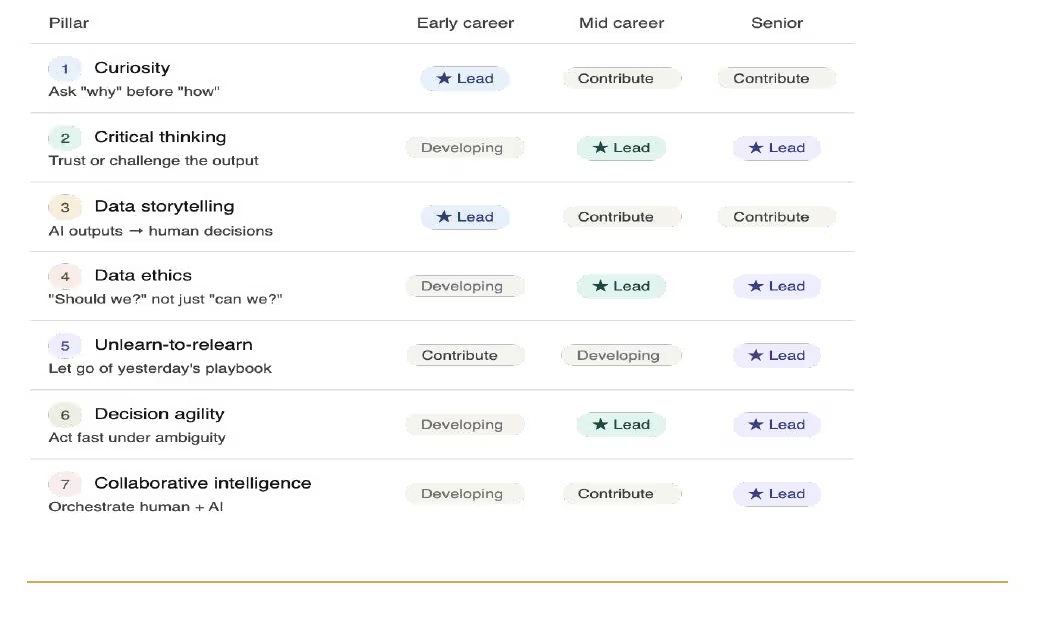
In every organization I’ve worked with, the two pillars that determine whether AI investment compounds or stalls are critical thinking and unlearn-to-relearn. The first governs whether AI output gets challenged before it flows into a decision. The second governs whether the people with the most institutional authority are willing to let go of the playbook that made them successful.
Get these two wrong, and no amount of tool deployment will move the needle.
A concrete example from my work: A data cataloging program where the tool was built correctly: every dataset mapped, every dictionary documented, every owner named, every domain linkage traced. However, adoption still stalled. The reason wasn’t the platform. Senior data owners and a number of brokers kept reaching for the Excel workflows they had built their careers around. No amount of platform investment resolves that. It’s an unlearn-to-relearn problem, and it sits squarely in the human layer. The catalog was ready. The people weren’t.
A second pattern, this time at the mid-career layer: Analysts who once produced sharp, user-specific project updates started routing their stakeholder communications through AI. The messages got longer, smoother, and more generic. The specificity that made their updates valuable: the sense that a person had actually thought about the stakeholder, context, and decision, quietly disappeared.
These are the professionals the critical thinking pillar relies on. When they outsource their judgment to AI rather than use it to sharpen their reasoning, the organization loses the very capability it most needs them to exercise.
How to map the pillars to career stages — and translate them into practice
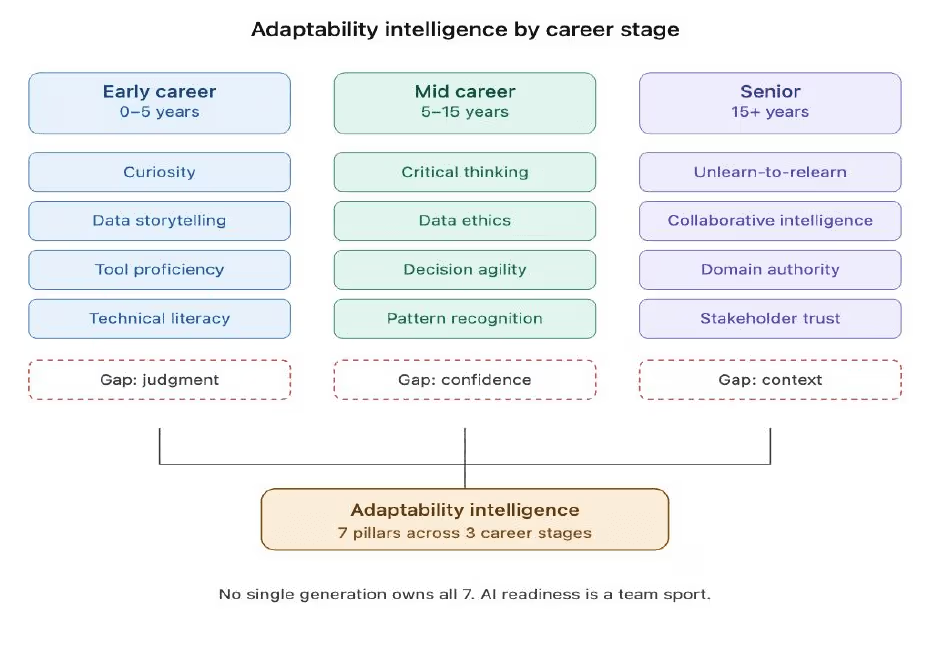
No single career stage leads on all seven pillars. Early-career professionals lead on curiosity and data storytelling. Mid-career professionals lead on critical thinking, data ethics, and decision agility. Senior professionals lead on unlearn-to-relearn and collaborative intelligence.
The framework’s practical value is in how leaders translate that mapping into three concrete design choices: training, workflow, and governance.
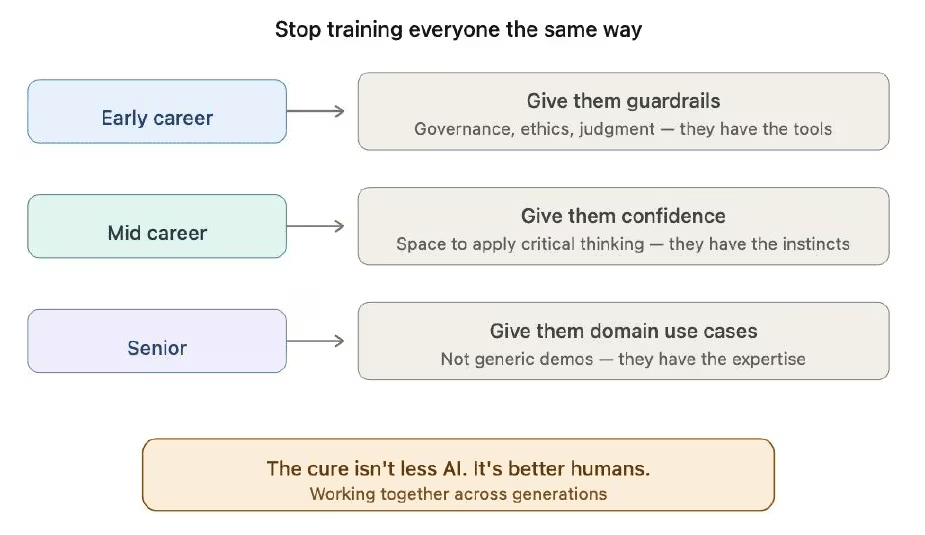
For early-career teams: Build guardrails, not more tools.
They already have the technical fluency. What they lack is the experience to evaluate what AI gives them.
- Training design: Replace generic prompt-engineering modules with case-based judgment labs. Give them flawed AI outputs and ask them to identify what’s wrong before teaching them how to generate better ones.
- Workflow design: Introduce a review gate before AI-generated outputs flow to senior stakeholders. Pair early-career professionals with mid-career reviewers as a default, not an exception.
- Governance: Make documentation of source and reasoning a hard requirement for AI-assisted deliverables. Adoption metrics should include evidence of critical evaluation, not just volume of use.
For mid-career professionals: Create the space and authority to apply critical thinking
They have the instincts but lack the permission. They’ve been told the future belongs to those who can code, and they’ve started to doubt the value of what they already know.
- Training design: Skip the generic AI literacy track. Give them AI use cases grounded in their own domain and ask them to stress-test the outputs against their experience. Treat them as evaluators, not learners.
- Workflow design: Build “challenge the model” checkpoints into critical workflows: forecasting, pricing, risk assessment, where a mid-career professional must formally sign off on whether the AI output is fit for purpose.
- Governance: Give them ownership of the feedback loop that corrects model behavior over time. This is where data ethics gets operationalized in practice rather than written into a policy document.
For senior leaders: Deliver domain use cases, not demos
A veteran risk manager does not need a prompt engineering workshop. She needs to see how AI operationalizes the framework she already carries in her head.
- Training design: Replace generic executive briefings with small-group sessions that start from a decision the leader actually owns and work backward to where AI fits.
- Workflow design: Structure AI rollouts to surface the legacy assumptions senior leaders need to let go of (the unlearn-to-relearn pillar) before deploying new capabilities. This is where pilot purgatory shows up: initiatives that stall because the operating model hasn’t been updated.
- Governance: Assign senior leaders explicit accountability for sequencing: which capabilities get built first, which legacy workflows get retired, and which cross-functional collaborations AI is meant to enable.
Harvard Business Review has found that the assumption that experienced workers cannot adapt to AI is unsupported. A Generation study reported that 89% of hiring managers rated experienced workers as performing equal to or better than younger peers. The problem was never capability. It was program design.
The sequencing problem
Adaptability Intelligence addresses the human layer, but it only works when sequenced correctly. Organizations that start with AI tools before addressing people and data foundations will continue to watch adoption stall. The effective sequence, in my experience, is bottom-up: human readiness first, data governance second, AI acceleration third.
From framework to action
Three moves for data and AI leaders this quarter:
- Audit existing AI training programs for career-stage differentiation. If every role gets the same deck, you have a readiness gap, not a training program.
- Identify your underinvested pillars. In almost every organization I’ve seen, critical thinking and unlearn-to-relearn are the neglected two.
- Change what you measure. Move adoption metrics away from tool usage and toward decision quality: how often AI-assisted work improves outcomes, not how often the tool was opened.
AI readiness is not a technology deployment challenge. It is a human capability challenge. The organizations that build the most adaptable people, at every level, will be the ones that capture real value from AI.
About the Author:
Nikunsh Desai is a data and AI strategy professional with over 12 years of enterprise experience spanning Marsh McLennan, Goldman Sachs, Morgan Stanley, and UBS. He is the creator of the Before the Prompt platform, which focuses on AI readiness through proprietary frameworks including Adaptability Intelligence and the BRIDGE Framework. His work addresses the intersection of data governance, AI adoption, and organizational change management.


 Elevate Your Personal Brand