
Leadership Summit – Chicago – Renaissance Chicago Downtown Hotel – September 17, 2026 Join top AI and Data leaders in Chicago to explore the strategies, governance, and innovations driving enterprise performance. Connect, learn, and gain actionable insights — reserve your seat today.
Webinar | The Multiplier Effect: How Top Data Leaders Translate Infrastructure into Business Impact Hear directly from leading data executives as they share how they are navigating data strategy, AI investment, and business value in the AI era.
Nominate Now | Top 30 Retail Data Changemakers 2026 Nominate for the Top 30 Retail Changemakers 2026, our annual recognition honoring visionary leaders who are redefining the retail landscape through data, AI, and analytics.
Opinion & Analysis
Agentic AI Governance: Building Integrity Beyond the Symbolic Veto Layer

Written by: Ankit Anand | Managing Consultant
Updated 10:00 AM EDT, July 22, 2026

As Chief Data Officers (CDOs) and Chief Data and Artificial Intelligence Officers (CDAIOs) race to transition from generative AI pilots to agentic AI deployments, they face an architectural cliff. These are systems designed to take autonomous action, not just draft text. Organizations are granting probabilistic models write access to their most sensitive systems of record: customer master data, product catalogs, financial ledgers, and inventory controls.
The challenge is no longer simply preventing hallucinations. It is ensuring accountability and protecting data integrity when autonomous agents execute high-stakes transactions at scale. While symbolic veto layers can provide one technical safeguard, they represent just one component of a broader enterprise AI governance strategy.
Large language models (LLMs) are probabilistic, not deterministic. Even with advanced prompt engineering and Retrieval-Augmented Generation (RAG, a technique that grounds AI responses in specific data sources), industry benchmarks show hallucination rates ranging from 3% to 20%, depending on task complexity (MIT Research, 2024; Vectara Hallucination Leaderboard).
If an agent with write access executes one million automated ERP transactions with a conservative 5% error rate, that results in 50,000 preventable corruptions of the organization’s core enterprise data.
Where Traditional Data Governance Falls Short for Agentic AI
Traditional enterprise guardrails are fundamentally misaligned with the speed and nature of agentic workflows:
- Manual Reviews Destroy Throughput: Forcing a human-in-the-loop for every agent-generated action neutralizes the ROI and velocity of automation.
- Rigid Database Locking Kills Agility: Traditional database constraints can prevent invalid data entry, but they often halt the agent’s session instead of allowing it to recover and continue.
- The “Read-Only” Compromise: Out of fear, many IT organizations restrict agents to read-only access. While safe, this reduces a sophisticated autonomous agent to an expensive search engine.
Some organizations have attempted to adapt existing policy engines, such as Open Policy Agent, or traditional MDM guardrails for agentic contexts. However, these tools were designed for synchronous, human-triggered requests, not for validating thousands of autonomous AI writes per minute.
To unlock the true value of agentic AI, enterprise architecture must evolve. Many organizations will need multiple governance mechanisms working together to balance autonomy with control. One approach is a neuro-symbolic architecture that combines probabilistic AI with a deterministic veto layer.
Building a Multi-Layered Governance Strategy
Maintaining a vendor-neutral and resilient architecture requires multiple governance approaches working together.
A symbolic veto layer acts as a real-time transactional gatekeeper, but it differs from “policy-as-code” methodologies, which focus on translating high-level legal requirements into executable rules across the software lifecycle. Unlike continuous compliance monitoring, which audits behavior after the fact, the veto layer provides pre-commit enforcement.
Together, transactional vetoes, lifecycle policies, and continuous monitoring create a defense-in-depth strategy that helps organizations govern autonomous actions while supporting ethical and regulatory compliance.
The Neuro-Symbolic Blueprint
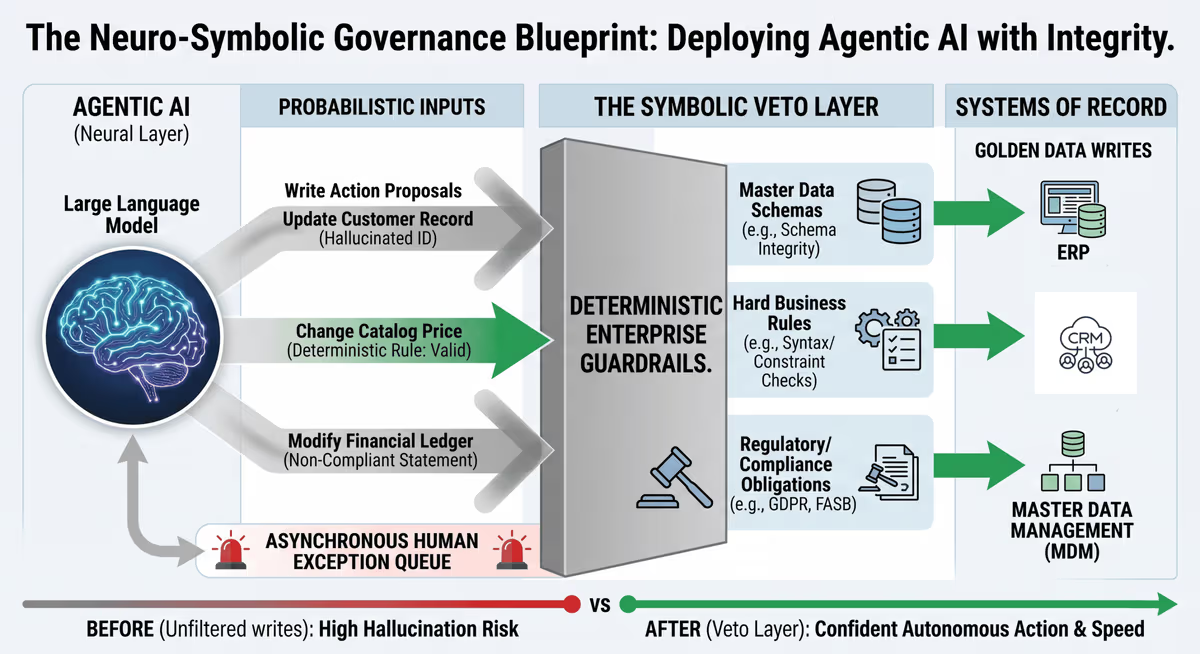
A neuro-symbolic architecture pairs the creative, contextual capabilities of deep learning with the absolute certainty of traditional, rules-based programming.
- The Neural Layer (The AI Agent): Handles pattern recognition, multi-step reasoning, unstructured data processing, and generating action proposals.
- The Symbolic Layer (The Gateway): A deterministic gatekeeper that enforces immutable business logic, data schemas, and regulatory constraints before a write command executes.
For example, an AI customer service agent attempts to update a corporate account record using a tax ID that matches an existing customer. The symbolic layer instantly triggers a veto based on a hard business rule: no duplicate tax IDs allowed. The transaction is blocked before it reaches the core database, protecting data integrity while allowing the exception to be handled gracefully.
Real-World Impact: Velocity with Integrity
In controlled pilot environments across multi-domain data landscapes, this dual-layer architecture demonstrated that speed and safety are not mutually exclusive. These pilot benchmarks suggest that operational integrity and velocity can improve simultaneously.
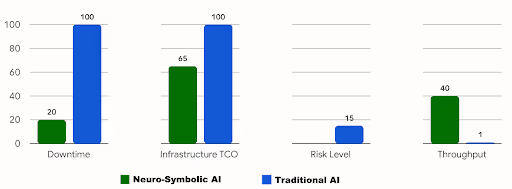
While results will vary across enterprise architectures and use cases, internal testing in reference implementations indicates that a symbolic veto layer can enable up to 40x higher transaction throughput and a 30 to 40% reduction in cloud infrastructure strain compared to traditional manual review processes.
- Improved Transaction Throughput: By offloading validation from the database layer to an in-memory symbolic gateway, reference implementations demonstrated up to 40x higher transaction throughput compared to traditional locking mechanisms.
- Reduced Cloud Infrastructure Strain: Filtering invalid or redundant write requests before they reach the database reduces unnecessary write operations, lowering cloud data debt and reducing overall total cost of ownership (TCO) by 30% to 40% in reference implementations.
- Greater System Resilience: By routing failed writes to an exception queue rather than terminating the agent’s session, organizations can maintain continuous operations while reducing deployment-related data remediation downtime by up to 80%.
The CDO/CDAIO’s Role
For the CDO and CDAIO, the rise of agentic AI represents a shift from data stewardship to algorithmic accountability. Leadership requires aligning technical guardrails, such as the symbolic veto layer, with organizational risk management frameworks and broader data governance policies. This involves defining clear lines of responsibility for autonomous decisions and ensuring transparent reporting on agent performance. By aligning technical guardrails with enterprise governance, data leaders can ensure that technical integrity supports broader business accountability as autonomous systems become part of core business operations.
An Action Plan for CDAIOs
To prepare enterprise architecture for autonomous agents, CDOs and CDAIOs should consider a four-part roadmap:
- Map Agentic Write-Domains: Audit your AI roadmap to identify exactly where agents will require write access, including updating CRM fields, altering inventory levels, modifying vendor master data, or triggering financial postings. For each domain, classify the risk tier: what is the downstream consequence if the agent writes corrupted data? A mis-updated shipping address is recoverable; a corrupted vendor tax ID that propagates into a financial ledger is not.
- Decouple Rules from the Model: System prompts and guardrail models alone should not be relied upon to enforce hard enterprise rules. A sufficiently complex prompt or an unexpected input can cause any neural model to bypass soft instructions. Keep your data governance rules in a deterministic, code-based layer that the LLM cannot override, reason around, or hallucinate past. For example, a rule stating “no vendor record may be created without a validated DUNS number” should live as executable logic in the symbolic gateway, not as a sentence in a system prompt that the model interprets probabilistically.This deterministic code-based layer can be built using open-source tools or integrated seamlessly with existing enterprise policy engines, ensuring a vendor-neutral architecture.
- Establish Asynchronous Human Escalation: When the symbolic layer vetoes an agent’s proposed write, route the failed transaction to an asynchronous exception queue rather than crashing the agent’s session or forcing an immediate human review. This design allows thousands of routine automations to clear at millisecond speed. Human reviewers engage only with genuine edge cases, typically 1–3% of total agent actions in a well-calibrated deployment.
- Measure Integrity Alongside Velocity: Transition your AI KPIs away from “tokens per second” or raw task completion rates and begin tracking two new metrics: Veto Rate, the percentage of AI-proposed writes blocked by the symbolic gateway, and Downstream Data Corruption Incidence. A Veto Rate that is too high signals the model is routinely proposing non-compliant actions and needs retraining or prompt refinement; a Veto Rate that drops to near zero over time signals your rules are maturing and the agent is operating within well-defined boundaries.
The organizations that succeed in the agentic AI transformation will not be the companies that deploy the largest or most expensive neural models. They will be the organizations that can confidently let their AI act because they have built a deterministic governance layer as sophisticated as the intelligence itself.




 Elevate Your Personal Brand