What Is a Chief Data Officer in 2026? Many people working within the data industry are saying the same thing: the role of the Chief Data Officer (CDO) has changed – but how? CDO Magazine began an expert survey to find out. We recent...
2026 CDO Report: Meet the Modern Data Team New survey of VP & C-level data and AI leaders confirms what’s stalling AI transformation.
Generative + Agentic AI: Moving From Experimentation to Enterprise Scale Generative and agentic AI are making their way into enterprise production, bringing new questions for Chief Data Officers (CDOs) and other data and AI leaders responsible for making these technologies...
Digital Transformation
Free the Humans! Why the Next Digital Transformation Should Retire Your ERP and CRM
Lessons from three decades of digital transformations and the intent-based architecture that comes next

Written by: Maribeth Achterberg | CEO, Verity Digital Advisory, LLC
Updated 10:00 AM EDT, October 21, 2026

For thirty years, “digital transformation” has been the North Star of corporate strategy. I have lived through four eras of that transformation: the PC, web and enterprise integration, mobile-cloud-big-data, and today’s AI and intelligent automation. Each promised liberation. Each quietly deepened our dependence on transactional systems of record.
My hypothesis for every Chief Data Officer (CDO) and data leader is this: the fifth era will not add another system. It will eliminate the transactional layer. Humans will stop typing into forms. Voice-to-text AI and wearable IoT sensors will capture business events as they happen, while an agentic “AI Brain,” governed by an ontology and semantic layer, structures and governs that information in a unified data infrastructure. ERP and CRM will join dial-up modems and floppy disks in IT history.
This retirement happens in two stages. First, the interface disappears: no one logs into ERP or CRM to key in orders or update opportunities. Then, the applications retire as systems of record because agents generate the data and the governed data foundation becomes the record. What survives is the discipline those systems enforced: transaction integrity, auditability, and regulatory compliance, now owned by the enterprise rather than a vendor.
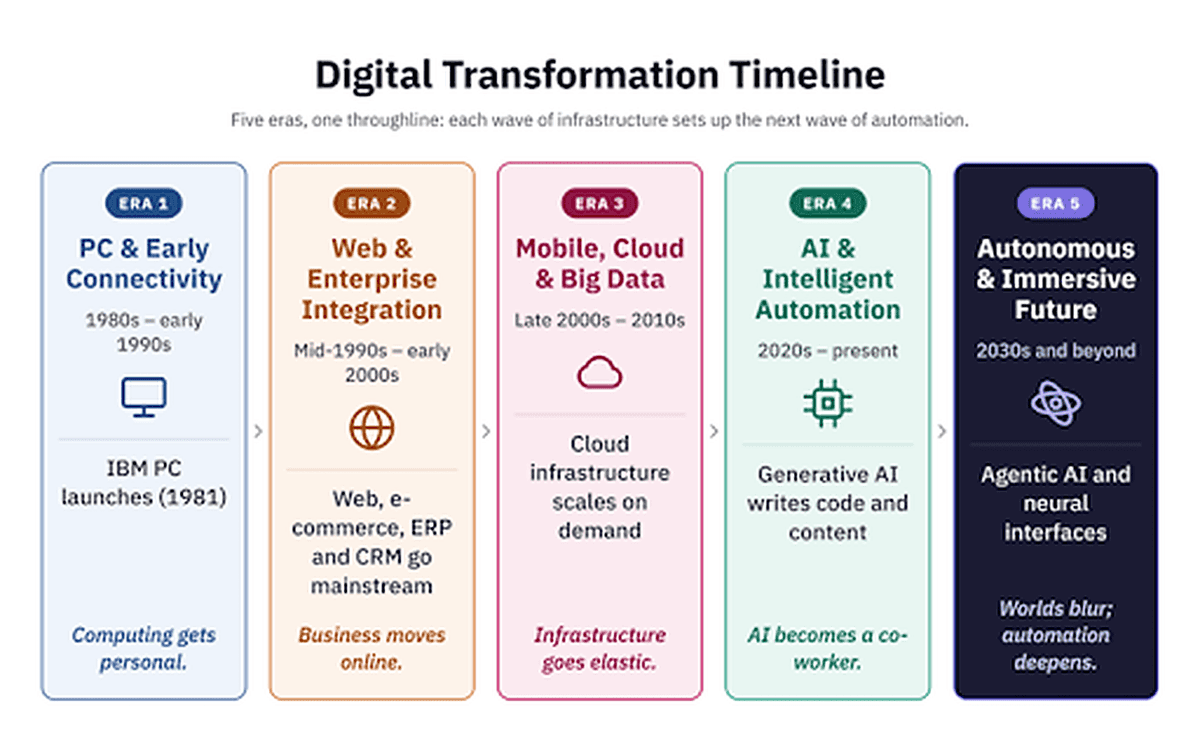
Figure 1: Four eras of digital transformation and a proposed fifth: from the PC era to the autonomous and immersive future.
Thirty Years, Four Eras, One Constant
Across the eras of digital transformation, one pattern persists: interfaces evolved from terminals to browsers, apps, and chat, while data architecture barely moved. From the first data warehouses in 1988 to today’s lakehouses, one assumption endured: people observe reality and then re-enter it into software.
Having worked through each era, I saw the pursuit of reliable financial information lead organizations to depend on software vendors and consultants as the “experts.” Yet when project budgets tightened, agreed implementation plans often stripped out data management first. The result remained the same: inadequate data architecture, siloed systems, and organizational resistance to change. From sales executives hiding cabinets full of paper files to leadership demanding custom fields in high-priced packaged software, I’ve witnessed decades of behavior that pushes us away from unified data, not toward it.
The Architecture Data Never Escaped
That legacy architecture still dominates the enterprise. Every function gets its own system: CRM for sales, ERP for finance and operations, warehouse management for logistics, HRIS for people. Each holds a fragmented data model and demands redundant entry, held together by fragile syncs and nightly batch jobs.
The result is familiar to every CDO: siloed data, missing context, weak governance, and competing versions of the truth. Worse, this architecture turns humans into middleware, translating what they already know into whatever form each system demands.
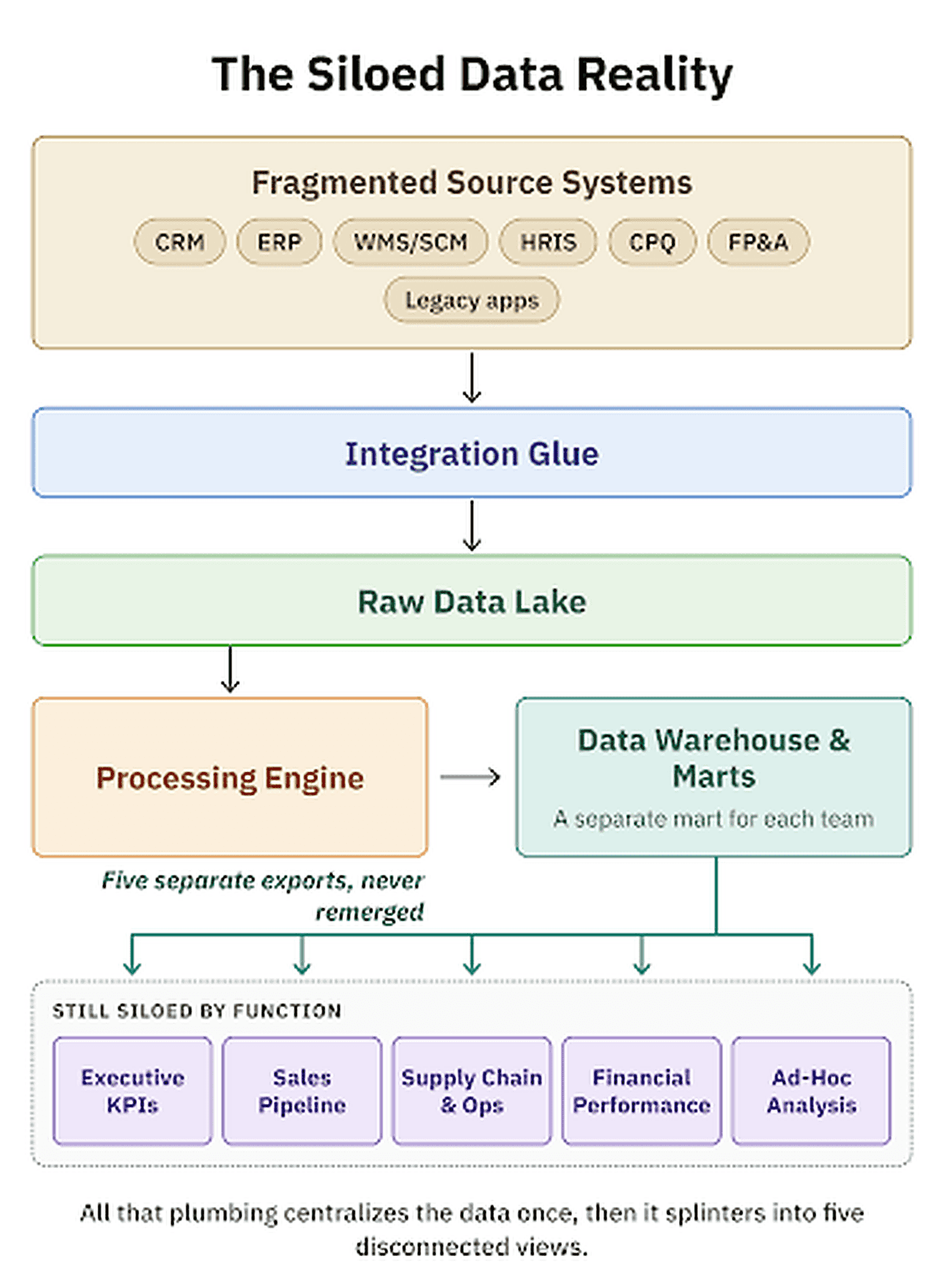
Figure 2: The siloed transactional reality — a system for every function, held together by integration “glue.”
The Bolt-On Trap: Mistakes Repeating
Many organizations believe they have entered the next era because they bolted an AI agent onto this stack. They have not. Automating over siloed, ungoverned data simply automates confusion. The thirty-year pattern repeats: vendors define architecture instead of enterprise leaders, applications take priority over data, responsibility is outsourced to integrators and SaaS providers, literacy is underfunded while fluency is expected, and risk governance lags.
From Forms to Intent: The Architecture That Replaces Transactional Systems
The fifth era requires a shift from a forms-based IT world to an intent-based AI architecture. Consider a field technician who finishes a delivery and simply says: “I dropped off 50 units at Client X, and they’re complaining about shipping damage on the last order.” Smart glasses, a lapel pin, or a smartwatch capture voice, visual context, and sensor data, while edge AI attaches location, time, and identity metadata.
The AI Brain extracts intent and generates structured payloads for an inventory update and a support ticket directly. Nobody logs into a CRM or ERP. The agent does not integrate with legacy software; it generates the data those systems used to capture, streaming it into a lakehouse medallion architecture:
- Bronze Layer: Preserves raw capture as immutable history for auditability and reprocessing
- Silver Layer: Validates entities against master data, matching “Client X” to a verified customer ID
- Operational Data Store (ODS): Maintains a low-latency current state for instant queries
- Gold Layer: Curates business metrics and feeds context back to the AI Brain for the next interaction
What Replaces the System of Record
Retiring these applications does not retire their obligations. Agents absorb the workflow; the controls move into the governance plane above:
- Transaction integrity: Agents propose events; they do not commit them unchecked. Validation against master data and policy, including approvals and segregation of duties, happens before anything reaches the ODS
- Auditability: The Bronze layer keeps every event as immutable history. Lineage logs record each agent’s identity, sources, and applied policy, showing how an entry was created, not just the keystroke
- Regulatory compliance: Retention, data residency, and SOX controls are enforced as policy in the governance plane, which produces an authoritative book of record on demand
The shift is not to an environment with no records, but from applications that people operate to a governed data foundation that agents operate with humans supervising the exceptions.
Ontology Is the New Application
None of this works without a data catalog and governance plane anchored by an ontology and semantic layer that defines what the enterprise means by its own words. When the AI Brain hears “client,” “unit,” or “damage,” the semantic layer identifies the entities, hierarchies, and policies that apply, while the governance plane tracks lineage, security, and schema evolution.
This inverts the CDO’s role. In the transactional era, business meaning was buried in vendor-owned code. In the intent-based era, it lives in a semantic layer owned by the enterprise data organization, elevating governance into the core operating system.
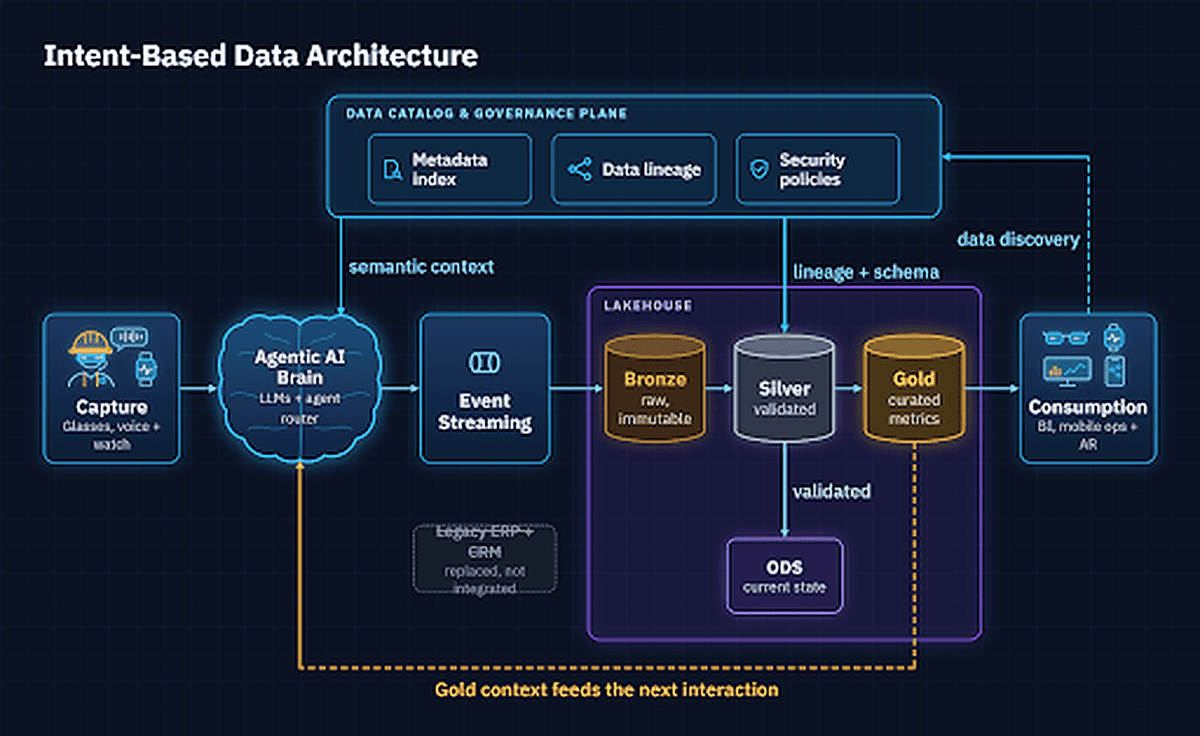
Figure 3: The data catalog and governance plane — semantic context, lineage, and security policies governing the AI Brain.
Five Moves Data Leaders Can Make Today
This future will not arrive by procurement. It arrives through deliberate re-architecture, and the groundwork starts now:
- Build a community of practitioners and fund their literacy. Practitioners will emerge in every function. Set the standard through communities of practice and literacy programs at every level. Fluency never arrives without investment.
- Govern jointly with cybersecurity and enterprise architecture. Connect your Data Governance, AI, and Cybersecurity councils, and deliver data sovereignty and loss prevention as one capability.
- Architect around dataflows, not platforms. Design around how data moves, not which software holds it, to expose leakage, eliminate redundancy, and free capital by rationalizing the application stack.
- Make the data catalog a product. Invest in a semantic layer intuitive enough to attract data consumers with minimal friction.
- Imagine the future and price it. Build business cases showing how voice and augmented reality, freed from keyboard and monitor, deliver bottom-line value.
From Enterprise Shift to Societal Shift
What follows the elimination of transactional systems is bigger than an IT refresh. It is an economic shift requiring a massive redeployment of capital, freeing people from non-value-added work like manual month-end validation. Projections run from enterprise adoption in the late 2020s, through human-AI teams in the 2030s and 2040s, toward broad societal transformation. I expect a melding of IT and OT that enables mass robotics in the next decade.
The timeline may be debated; the direction should not be. Every prior era rewarded organizations that fixed their data foundations before the wave of change crested. The question is no longer whether the transactional layer will dissolve into voice, sensors, and agents, but whether your data is cataloged, governed, and semantically defined when it does.


 Elevate Your Personal Brand


