
What Is a Chief Data Officer in 2026? Many people working within the data industry are saying the same thing: the role of the Chief Data Officer (CDO) has changed – but how? CDO Magazine began an expert survey to find out. We recent...
Generative + Agentic AI: Moving From Experimentation to Enterprise Scale Generative and agentic AI are making their way into enterprise production, bringing new questions for Chief Data Officers (CDOs) and other data and AI leaders responsible for making these technologies...
Webinar | The Agentic Mindset Shift: How to Onboard an Agentic Data Team Three sessions, real playbooks, proven results you can replicate.
Data Management
What AI Can’t Learn From Your Data

Written by: Brad Lindsey | Head of Enterprise Data, Blue Yonder
Updated 10:00 AM EDT, September 8, 2026

Recently, my team was tracing one of our executive metrics back to its source. What should have been a routine exercise turned into a useful reminder of where enterprise knowledge actually lives. The number was right, but the reasons it was right weren’t written down anywhere the data could show us. Getting to the correct figure depended on things like a month-end adjustment, a set of records treated as exceptions, and a rule about what to include that everyone close to the metric simply knew. None of that context sat in a system. It sat in the judgment of the people who worked with the number every day, and it traveled with them from meeting to meeting.
That is how institutional knowledge tends to work. The data tells you what a number is; the people tell you what it means. Experienced employees learn, over years, which numbers Finance considers official, when operational metrics diverge from financial ones, and which reports need a caveat before anyone acts on them. Much of that understanding was never captured anywhere, because it never had to be. The organization relied on people to fill the gap between what the data said and what it meant.
AI changes that equation, and it’s worth being precise about how.
The conversation around enterprise AI almost always begins with technology. Which models? Which copilots? How quickly can we automate? Those are fair questions, but they assume something more fundamental is already in place: that the organization has captured a consistent, explicit understanding of its own business in a form systems can use. Too often, it hasn’t. It has experienced employees instead.
AI removes the safety net those employees provide. An AI assistant cannot choose between two valid definitions of revenue unless someone has described the difference. It cannot infer that one customer hierarchy supports sales planning while another supports financial reporting. It cannot know that a metric requires a month-end adjustment simply because the people who have always known it have never had to say so out loud. Where an experienced analyst would silently apply the right context, an AI assistant applies whatever context it was given — and if it was given none, it may invent one.
In other words, AI doesn’t replace institutional knowledge. It depends on organizations making that knowledge explicit, and it tends to expose the gap loudly, in front of the people who most want to trust the answer. That single shift reorders the way I think about enterprise data strategy.
Managing the Meaning Behind the Data
For years, data organizations have focused on managing data as an asset: building platforms, integrating information, improving quality, expanding access. Those capabilities remain essential. But they were built for a consumer who could supply their own context. That consumer has changed. Increasingly, enterprise value comes not from managing the data itself, but from managing the meaning behind it — the definitions, ownership, assumptions, and exceptions that explain how the business actually operates.
This is also where a technology like the semantic layer earns a second look, not as the point, but as one of the few practical instruments for the job.
We usually describe semantic layers in technical terms: metrics, hierarchies, calculation logic. Those capabilities matter, but they are implementation details. The more consequential thing a semantic layer does is capture how the business has agreed to interpret itself — what counts as a customer, when revenue is recognized, which hierarchy governs which decision — and hold that agreement in a governed form rather than in individual memory.
That reframes it from a piece of reporting technology into a piece of organizational design: a place to write down the definitions the business has always depended on but rarely documented.
The layer itself isn’t the achievement, but it is the mechanism. The achievement is that the knowledge finally exists somewhere other than in people’s heads, in a form the business can inspect and stand behind.
How Data Leaders Can Capture Institutional Knowledge
The practical question for data leaders is where to start. The goal is not to document everything employees know. It is to identify the knowledge a person currently has to supply for data to be interpreted correctly. Start where ambiguity carries consequence: the metrics executives use to run the business, definitions that differ across functions, recurring exceptions analysts routinely apply, and decision rules that materially change an answer.
The people who know those rules today — the business owners, finance partners, operational leaders, and the analysts closest to the data — need to define them together, while data teams provide the structure to make them governed and machine-readable. And that knowledge needs an owner. Definitions should be treated like other critical enterprise assets: assigned to accountable business owners, reviewed when processes change, and periodically validated against how the business actually operates.
The useful mental model here isn’t a maturity staircase you climb and leave behind. It’s a layer everything has to pass through.
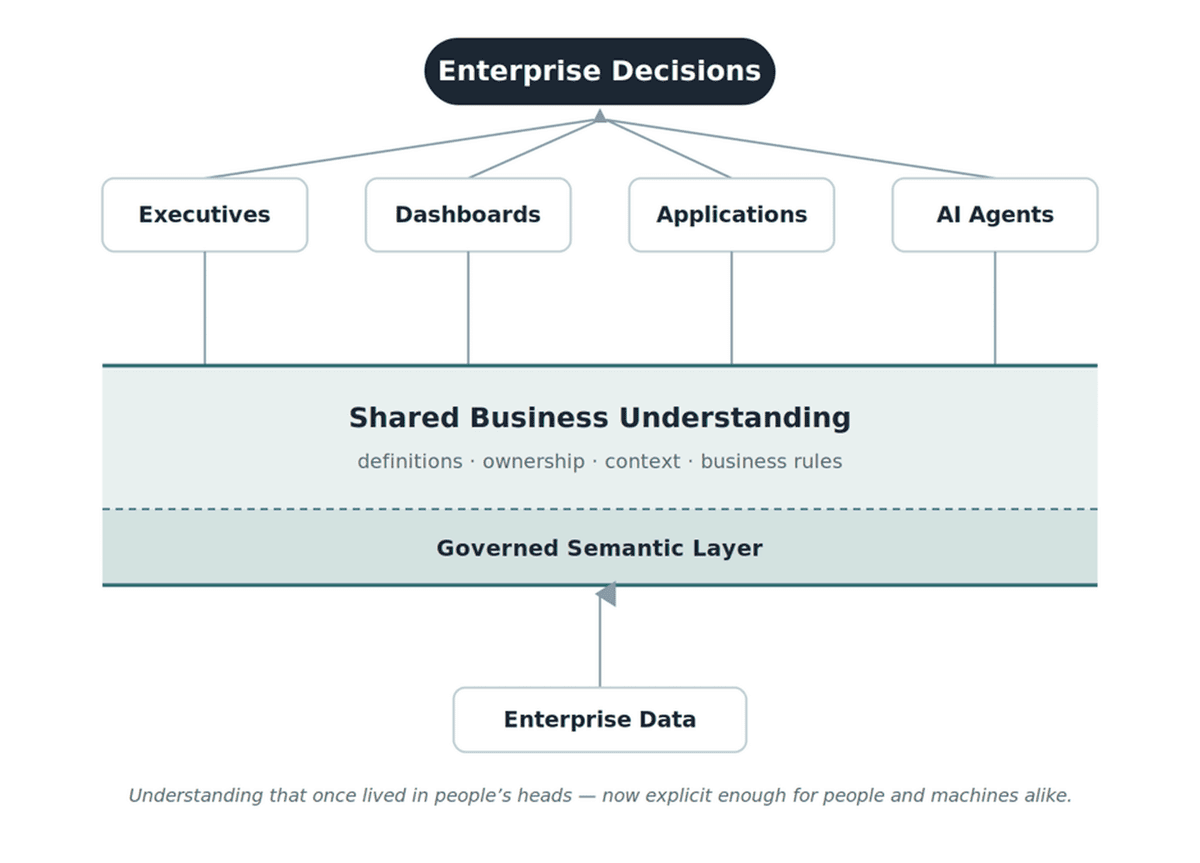
Figure 1: A governed semantic layer makes shared business understanding available to both people and AI systems.
The diagram highlights an important shift. The decisions at the top aren’t produced by the AI systems or the raw data on their own. They rest on the shared understanding in the middle, and anything that reaches past it, straight from data to output, is operating on meaning no one agreed to.
Raising the Standard for Enterprise Data
Seen through this lens, the familiar capabilities take on a different weight. Governance extends beyond compliance; it also becomes the deliberate act of deciding and documenting what the business means. Data quality is no longer just the hunt for invalid values; it is ensuring the definitions themselves hold. Semantic models are no longer a reporting technology; they are where the enterprise’s shared understanding is written down and enforced. Together, these capabilities do one job: they make the way a company understands itself explicit enough that a person and a machine reach for the same meaning.
This is why I believe AI is raising the standard for enterprise data rather than redefining it. The objective has not changed: help the business make better decisions with information it can trust. AI simply requires that trust extend beyond people. It requires us to express the business clearly enough that systems can understand it as reliably as our most experienced employees always have.
The organizations that get the most from AI will invest in new models, and they should. But the models — which are widely available — aren’t where the advantage lives. It belongs to the companies willing to do the slower work of moving their understanding of the business out of individual memory and into the enterprise itself, where it can be examined, questioned, and trusted without depending on who happens to be in the room.
That is what it means for a company to document how it thinks. It was always good discipline, but AI is what now makes it unavoidable.


 Elevate Your Personal Brand