
What Is a Chief Data Officer in 2026? Many people working within the data industry are saying the same thing: the role of the Chief Data Officer (CDO) has changed – but how? CDO Magazine began an expert survey to find out. We recent...
2026 CDO Report: Meet the Modern Data Team New survey of VP & C-level data and AI leaders confirms what’s stalling AI transformation.
Generative + Agentic AI: Moving From Experimentation to Enterprise Scale Generative and agentic AI are making their way into enterprise production, bringing new questions for Chief Data Officers (CDOs) and other data and AI leaders responsible for making these technologies...
Data Management
The Product Mindset Gap: 5 Principles for Transforming Data Projects Into Data Products

Written by: Jenna Zhou | Distinguished Engineer, Dell
Updated 10:00 AM EDT, October 20, 2026

As organizations accelerate investments in GenAI and agentic AI, many Chief Data Officers (CDOs) are discovering a fundamental limitation in their data strategies: traditional data projects were never designed to support continuously evolving, AI-driven operating models.
The challenge is no longer simply collecting and managing data. It is ensuring that data can be continuously consumed, governed, improved, and reused across business functions, applications, AI models, and autonomous agents. Yet many first-generation Data as a Product (DaaP) initiatives fall short of this goal, merely repackaging existing datasets without changing how value is created or sustained.
In my experience, the failure of many DaaP initiatives is not primarily a technology problem. I have repeatedly seen organizations invest in modern data platforms, catalogs, and governance capabilities, yet struggle to achieve adoption because they are still executing data projects rather than treating data as a product from the outset, with clearly defined users, measurable outcomes, accountable ownership, and ongoing enhancement based on feedback.
The difference between a data project and a data product is not the data itself. It is the operating model used to create and sustain value.
Drawing on lessons learned across enterprise data transformations, five principles consistently distinguish successful DaaP implementations:
- Be consumption and value driven
- Apply product thinking and work backward from user needs
- Design for interoperability, reusability, and scalability
- Establish clear ownership, accountability, and governance
- Embrace agile delivery and continuous improvement
Together, these principles provide a foundation for building trusted data products capable of supporting the growing demands of AI-powered enterprises.
From Data Projects to Data Products
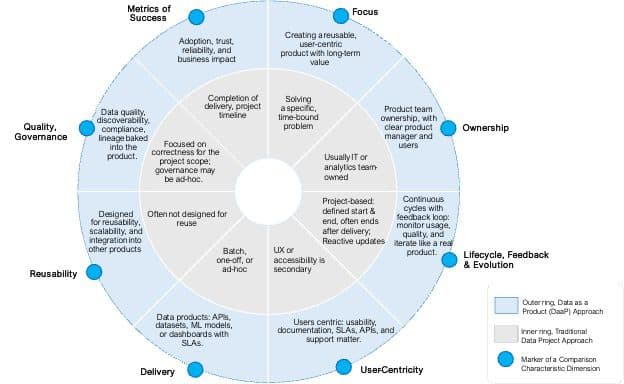
Traditional data initiatives typically operate as projects: requirements are gathered, outputs are delivered, and ownership often fades once implementation is complete. While effective for point-in-time needs, this approach frequently reinforces silos and limits long-term business value.
DaaP represents a fundamentally different approach. Rather than treating data as a project deliverable, DaaP manages data as a product throughout its lifecycle, with clear ownership, continuous improvement, and a relentless focus on delivering business outcomes.
At its core, the traditional data project approach optimizes for delivery. DaaP optimizes adoption, trust, reuse, and sustained value.
This distinction is becoming increasingly important as organizations deploy AI at scale. AI systems require trusted, discoverable, and reusable data assets. A project mindset can deliver a dataset. A product mindset creates a foundation for continuous AI-driven innovation.
Principle 1: Be Consumption and Value Driven
Data products should be designed around consumers rather than source systems.
Consumers may include business users, applications, AI models, data scientists, or autonomous agents. A Customer 360 product, for example, may simultaneously support marketing teams, customer service operations, recommendation engines, and AI copilots. A governed supplier product may become a foundational asset for autonomous procurement workflows.
One of the most common mistakes in DaaP initiatives is assuming that every dataset can simply be relabeled as a data product.
It cannot.
Without defined consumers, measurable outcomes, clear ownership, and lifecycle management, a dataset remains a data artifact rather than a product.
The true measure of a data product is not the data it contains. It is the value it creates. Organizations should therefore prioritize products based on business impact, adoption, and reuse rather than purely technical considerations.
Principle 2: Apply Product Thinking and Work Backward From User Needs
Many data products fail because they are built before demand is validated. This is one of the largest gaps between project thinking and product thinking.
Project teams often start by asking, “What data can we publish?” Product teams start by asking, “What problem are we solving, and who will use it?”
Consider a finance organization that creates dozens of financial data products for a marketplace. The products are technically sound, well governed, and fully cataloged. Yet adoption remains low because consumer demand was never validated. Teams continue using locally managed spreadsheets and shadow datasets because the published products do not solve their most pressing needs.
The issue is not engineering quality. It is a lack of product-market fit.
Successful organizations work backward from user needs. They validate demand early through metadata, schemas, sample datasets, mock interfaces, or marketplace listings before investing heavily in development. This approach improves adoption, reduces wasted investment, and increases the likelihood of measurable business outcomes.
Principle 3: Design for Interoperability, Reusability, and Scalability
Enterprise value emerges when data products become reusable building blocks rather than isolated solutions.
To achieve this, organizations must intentionally design for:
- Interoperability through common information models, business vocabulary, and ontologies
- Reusability through modular products that can support multiple consumers and use cases
- Scalability through standardized contracts, governance, and delivery mechanisms
For example, a trusted product hierarchy can be consumed across finance, supply chain, sales, and AI applications. A customer product with standardized identifiers can support customer service workflows, analytics platforms, recommendation systems, and agentic AI environments.
Achieving reuse in practice can be more difficult than it appears. Business teams often face unique requirements, tight delivery timelines, or established ways of working that encourage creating new datasets rather than adopting existing ones. In many cases, teams are measured on local outcomes rather than enterprise-wide reuse, creating incentives that unintentionally favor duplication.
Successful organizations address these challenges by making reusable products easy to discover, easy to consume, and valuable enough that adoption becomes the preferred path rather than an additional obligation. They also provide incentives that reward both producers and consumers for reusability.
Principle 4: Establish Clear Ownership, Accountability, and Governance
Each product should have a designated owner accountable for governance, consumer adoption, lifecycle management, and value realization. Products should be aligned with business domains and have clear decision rights and escalation paths.
Ownership should extend beyond publication and be tied to measurable outcomes. Effective product owners monitor adoption, gather consumer feedback, prioritize enhancements, and track metrics such as usage, satisfaction, data quality, and business impact. By combining decision-making authority with accountability for results, organizations can ensure data products remain relevant and valuable throughout their lifecycle.
Governance remains critically important. Data products increasingly support analytical, predictive, and generative AI systems. Trusted ownership, transparent lineage, and strong stewardship help ensure reliable and responsible outcomes.
However, governance should not merely ask, “Is this product compliant?” It should also ask, “Is this product creating value?”
Principle 5: Embrace Agile Delivery and Continuous Improvement
Unlike projects, products are never truly finished.
Sustained value requires continuous improvement informed by consumer feedback, usage analytics, and evolving business needs. Usage telemetry, product analytics, and user engagement metrics should help guide enhancement priorities and investment decisions. GenAI can further assist by identifying consumer pain points, analyzing usage patterns, and recommending improvements.
This principle becomes particularly important as organizations move toward AI-driven operating models. Autonomous agents increasingly discover, interpret, and consume data products with limited human intervention. As a result, quality, semantic consistency, observability, and reliability become even more critical.
Continuous improvement should also extend beyond enhancement. Mature product organizations actively manage the full lifecycle of their products, including adoption monitoring, evolution, consolidation, and eventual retirement when products no longer deliver value. Decisions should be informed by metrics such as adoption, consumer satisfaction, business impact, data quality, and maintenance costs. Together, these indicators help determine whether a product should be enhanced, consolidated, or retired.
The objective is not simply to keep products operational. It is to keep them relevant.
Looking Ahead
Data as a Product (DaaP) represents a new operating model: a shift from delivering outputs to creating and sustaining value.
As organizations accelerate toward AI-enabled and agent-driven operating models, the distinction between data projects and data products becomes increasingly important. Technology platforms, catalogs, marketplaces, and governance frameworks are necessary, but they are not sufficient.
For CDOs, the challenge is not simply managing data assets. It is creating the conditions for data products to succeed through clear ownership, aligned incentives, and a relentless focus on business value. In the age of AI, this means building a product culture that turns data into a continuously compounding source of business value.



 Elevate Your Personal Brand


