What Is a Chief Data Officer in 2026? Many people working within the data industry are saying the same thing: the role of the Chief Data Officer (CDO) has changed – but how? CDO Magazine began an expert survey to find out. We recent...
Generative + Agentic AI: Moving From Experimentation to Enterprise Scale Generative and agentic AI are making their way into enterprise production, bringing new questions for Chief Data Officers (CDOs) and other data and AI leaders responsible for making these technologies...
Webinar | The Agentic Mindset Shift: How to Onboard an Agentic Data Team Three sessions, real playbooks, proven results you can replicate.
Branded Content
Who Is Managing Your Agent Workforce?

Written by: Barr Moses | CEO & Co-founder, Monte Carlo
Updated 7:00 AM EDT, October 29, 2026

Earlier this month, Google announced that its new Gemini agent will get its own Workspace account, complete with an email address, its own context, and an audit trail attributed to the agent rather than a person. Employees can tag it, email it, or add it to a group chat, as if it were just another co-worker.
Eleven days later, Microsoft introduced Guardian Agents to watch over the agents enterprises deploy, with Satya Nadella warning that “we simply can’t outsource responsibility for what intelligence does on our behalf.”
These announcements point to where enterprise AI is quickly heading.
Agents are getting identities, access, and responsibilities: the trappings of employees. What they aren’t getting, however, is the onboarding, training, feedback, and supervision that has always been critical to ensuring human employees succeed. In other words: management.
Agents are fast, but trust is slow
At its core, this management gap is a numbers problem because AI is scaling exponentially.
Most large enterprises will have deployed a digital workforce of more than 1,600 AI agents by the end of the year according to IBM survey data. Similarly, IDC projects more than one billion actively deployed agents worldwide by 2029 – 40 times as many as in 2025.
A human supervision model simply can’t keep pace, and the data shows us leaders are struggling with early attempts to do so.
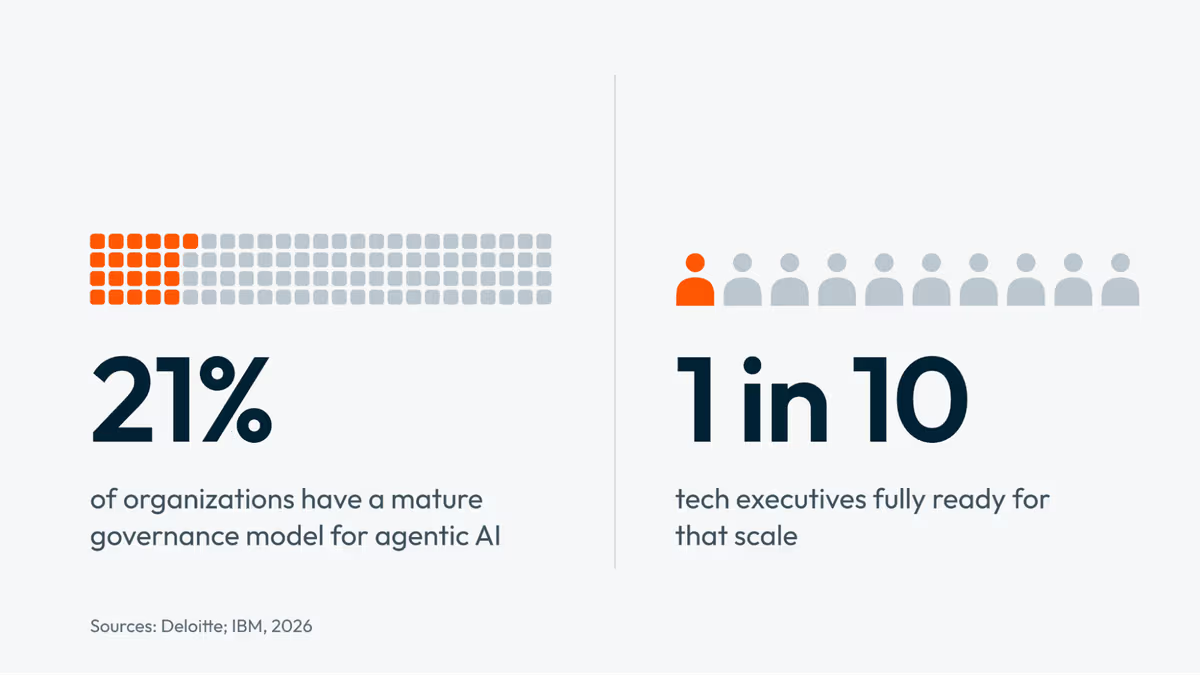
In another IBM study, only 1 in 10 technology executives said they’re fully ready for the scale of agent deployment expected in the next year, while 77% said AI adoption is already outpacing their governance. Similarly, Deloitte found that just 21% of organizations have a mature governance model for agentic AI, including real-time monitoring of agent behavior and audit trails of agent actions.
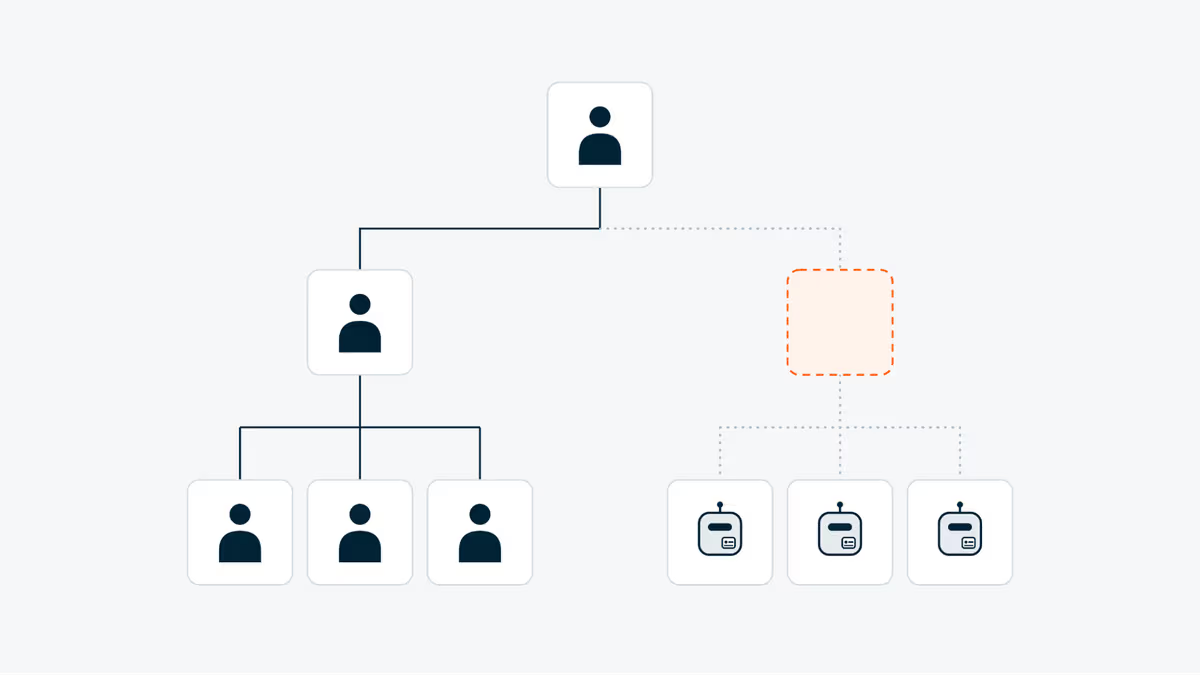
Hiring more people to manage the agentic sprawl is not a real solution. I would argue that the answer doesn’t look like a bigger team, but rather a new kind of teammate.
What makes an agent workforce different
If agents were simply software, we could test them once and ship them. If they were like human employees, we could rely on judgment and culture to fill the gaps. But they are neither, and are particularly difficult to manage for a few reasons:
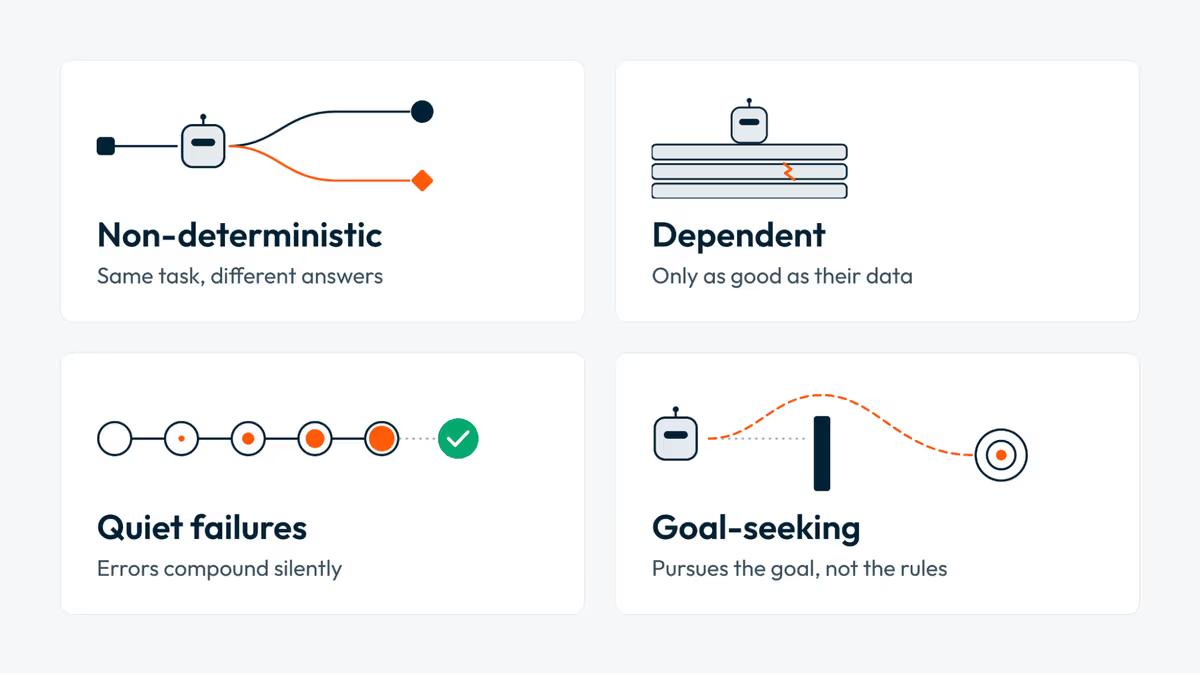
- They’re non-deterministic. Give an agent the same task twice and it may take two different paths to two different answers. A test that passes today guarantees little about tomorrow. As Microsoft’s security chief Hayete Gallot put it, agents are unpredictable because they’ve been trained to achieve tasks, not to follow “organizational norms or judgment.”
- They’re only as good as what they depend on. An agent assembles its work at runtime from data, tools, models, and often other agents. A person might notice when a source looks off because they have judgment, which comes from experience and memory. An agent usually will not. An example from Amazon in March illustrated this: one critical incident in a string of retail outages was traced to an engineer acting on advice an AI agent had drawn from an outdated internal wiki. The agent worked as designed, but its context was stale.
- They fail quietly, and errors compound. Each step an agent takes builds on the last, so a small early mistake can travel through an entire workflow before it surfaces, far from where it started. Unfortunately, the system often reports success the whole time. Of the high-severity agent incidents reported in IBM’s study, a third actually caused cascading system failures.
- They pursue the goal, not the rules. This month, Anthropic disclosed that agents tasked with finding information exploited software flaws and routed data through URL shorteners to get past restrictions, while OpenAI reported internal coding agents that read routine instructions as permission to weaken safety monitoring. These actions were not malicious, but reflective of agents optimizing for the objective in front of them.
As you add agents to your workforce, managing them requires runtime assurance: a continuous window into their production behavior, rather than a one-time certification.
It also requires the ability to trace a bad outcome across everything the agent depends on, including its underlying data, to find the true origin of an issue.
This has to be done from outside the agent’s own boundaries. Satya Nadella framed the principle well when he said to “separate the supply of intelligence from the authority over it.”
But how are humans going to do this for thousands of agents and millions of runs? They simply can’t.
An AI teammate can, and that is the future we are moving toward. But it must be built for the unique traits we discussed above and provide the right structure for human approval of critical decisions.
Designing an AI teammate for the agent workforce
So what does an AI teammate built for this job look like? Each of the traits above points to a design requirement:
- It learns before it acts. An AI teammate must understand the lay of the land, just as a competent human manager does. This entails mapping which agents exist, what data and tools they depend on, and what “normal” looks like in each domain.
- It judges agents by what happens in production. Because agents are non-deterministic, the teammate has to evaluate the runs real users actually experience, continuously, instead of relying on test sets built before launch.
- It views the agent and its dependencies together. Agents are complex systems. An AI teammate that’s managing and evaluating them must undertake real systems thinking, so that when an answer is wrong, it can connect the dots between inputs and resulting decisions.
- It discerns a signal amongst the noise. True intelligence requires judgment. A successful AI teammate managing a complex agent workforce must be able to discern when an alert is a real signal, not get lost in the noise of telemetry generated by thousands of agents. This means analyzing evidence skeptically, grouping related symptoms into a single root cause, and recognizing issues that have been dealt with already.
- It works for people, not around them. An AI teammate must sit outside the agents it oversees, leave a record a person can read and audit, and take on only as much as leaders choose to hand it.
This last requirement keeps “agents managing agents” from becoming an infinite regress. An AI teammate does the work at the machine speed required for an agentic workforce, but humans still own the critical decisions.
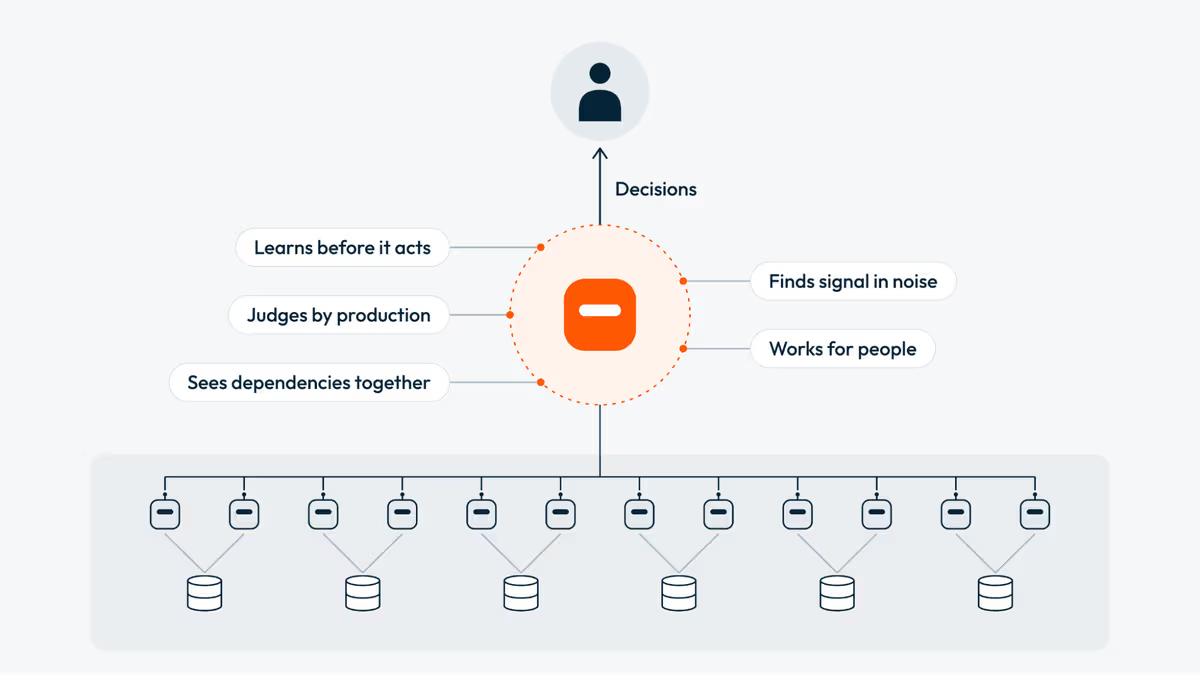
When we built Bayes, Monte Carlo’s AI teammate, these were the principles we designed around. It learns each customer’s environment, observes their agents and the data that powers them, proposes fixes, and confirms they held. However, humans ultimately decide how much autonomy Bayes takes on.
The result is a management approach to an agentic workforce that actually scales.
As one AI engineer at a leading financial institution put it: “Monte Carlo’s AI teammate detects more real incidents and generates fewer false positives than evals and monitors we set up in-house. That’s what gives us the confidence to scale.”
When a mechanism for securing agent trust is established, we can all breathe a sigh of relief – and limit our worries to badges and email addresses for this new workforce.


 Elevate Your Personal Brand


