
Leadership Summit – Chicago – Renaissance Chicago Downtown Hotel – September 17, 2026 Join top AI and Data leaders in Chicago to explore the strategies, governance, and innovations driving enterprise performance. Connect, learn, and gain actionable insights — reserve your seat today.
Webinar | The Multiplier Effect: How Top Data Leaders Translate Infrastructure into Business Impact Hear directly from leading data executives as they share how they are navigating data strategy, AI investment, and business value in the AI era.
Nominate Now | Top 30 Retail Data Changemakers 2026 Nominate for the Top 30 Retail Changemakers 2026, our annual recognition honoring visionary leaders who are redefining the retail landscape through data, AI, and analytics.
Branded Content
Understanding the ROI of Data Adoption Through a Data Product Marketplace

Written by: Franck Carassus | Chief Sales Officer and Co-Founder at Huwise
Updated 8:00 AM EDT, September 14, 2026
The latest Gartner Hype Cycle for Data, Analytics and AI Leaders lists over 40 different solution areas, each of which covers multiple tools and capabilities. This shows the challenge that Chief Data Officers (CDOs) face—they have an enormous (and growing) range of technology options that they can invest in. Selecting those that will deliver real business value and ROI is critical.
By making data easily discoverable and driving adoption by business employees and AI agents, data product marketplaces deliver this value. But what ROI do they actually provide? To find out, Huwise commissioned Forrester Consulting to conduct a Total Economic Impact™ (TEI) study on the financial benefits its data product marketplace delivers. The headline results are payback in six months, 474% ROI, and $6.5 million in net benefits over three years for a 10,000-employee company. This article drills down to explain the figures behind the headlines and to help CDOs understand the impact that a data product marketplace can have within their own organization.
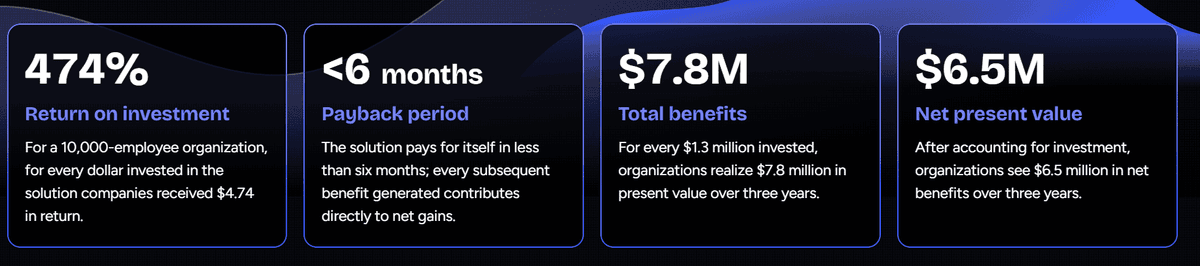
Headline findings of Forrester Consulting/Huwise Total Economic Impact study
Learn how data product marketplaces can scale data products and agentic AI at our executive roundtable featuring Forrester Consulting analysts and Huwise customer Workday.
The 4 Key Challenges to Data Sharing
In the past, data was used locally, in the departments where it was generated, or was managed reactively to meet governance and compliance objectives. CDOs now understand the importance of increasing and scaling data consumption across the business. However, four issues hold them back:
Complex Data Stacks
Over time, as data management has expanded, so has the number of solutions deployed in an organization’s data stack. Tool functionality often overlaps, and complexity leads to increased fragmentation, silos, and inefficiency. Data teams spend their time connecting and managing tools, rather than focusing on making more data available across the business.
Lack of Business Trust in Data
To use data confidently, business users need to understand what it covers and trust that it is high quality and the right fit for their needs. However, in many organizations, that trust simply isn’t there. Data is poorly described, and there is no single, consistent source of metrics, definitions, or documentation across the organization. For example, how sales describes a “customer” is different from how the finance team does. The result is that users either stick to their own, limited, departmental data or request reports from IT, which adds to workloads.
Inefficient Data Processes
Linked to the complexity of data stacks and the sheer volume of data now available, data analysts and teams spend their time reactively managing and reconciling data, rather than proactively delivering insights. This dramatically reduces their productivity and means that they are seen as a cost center, rather than a department that delivers business value and innovation.
IT Bottlenecks Around Data Access
If business teams either cannot access the right data or don’t trust the information they find, they turn to IT to get answers. Business requests for data pile up, adding to IT workloads, creating bottlenecks, lengthening time to insight, and limiting agility. IT teams spend their time responding to requests, rather than on more strategic activities.
What Is a Data Product Marketplace?
Data product marketplaces are designed to overcome these four issues. Rated by Gartner as “essential” for CDOs looking to increase value and demonstrate ROI, data marketplaces are a centralized, self-service space for publishing, consuming, and collaborating around data, especially data products. They aim to make accessing and consuming data as simple as buying a product online from an e-commerce store. Consequently, Huwise’s data product marketplace is built around a seamless, intuitive e-commerce-style interface, backed by robust security and governance to protect data. This enables everyone (humans and AI agents) to easily discover, trust, and consume the right data for their roles. You don’t need technical skills to consume data, while data owners and CDOs are able to effectively share their data with the right users.
How the Forrester Total Economic Impact™ (TEI) Methodology Works
Forrester’s TEI methodology aims to demonstrate the tangible value of business and technology initiatives to both senior management and other key stakeholders. It translates benefits into clear financial metrics that show ROI and payback times. For Huwise, Forrester interviewed four customers from the banking & finance, insurance, technology, and energy & utilities sectors. These findings were aggregated and combined into a single composite organization with 10,000 global employees, with analysis highlighting the quantifiable business benefits received alongside tangible, yet harder-to-measure improvements.
Breaking the benefits down by audience
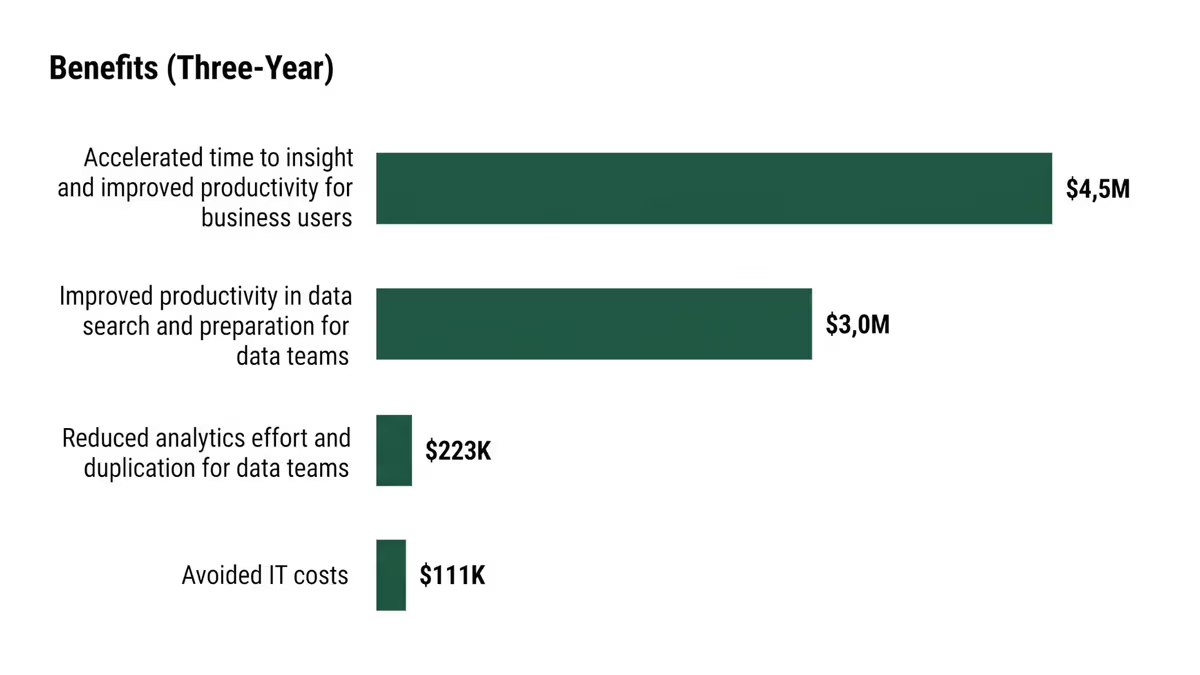
Breaking down the financial benefits of a Huwise data product marketplace
The TEI demonstrates quantifiable benefits for three groups – CDOs & data teams, business users, and IT departments.
Benefits for the CDO and Data Teams
Data teams are under pressure to deliver value, yet spend too much of their time on reactive or duplicated data preparation and management activities. Using Huwise simplifies this process:
- It reduces the time taken to prepare data by 50%, saving 3 days per month, per person. This equates to $3.0 million in savings over three years.
- Duplicated work is cut by a factor of four by providing a single source of data, available to all. This saves 10 days per year, per data expert, saving $223,000.
- By finally freeing data from solution silos, it increases value from existing tech investments.
- It enables agentic AI deployments through access to reliable, AI-ready, and contextualized information.
- These time savings can be applied to more strategic activities, further increasing ROI and demonstrating value for CDOs.
IT Teams
Rather than focusing on more strategic work, IT teams currently spend too much of their time responding to user requests for data. Huwise removes this overhead:
- Users can access data independently through self-service, without submitting requests to IT, saving 720 hours per year.
- Functionality within Huwise enables IT departments to consolidate or retire other tools, cutting license costs by 50%.
- Together, this leads to an overall saving of $111,000 over three years.
- As a SaaS-native platform, Huwise reduces long-term operational costs and the resources required compared to in-house solutions.
The Business
Business users waste large amounts of time looking for the right data to help do their jobs—and even if they do find it, they don’t trust that it is accurate or reliable. Huwise democratizes access to data:
- AI-powered discovery reduces data search time for business users by 50%, delivering $4.5 million in productivity savings.
- It increases trust in data and builds a data-driven culture through self-service and ease of use.
- A single, consistent source of information boosts organizational agility and decision-making.
Quantifying the Total Benefits
Based on its analysis, Forrester calculates that these benefits add up to $7.8 million over three years for a 10,000-employee company. After subtracting investment costs of $1.3 million, Huwise therefore generates $6.5 million in net benefits, with payback achieved in just six months.
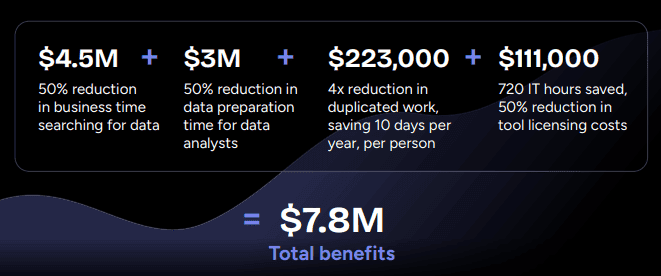
The total financial benefits of a Huwise data product marketplace
Putting Data at the Heart of the Business
As Forrester’s report shows, data marketplaces drive data adoption at scale. Business teams actively use data to make decisions and collaborate through self-service, helping build a vibrant data culture. Data and IT workloads are reduced, enabling teams to work on higher-value activities. Contextualized data provides a foundation for agentic AI, while CDOs can demonstrate how they support business objectives. Overall, this creates a more agile, innovative, and productive organization with data at its heart.

Find out more about the business impact of data product marketplaces in our 13 October webinar, featuring:
- Market trends analysis: Jayesh Chaurasia, Forrester Analyst, will break down the key trends in data product adoption and AI delivery
- Key TEI results: Jan Sythoff, Forrester TEI Consultant, will share the methodology and quantified results of the study
- Customer feedback: Joe DosSantos of Huwise customer Workday will share first-hand experience on the challenges faced before adoption and the real day-to-day impact on data and business teams




 Elevate Your Personal Brand