
2026 CDO Report: Meet the Modern Data Team New survey of VP & C-level data and AI leaders confirms what’s stalling AI transformation.
Webinar | The 2026 Data & AI Compensation Benchmark: What Executive Talent Is Really Worth From compensation benchmarks to organizational influence, uncover what the market reveals about the evolving data and AI executive role.
Understanding the ROI of Data Adoption Through a Data Product Marketplace The latest Gartner Hype Cycle for Data, Analytics and AI Leaders lists over 40 different solution areas, each of which covers multiple tools and capabilities. This shows the challenge that Chief Data...
Branded Content
The 3 Shifts Moving AI From Data Access to Contextual Intelligence

Written by: Ryan Trimberger | CEO and Co-Founder, 4Minds
Updated 8:00 AM EDT, August 10, 2026

Enterprise AI has reached an inflection point.
Over the past several years, organizations have invested heavily in large language models (LLMs), retrieval systems, and AI applications designed to improve productivity and automate work. Yet despite the excitement, many organizations continue to struggle to move AI initiatives beyond pilots and isolated use cases.
The gap between AI experimentation and measurable business impact is becoming increasingly clear. According to MIT NANDA research, 95% of generative AI pilots have failed to deliver measurable profit-and-loss impact. Gartner has also predicted that more than 40% of agentic AI projects may be canceled by the end of 2027 due to challenges scaling AI initiatives beyond initial experimentation.
The challenge is that most AI architectures were built to access information, not understand the business.
As organizations look to scale AI across the enterprise, three major shifts are emerging that will define the next generation of enterprise AI.
Shift #1: From data access to data readiness
The first wave of enterprise AI focused on connecting AI to data.
Unfortunately, data remains fragmented across applications, databases, documents, workflows, and operational systems. Before AI can create meaningful value, organizations must first make that information AI-ready.
This requires more than simply connecting systems. Data must be collected, transformed, organized, and enriched so that AI can use it effectively. For many organizations, this process consumes the majority of time, budget, and resources allocated to AI initiatives.
As a result, data readiness has become one of the most important prerequisites for AI success.
Organizations that can rapidly transform fragmented information into AI-ready data will be better positioned to scale AI initiatives across the business.
Shift #2: From information retrieval to contextual intelligence
Once data is AI-ready, a second challenge emerges.
AI can access information, but it still doesn’t understand how the business operates.
Customers, products, suppliers, policies, processes, and decisions are all connected through relationships that rarely exist within a single document or database. Employees understand these connections because they accumulate institutional knowledge over time.
Traditional AI systems do not.
Even advanced retrieval architectures can locate relevant information without understanding why it matters or how it connects to broader business objectives.
This is why many AI systems produce technically correct answers that fail to deliver meaningful business outcomes.
The next generation of AI requires a contextual intelligence layer that captures business relationships, organizational knowledge, and operational context. By connecting information across the enterprise, AI can move beyond retrieval and begin to reason more effectively about business decisions and actions.
Shift #3: From static models to continuous learning
Most organizations still approach AI models as static assets. Models are trained or fine-tuned, deployed into production, and periodically updated as needed.
The problem is that businesses never stop changing.
New products launch. Customer expectations evolve. Teams reorganize. Regulations shift. Market conditions change.
As the business evolves, static models gradually become less aligned with current reality.
The next generation of AI requires continuous learning. Models must be able to adapt as new information, relationships, and business conditions emerge. Rather than relying on periodic retraining cycles, AI should continuously refine its understanding of the business and improve over time.
This enables organizations to build custom AI models that remain aligned with the business, producing more accurate insights, recommendations, and outcomes as conditions change.
The future belongs to contextual intelligence
The organizations that gain the greatest advantage from AI will not necessarily be those with access to the largest models.
They will be the ones that can transform data into business context, build intelligence around that context, and continuously learn as the business evolves.
This is the vision behind 4Minds.
The 4Minds Contextual AI Platform helps organizations accelerate data readiness, create a continuously evolving intelligence layer that captures business context, and build custom AI models grounded in their unique operations, processes, and institutional knowledge.
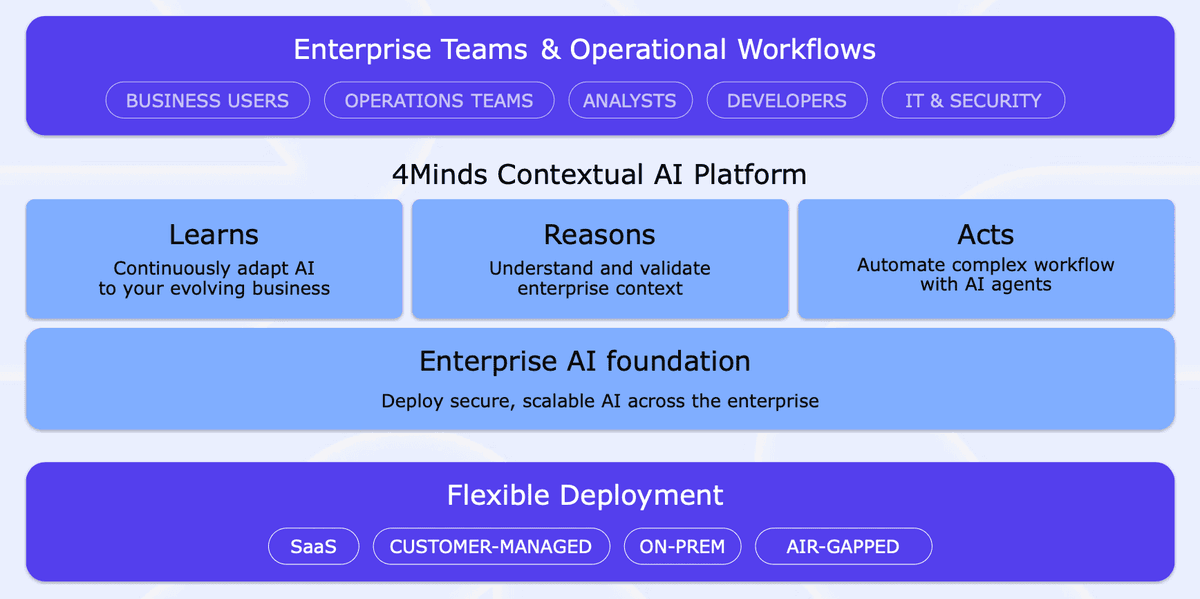
The 4Minds Contextual AI Platform continuously learns from enterprise data, reasons across business context, and takes action through AI agents.
What does this look like in practice?
Consider a global manufacturer managing data across ERP systems, production environments, inventory platforms, supplier networks, and demand planning tools. Traditional AI can retrieve information from each of these systems, but it often struggles to understand how they relate to one another.
A delayed supplier shipment, for example, may impact production schedules, inventory levels, customer orders, and revenue forecasts simultaneously. By creating a contextual intelligence layer that connects these relationships, AI can reason across the entire supply chain, identify potential disruptions before they occur, and recommend actions based on the unique operating realities of the business.
As new data and conditions emerge, the system continuously adapts, helping teams make faster, more informed decisions.
By combining automated data readiness, contextual intelligence, model fine-tuning, and continuous learning, 4Minds enables enterprises to move beyond AI that simply retrieves information toward AI that understands how the business operates and evolves alongside it.
The result is AI that can reason more effectively, automate with greater confidence, and deliver outcomes that become more accurate and relevant over time.
As enterprises move from experimentation to production-scale AI, success will depend on more than access to data or foundation models alone.
It will depend on the ability to transform enterprise knowledge into contextual intelligence.
That is the next frontier of enterprise AI and the future 4Minds is helping organizations build today.
Learn how 4Minds helps organizations transform fragmented enterprise data into contextual intelligence and build AI systems that continuously adapt as the business evolves by visiting us at www.4minds.ai.
About the author:
Ryan Trimberger is the CEO and Co-Founder of 4Minds, the Contextual AI Platform helping organizations transform enterprise data into business context and build AI systems that reason, learn, and adapt as the business evolves. The 4Minds platform accelerates data readiness, creates a continuously evolving intelligence layer that captures institutional knowledge, and enables organizations to deploy AI grounded in the unique context of their business.
A serial technology entrepreneur, Ryan has built and successfully exited multiple technology companies before founding 4Minds. Throughout his career, he has focused on helping organizations unlock greater value from their data and technology investments. Under his leadership, 4Minds is pioneering a new approach to enterprise AI that goes beyond information retrieval by enabling AI to understand relationships, context, and changing business conditions. Ryan is passionate about helping enterprises move from AI experimentation to scalable, trusted, and measurable business outcomes through contextual intelligence and adaptive reasoning.


 Elevate Your Personal Brand