
What Is a Chief Data Officer in 2026? Many people working within the data industry are saying the same thing: the role of the Chief Data Officer (CDO) has changed – but how? CDO Magazine began an expert survey to find out. We recent...
Generative + Agentic AI: Moving From Experimentation to Enterprise Scale Generative and agentic AI are making their way into enterprise production, bringing new questions for Chief Data Officers (CDOs) and other data and AI leaders responsible for making these technologies...
Webinar | The Agentic Mindset Shift: How to Onboard an Agentic Data Team Three sessions, real playbooks, proven results you can replicate.
Branded Content
Hidden Risk, Missed SLAs: Why Data Reliability Is the Real AI Bottleneck

Written by: Jonathan Hiett | Global Solution Architect, Broadcom
Updated 8:00 AM EDT, July 20, 2026

As enterprises accelerate their transition from AI experimentation to production at scale, a systemic risk is quietly compounding: the structural fragility of the data supply chain. The conversation among technology leaders must rapidly mature beyond building isolated algorithmic models and shift toward securing the systematic reliability of the data assets that fuel them.
The business risk of neglecting this operational foundation is stark. Broadcom’s study, conducted by Dimensional Research, reveals that an overwhelming 96% of data leaders report pipeline performance issues are delaying their AI initiatives and degrading model accuracy. For the modern enterprise, data velocity is meaningless without data predictability; the true bottleneck to AI-driven corporate ROI is no longer the capacity of the model, but the operational reliability of the automated pipelines that feed it.
This systemic vulnerability is driven by the Orchestration Paradox. We are witnessing an unprecedented explosion in data tooling, yet this hyper-growth has directly triggered rampant infrastructure fragmentation across the enterprise. Consider the market velocity of the modern data stack: by late 2024, Apache Airflow downloads surged to more than 31 million per month– a leap from just 888,000 in 2020.
While this democratization empowers individual data engineering teams to build workflows faster, it simultaneously creates an unmanaged sprawl of decentralized, multi-cloud pipeline configurations. Because these powerful tools are deployed in functional silos without an overarching system of record, the supporting corporate infrastructure has become highly fragmented, inadvertently serving as a primary roadblock to enterprise innovation.
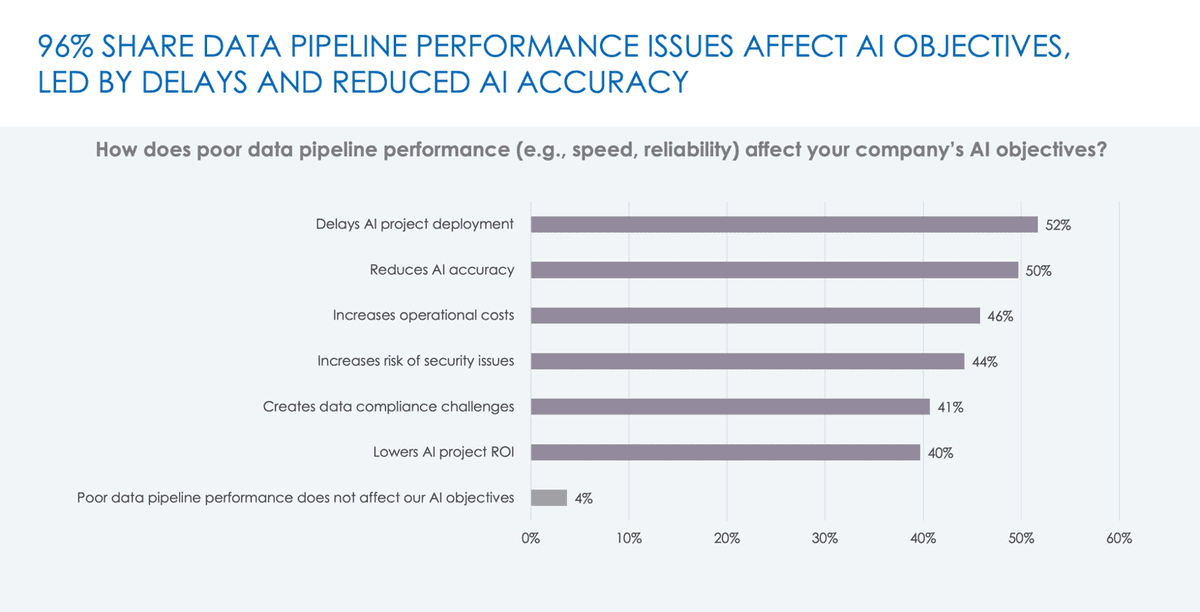
In a recent Dimensional Research survey, 96% of data leaders say that data pipeline performance issues are delaying their AI initiatives and reducing AI accuracy.
The Rise of Silent Failures
In the early days of DataOps, success was measured by green dashboards. If a job was completed successfully, the data was assumed to be correct. But as workflows now span multiple platforms and teams, many problems no longer surface as obvious failures. We are entering an era where operational risks remain silent until they cause real business impact.
Consider slow performance degradation. A critical task that historically took 10 minutes might creep up to 12, then 15 minutes, due to subtle changes in data volume or infrastructure. Because no single run breaches an explicit timeout, the pipeline stays green. However, the cumulative effect means the final data product misses its delivery SLA, impacting business intelligence reports and leadership decisions.
Furthermore, the common practice of providing each team with its own Airflow instance for isolation has backfired, leading to rampant fragmentation. This creates cross-instance blindness, where dependencies between teams are managed through fragile, point-to-point alerts. When one team changes a schedule, the downstream system doesn’t fail; it simply waits indefinitely, grinding critical business processes to a halt without a clear indication of why.
The Human and Economic Cost
This fragmentation is not just a technical nuisance; it is a drain on our most valuable resource: engineering talent. The research from Dimensional Research highlights a growing efficiency gap: 83% of AI and data experts now dedicate at least 10% of their time to pipeline management. Furthermore, one in three experts spends more than 25% of their day on these tasks rather than on actual innovation.
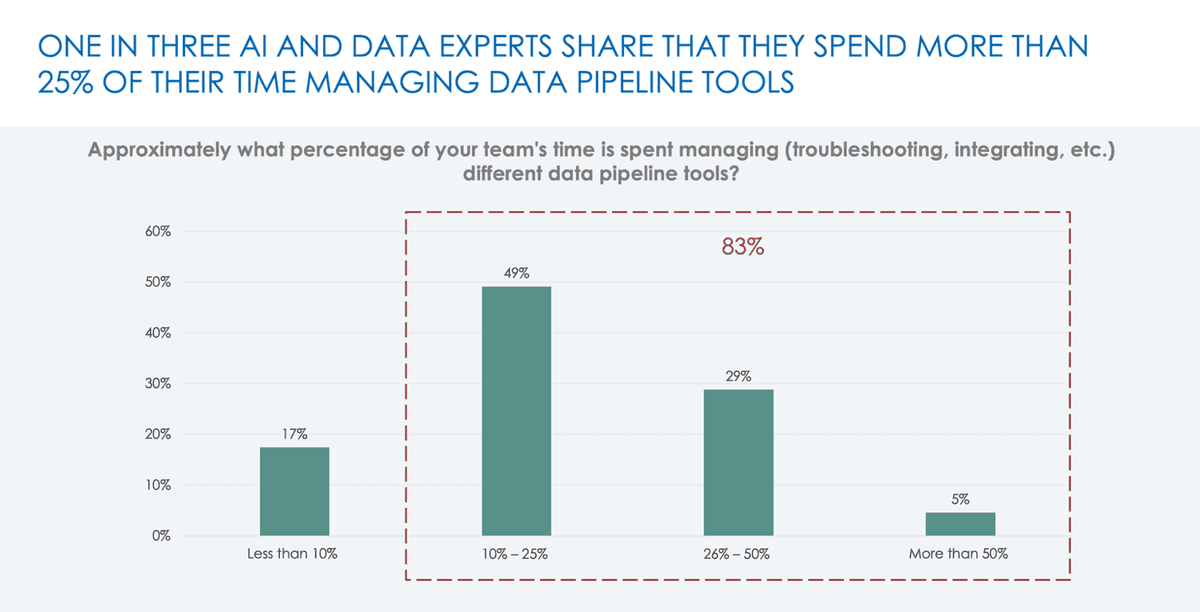
Dimensional Research found that 83% of AI and data experts dedicate at least 10% of their time to data pipeline management, and furthermore, one in three, spend more than 25% of their day on these tasks.
This is in line with prior research, which found that Airflow issues significantly reduce revenue and team productivity. These issues are creating an “observability tax” that has become too expensive to ignore. Instead of driving innovation, highly skilled data engineers often end up acting as manual traffic controllers for data workflows rather than doing what’s required to move the business forward, such as building AI-powered analytics, data products, and next-generation decision intelligence.
From Instance Management to Business Service Observability
Bridging the operational gap between technical data execution and realized corporate value requires data leaders to pivot their strategy. Organizations must transition from the reactive management of isolated, decentralized pipeline instances to the proactive governance of the holistic service commitments the data team has made to the business.
This operational maturity mandates an Intelligent Control Plane, an overarching administrative system of record that sits above a distributed, multi-cloud data estate to deliver unified context, predictive analytics, and centralized governance.
For technology leaders architecting this modern data ecosystem, four strategic capabilities are non-negotiable:
- Predictive SLA Management: Traditional, reactive alerting, such as receiving a notification that a critical pipeline run failed ten minutes ago, is insufficient for enterprise operations. C-suite leadership demands calendar-aware, probabilistic forecasting capable of accounting for complex business cycles, such as fiscal period closings, market volatility, and seasonal data spikes.
- Dynamic Critical Path Analysis: Within highly complex data environments, treating all pipeline anomalies equally introduces operational paralysis. While a latency delay in a localized, non-critical data branch is noise, a minor performance lag in a core cross-team dependency can completely disrupt downstream business operations. Automated, dynamic critical path analysis enables teams to bypass superficial telemetry noise, immediately isolating the exact, high-priority technical tasks that are jeopardizing a hard business milestone or data product delivery.
- FinOps and Cost Governance: In modern cloud-native environments, a structural lack of visibility into pipeline operations translates into wasted corporate budget and compute inefficiencies. By correlating end-to-end pipeline execution with real-time cloud infrastructure utilization, organizations unlock granular financial governance. This transparency allows leadership to systematically determine which priority data workflows actually require premium, high-performance compute resources to satisfy a strict business SLA, and which over-provisioned tasks can be throttled back to protect corporate margins.
- Federated Governance: Scaling enterprise AI cannot be achieved through rigid, hyper-centralized command structures that restrict agility. Modern architecture must respect and preserve the operational sovereignty of individual, decentralized business units, such as Finance, Marketing, and Product Engineering, while simultaneously establishing a unified, single pane of glass for enterprise-wide observability. This cross-functional framework ensures that independent teams maintain their execution velocity while corporate leadership confidently satisfies stringent audit, compliance, and data-provenance mandates.
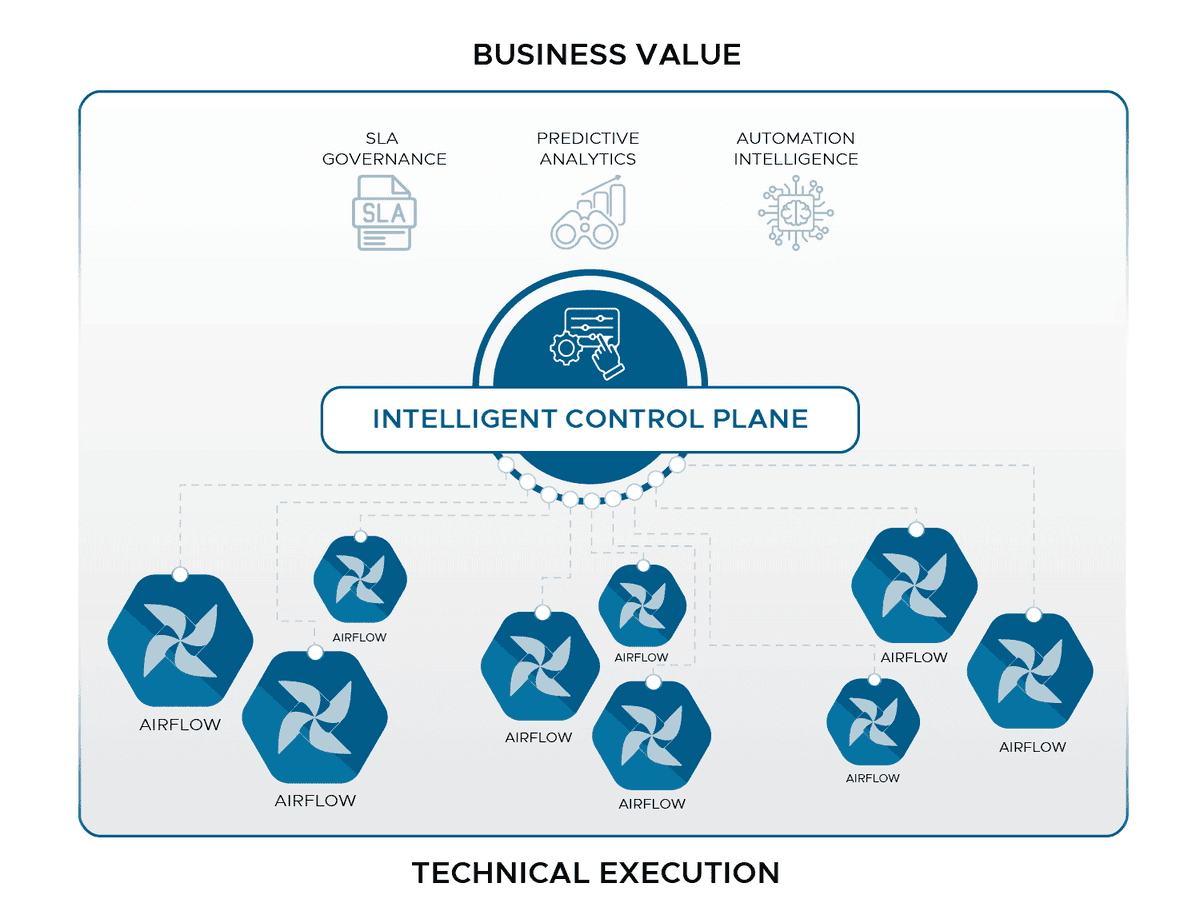
The Intelligent Control Plane sits above the data estate to provide context, prediction, and governance.
The Path Forward
The goal is to evolve from technical SLAs, such as task uptime, to Data Product SLAs that govern the freshness, quality, and cost of critical assets, such as a Certified Customer 360 View.
AI models are only as powerful as the data supply chains that feed them. Reclaiming the observability tax and introducing a unified intelligent control plane allows organizations to turn data platforms from fragile operational systems into the most trusted infrastructure in the enterprise. The future of DataOps is not about managing tools- it is about delivering business value with confidence.
Read the research here.
For more from Jon Hiett, attend Broadcom’s 2026 Automation Virtual Summit and watch his session.
About the Author:
Jonathan Hiett is a Global Solution Architect at Broadcom, focusing on enterprise automation, advanced orchestration, and cross-platform data reliability. With over two decades of technical leadership spanning the financial services and IT sectors, Jonathan advises global enterprise executive teams on how to transform infrastructure complexity into highly resilient, AI-ready data operations. During his distinguished career, he has built world-class data and automation solutions. A recognized industry speaker and strategist, he champions the foundational principle that “automation operationalizes AI”.



 Elevate Your Personal Brand