
What Is a Chief Data Officer in 2026? Many people working within the data industry are saying the same thing: the role of the Chief Data Officer (CDO) has changed – but how? CDO Magazine began an expert survey to find out. We recent...
2026 CDO Report: Meet the Modern Data Team New survey of VP & C-level data and AI leaders confirms what’s stalling AI transformation.
Generative + Agentic AI: Moving From Experimentation to Enterprise Scale Generative and agentic AI are making their way into enterprise production, bringing new questions for Chief Data Officers (CDOs) and other data and AI leaders responsible for making these technologies...
Artificial Intelligence
Tsinghua University Issues First Campus-Wide Guidelines on AI Use in Education

Written by: CDO Magazine
Updated 6:48 AM EST, December 15, 2025
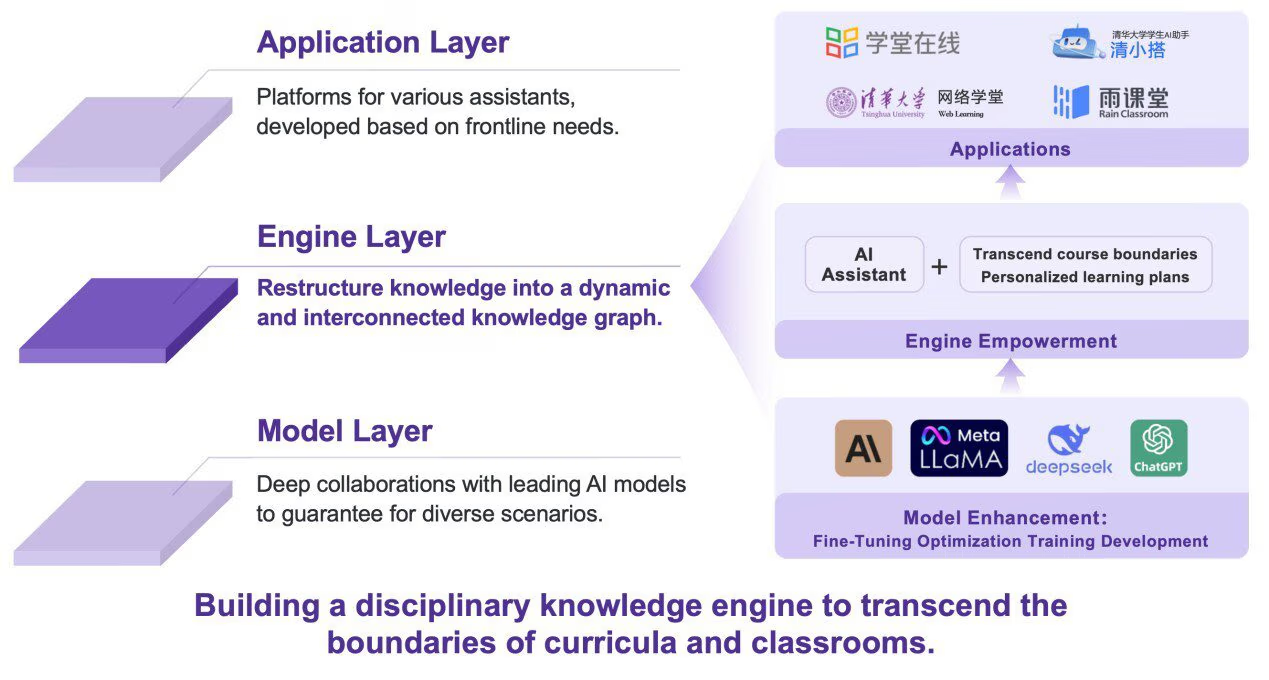
The three-layer decoupled architecture of AI in Education from Tsinghua University
China’s Tsinghua University has released its first comprehensive framework governing the use of artificial intelligence in teaching and academic research, marking a major step in how one of China’s top universities adapts to the rapid rise of generative AI in classrooms and labs.
The “Tsinghua University Guiding Principles for the Application of Artificial Intelligence in Education” set out systematic, multi-level norms for faculty, students, and researchers as AI tools become increasingly embedded in learning and idea generation.
The document is divided into three parts — General Provisions, Teaching and Learning, and Theses, Dissertations, and Practical Achievements — offering detailed, scenario-based rules for everything from course design to graduate research.
The General Provisions outline five core principles: responsibility, compliance and integrity, data security, prudence and critical thinking, and fairness and inclusiveness. AI must remain an auxiliary tool, the guidelines say, with teachers and students driving learning. Proper disclosure of AI use is mandatory, misuse is prohibited, and the university warns against cognitive complacency, urging multi-source verification to counter AI-generated errors. The document also stresses the need to address algorithmic bias and prevent widening digital divides.
In the Teaching and Learning section, instructors are asked to define AI’s role in each course, explain the rules at the semester’s start, and take responsibility for any AI-generated materials they use. Students may employ AI as a learning aid, but copying or mechanically rephrasing AI output for assignments is banned.
Under Theses, Dissertations, and Practical Achievements, AI cannot replace academic training or independent intellectual work. Ghostwriting, plagiarism, fabrication, and other forms of misconduct are explicitly prohibited. Advisors must guide appropriate AI use and maintain oversight to ensure originality and academic integrity.



 Elevate Your Personal Brand