
Webinar | Your AI Is Ready. Your Data Access Isn’t. Discover how leading data executives are enabling AI innovation while maintaining strong governance.
CDO Magazine Unveils the Top 25 Chicago Data & AI Leaders 2026 CDO Magazine proudly presents the Top 25 Chicago Data & AI Leaders 2026, recognizing the executives leading high-impact data, analytics, and AI initiatives across some of the world’s most influential...
The Evolving Role of the Data, AI, and Analytics Executive: 2026 Benchmark Survey
Artificial Intelligence
OpenAI Brings GPT-Live to ChatGPT Voice

Written by: Neelakshi Chakraborty, Reporter, CDO Magazine
Updated 5:04 PM EDT, July 10, 2026
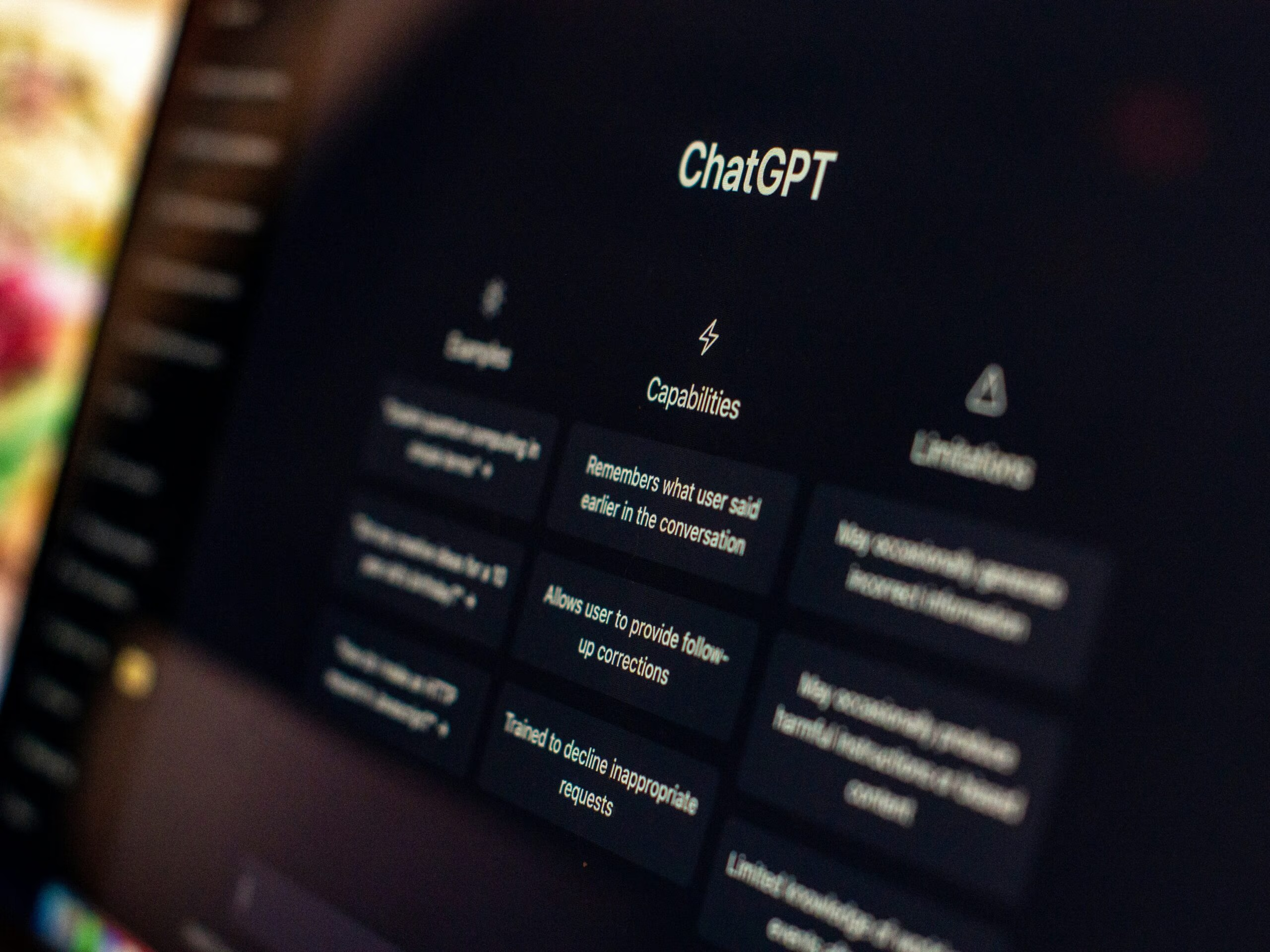
Photo credit: Unsplash.com
OpenAI has introduced GPT-Live, a new voice model system that now powers ChatGPT Voice. The company said the model is designed to make conversations with AI feel closer to speaking with another person, while also supporting more complex tasks through deeper reasoning and background delegation.
GPT-Live is built on a full-duplex architecture, allowing the model to listen and speak at the same time. In practice, this means ChatGPT Voice can acknowledge a user with phrases such as “mhmm” or “yeah,” respond in quick back-and-forth exchanges, or stay quiet when a user pauses to think.
A More Natural Voice Architecture
The launch marks a shift from earlier voice systems that processed conversations through separate or turn-based stages. GPT-Live continuously processes input while generating output, allowing it to decide many times per second whether to speak, listen, pause, interrupt, or invoke a tool.
For questions requiring a web search, deeper reasoning, or more complex work, GPT-Live can delegate the task to OpenAI’s latest frontier model in the background and return the result when ready. At launch, GPT-Live uses GPT-5.5 behind the scenes, with OpenAI saying the underlying model will be updated as new frontier models are released.
OpenAI is rolling out two versions: GPT-Live-1 and GPT-Live-1 mini. GPT-Live-1 will become the default model for ChatGPT Voice for Go, Plus, and Pro users, while GPT-Live-1 mini will become the default for free users. The models are rolling out globally across iOS, Android, and ChatGPT.com, with API availability planned later.
Why It Matters
The release expands ChatGPT Voice from a spoken interface into a more capable conversational layer for AI interaction. OpenAI said GPT-Live can support more natural conversations, smarter answers, and better listening and dynamic visuals while continuing to work with search, memory, images, and file uploads.
The model also points toward more agentic voice experiences. OpenAI said the research could eventually support longer-running and more complex work through voice, where conversation remains active while reasoning and task execution happen in the background.
OpenAI said GPT-Live has been designed with voice-specific safeguards, including expanded audio-native safety testing, red-teaming for risks unique to voice, and real-time safeguards that can steer, interrupt, or end higher-risk conversations. The system uses predefined voices in ChatGPT and includes protections intended to prevent imitation of a real person’s voice.



 Elevate Your Personal Brand