
What Is a Chief Data Officer in 2026? Many people working within the data industry are saying the same thing: the role of the Chief Data Officer (CDO) has changed – but how? CDO Magazine began an expert survey to find out. We recent...
Generative + Agentic AI: Moving From Experimentation to Enterprise Scale Generative and agentic AI are making their way into enterprise production, bringing new questions for Chief Data Officers (CDOs) and other data and AI leaders responsible for making these technologies...
Leadership Summit – Boston – Westin Boston Seaport District – December 10, 2026 Join top AI and Data leaders in Boston to explore the strategies, governance, and innovations driving enterprise performance. Connect, learn, and gain actionable insights — reserve your seat today.
Artificial Intelligence
Agentic AI in the Enterprise: What Leaders Need to Know Now

Written by: Moataz Mahmoud | SVP, Enterprise Data Management, First Citizens Bank
Updated 11:00 AM EST, November 25, 2026

(This article originally appeared in CDO Magazine’s Trend Report, Generative + Agentic AI: Moving From Experimentation to Enterprise Scale.)
The first wave of enterprise AI adoption focused primarily on assistance. Organizations deployed generative AI productivity tools as workforce multipliers, helping employees work more efficiently and reducing friction across day-to-day activities. The workforce, however, remained responsible for orchestration, judgment, and execution.
Agentic AI changes that operating model significantly. Agentic systems can coordinate actions across multiple steps and systems, select tools, adapt execution paths, and escalate exceptions based on changing conditions.
The important shift for enterprise leaders is that AI is beginning to participate directly in operational execution. Enterprise systems were historically designed around deterministic workflows, predefined logic, and clearly defined approval paths. Agentic systems introduce adaptive orchestration into those environments. Two identical requests may follow different execution paths depending on retrieved information, runtime context, or downstream system conditions.
That flexibility creates significant opportunities for more intelligent coordination across fragmented enterprise processes. It also changes the governance question. Leaders must now think beyond whether a model produces an acceptable response and consider what the system is authorized to access, decide, and execute while it is operating.
As agentic systems become more embedded in enterprise workflows, chief information officers (CIOs) and chief data officers (CDOs) face a new challenge: how to capture the value of adaptive execution while maintaining clear authority boundaries, operational visibility, human oversight, and accountability.
From AI Assistants to Adaptive Enterprise Execution
The key distinction between an AI assistant and an agentic system is who determines what happens next. With an assistant, the user remains the orchestrator. The system may summarize information or recommend an action, but a person decides whether to proceed and initiates the next step. With an agentic system, part of that orchestration can shift to AI. The agent may determine which tool to use, when to escalate an exception, or which downstream action should follow based on the conditions it encounters.
That difference is significant. An assistant generates content. An agent can influence operational outcomes.
Consider a financial services workflow that spans know-your-customer (KYC) processes, policy validation, fraud checks, communications, and approvals. An assistant might help an employee complete individual tasks within that process. An agentic system could coordinate several of those activities across platforms, moving the workflow forward with less direct human orchestration.
This is where the leadership question becomes more important than the technology itself: how much of that orchestration should the enterprise delegate, and under what conditions?
Autonomy Should Be Proportional to Consequence
From my perspective, autonomy should be treated as a risk decision, not simply a technological capability. The fact that an agent can take an action independently does not mean the enterprise should allow it to do so.
Two questions are important when deciding how much autonomy to grant:
- Can the action be reversed?
- How far could a failure spread?
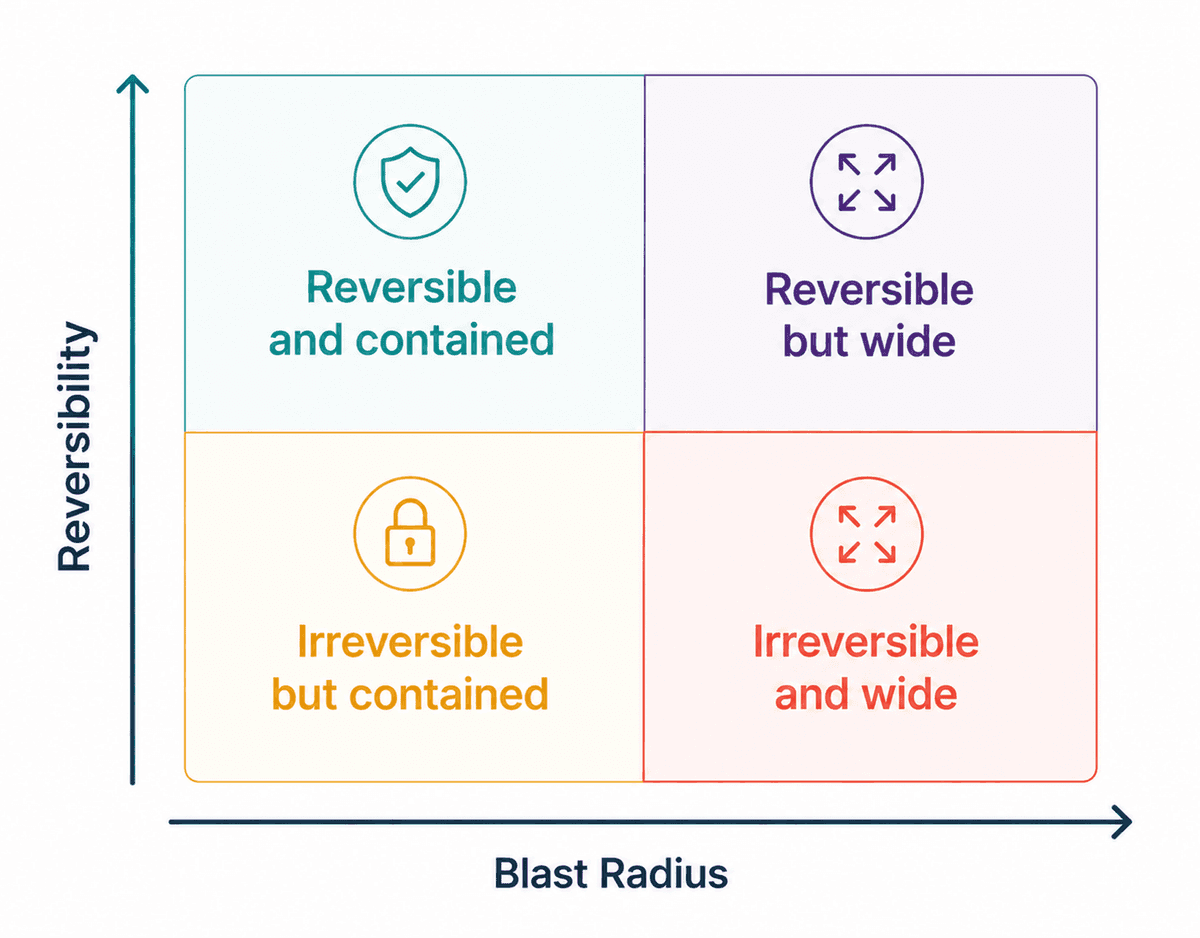
Figure 1: Autonomy decision framework based on reversibility and blast radius
A recommendation that can be reviewed and corrected carries a very different risk profile from an action that changes a system of record or triggers a financial transaction.
The goal is to match the level of autonomy to the consequences of being wrong. In some cases, that may mean limiting the agent to recommendation or draft mode. In others, controlled execution may be appropriate. Where there is no reliable recovery path or the consequences of failure cannot be contained, the organization may decide not to allow autonomous execution.
Where Multi-Agent Architecture Adds Value
Task separability is the key design signal. When a workflow can be decomposed into independent tasks, specialized agents can operate with focused context or work in parallel. For example, one agent may handle retrieval, another may validate policy, and another may perform analytical reasoning, while a coordinating agent manages the handoffs and synthesizes the result.
The deciding factor is how dependent those activities are on one another. If each activity relies heavily on the output of the previous one, multiple agents may add unnecessary coordination overhead. Multi-agent architectures are better suited to workloads that are separable, specialized, or too broad for one agent to manage efficiently within a single context.
The economics of coordination also matter. Each additional agent consumes its own context, model calls, and tool interactions, so the architecture should produce a measurable improvement in quality, speed, coverage, or business value.
The strongest architectures often start simple, adding agents only where specialization or parallelism creates a clear advantage. Complexity should earn its place.
Multi-Agent Systems Expand the Failure Surface
The benefits of multi-agent architecture come with an expanded failure surface. Each additional agent introduces another point where an error can enter the workflow. As agents begin to depend on one another, those errors can compound. A weak intermediate result can influence downstream decisions before the issue is detected.
Reducing that failure surface starts with bounded delegation and clear separation of responsibilities:
- The number of agents should reflect the actual independent workstreams in the process
- Each agent should receive only the context required for its task and operate with the minimum tools and permissions needed to complete it
- Intermediate results should be validated before they influence downstream actions, particularly where errors could propagate across agents or systems
The principle is that capability and failure surface grow together. As more agents and tools are introduced, the architecture will require stronger boundaries and greater visibility into how work is delegated and executed. This is where governance must extend beyond design-time controls and operate at runtime.
Governance Must Operate at Runtime
One challenge I see organizations underestimate is the shift from governing model outputs to governing execution authority while the system is operating. Traditional AI governance has mainly focused on the model lifecycle. Agentic AI expands that scope to what the system is allowed to do while it is operating, not only the quality of the model output.
Runtime governance starts with enforceable boundaries. Enterprises need to define what an agent can access, which tools it can use, what actions it can execute independently, and where approval or escalation is required. Critical controls should distinguish between probabilistic guidance and deterministic enforcement. Prompts and contextual instructions can influence how an agent behaves, but high-consequence actions require deterministic controls such as permissions, policy rules, execution gates, approval workflows, and scoped tool access.
Observability is what makes runtime governance auditable. For agentic systems, explainability extends beyond the final response to the execution path, controls, and decisions that shaped the outcome. Organizations need sufficient traceability to reconstruct what informed a decision, which controls were applied, and what action followed. Trust ultimately depends on:
- Grounded evidence
- Enforceable runtime controls
- A preserved decision record
Before moving an agentic workflow into production, leaders should be able to answer a few practical questions:
- What actions can the agent take independently?
- Where is human approval required?
- Can the organization reconstruct what happened and why?
- What happens when an agent, model, tool, or downstream system fails?
Human oversight should be calibrated to consequence. Actions with limited reversibility or material downstream impact should trigger explicit approval or intervention points, while lower-risk actions can remain within predefined execution boundaries and escalate when those boundaries are exceeded.
At enterprise scale, governance becomes part of the execution architecture.
Regulatory Expectations Are Taking Shape
Agentic AI can sit inside several compliance boundaries at the same time. A workflow handling EU personal data, protected health information, or a federal workload may require different decisions about data movement and deployment architecture. These are not downstream legal considerations. They can materially shape how the system is designed before it reaches production.
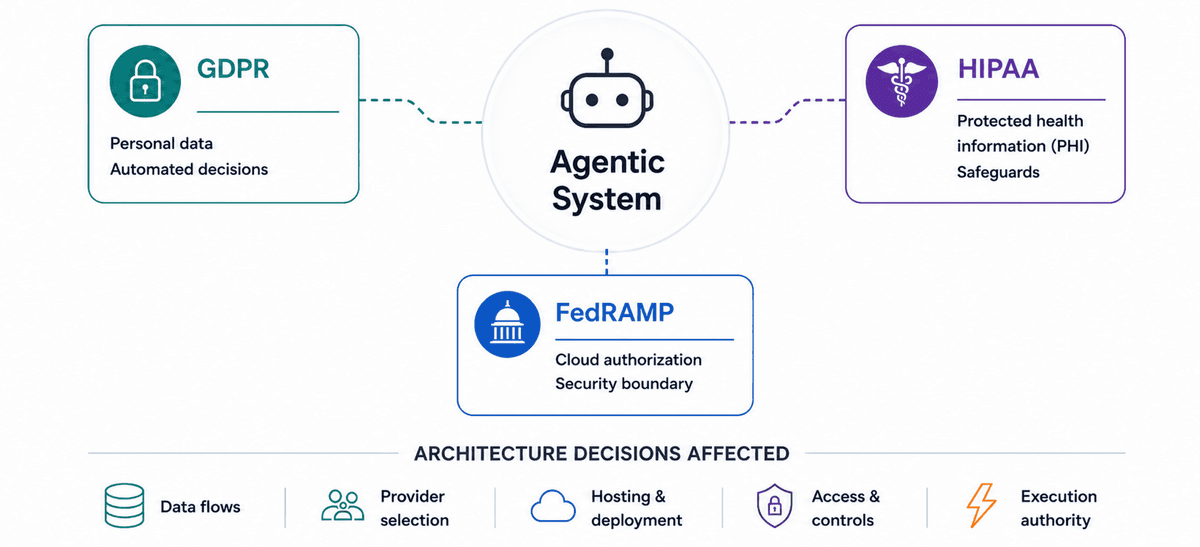
Figure 2: A single agentic system may operate across multiple regulatory boundaries
The architectural implications differ by regime:
- GDPR can shape what personal data enters the AI pipeline and where it is processed. It can also affect whether automated decisions require additional safeguards or human review.
- HIPAA brings protected health information into the design boundary, affecting auditability and how external providers participate in the workflow.
- FedRAMP can shape hosting and deployment by defining the security and authorization boundary for federal cloud workloads.
In financial services, the regulatory picture is less prescriptive. The April 2026 interagency guidance, SR 26-2, explicitly excludes generative and agentic AI from its scope and instead points banks to broader risk management practices. That leaves institutions to define architecture and control boundaries consistent with their own risk posture.
Organizations can scale AI more effectively when compliance is designed as a shared control layer. Common requirements can be embedded into reusable platform controls and applied with different levels of rigor based on risk. This gives product teams clearer operating boundaries and allows regulatory changes to be absorbed more efficiently across the AI portfolio, as updates to the shared control layer can extend across multiple agentic workflows rather than being addressed one use case at a time.
Conclusion
Agentic AI represents a meaningful shift in how enterprises use AI. The opportunity is not limited to generating better answers or assisting employees. These systems are beginning to participate directly in execution, which means architecture decisions determine how much authority the enterprise is willing to delegate.
Scaling agentic AI will depend on whether organizations can define appropriate boundaries and enforce them consistently. Autonomy should reflect the consequences of being wrong. Multi-agent designs should be introduced where they create a clear advantage, with governance remaining active as the system operates. In regulated environments, those boundaries should also translate into reusable controls that can evolve across the AI portfolio.
The real enterprise challenge is defining how much autonomy the organization can support without losing control.
TR blurb:
NEW CDO MAGAZINE TREND REPORT
This is just one perspective.
Explore the bigger picture.
You’ve just read one executive’s perspective on the challenges of scaling AI. Discover what the research reveals and what other data and AI leaders are saying about governance, security, context, and the move from experimentation to enterprise scale.
Generative + Agentic AI: Moving From Experimentation to Enterprise Scale


 Elevate Your Personal Brand