
What Is a Chief Data Officer in 2026? Many people working within the data industry are saying the same thing: the role of the Chief Data Officer (CDO) has changed – but how? CDO Magazine began an expert survey to find out. We recent...
2026 CDO Report: Meet the Modern Data Team New survey of VP & C-level data and AI leaders confirms what’s stalling AI transformation.
Generative + Agentic AI: Moving From Experimentation to Enterprise Scale Generative and agentic AI are making their way into enterprise production, bringing new questions for Chief Data Officers (CDOs) and other data and AI leaders responsible for making these technologies...
AI Governance
The Value-Based Imperative: A Framework for Responsible AI Adoption

Written by: Grace Crossette-Thambiah Ph.D.
Updated 2:00 PM EDT, August 18, 2026

The rapid propagation of artificial intelligence (AI) technologies presents organizations with transformative opportunities. At the same time, AI introduces complex challenges related to risk, value, and ethics. The decision to adopt AI should not be driven by technological innovation alone, but by a rigorous, value-based framework. This framework should consider whether AI:
- Serves a clear purpose,
- Provides financial value,
- Complies with data requirements, and
- Can be implemented ethically.
Based on my experience in AI and data governance, I propose a Three-Pillar Model for responsible AI adoption:
- Need
- Efficiency and Financials
- Data Quality, Governance, and Ethical Implementation
1. Purpose-Driven Adoption: Need and Objectives
The foundation of value-based AI adoption is the concept of Need. AI should be a solution to a business problem. Its deployment must align with the organization’s or department’s core mission and objectives. The success of AI adoption should be measured by how well it helps the organization or department accomplish those objectives.
For example, a hospital adopting an AI diagnostic tool should measure success not just by its speed, but by its impact on reducing misdiagnosis rates (a core objective) or improving patient outcomes. This helps ensure that resources are committed to AI initiatives that support high-priority strategic goals, rather than marginal or non-essential applications. A clear use case and value proposition can also increase the likelihood of successful adoption and tangible benefits.
2. Operationalizing Value: Efficiency and Financials
Once a clear need is established, the next pillar, Efficiency and Financials, considers tangible return on investment (ROI) and operational improvement.
- Efficiency for Efficacy: Asking how AI promotes efficacy pushes the discussion beyond simple task automation. It requires evaluating how AI enhances the quality and impact of human effort. AI-driven efficiency can lead to greater efficacy, empowering human employees to focus on higher-level, creative, and strategic tasks.For example, an AI system that processes invoices quickly is not just efficient; it can improve the efficacy of the finance team by freeing employees to focus on more complex financial analysis. Other benefits can include streamlining processes, reducing labor costs associated with repetitive tasks, and enabling faster, data-informed decision-making.
- Financial Savings or Revenue Growth: Another measure of business value is the projected financial savings or gain.
- Cost Optimization: Reducing overhead through automation and optimized resource allocation
- Value Creation: Supporting revenue growth through personalized customer experiences, faster time-to-market, or new AI-enabled business models
A value-based assessment should clearly project and track this financial impact to justify the investment from pilot to enterprise-wide production.
3. The Critical Foundation: Data Quality, Governance, and Ethical Implementation
The power of AI is intrinsically linked to the quality of its inputs, making good data and ethical governance critical to responsible implementation. AI models depend on the quality of the data they are trained on.
- Data Quality and Governance: Responsible AI adoption requires good data supported by proper governance frameworks. “Good data” means data that is accurate, complete, relevant, and representative.
- Governance Frameworks: Organizations should establish clear policies for data collection, storage, access, and usage, ensuring data integrity and lineage.
- Without robust data governance, AI systems risk producing flawed, unreliable, or biased outcomes, which can undermine the value of the initiative in terms of need or efficiency.
- Ethical Implementation and Human Oversight: The third pillar also calls for the integration of ethical guardrails, including appropriate human oversight in AI adoption and decision-making.
- Human-in-the-Loop (HITL): Human-led committees can help evaluate and implement bias detection mechanisms to reduce the risk of AI models inheriting or amplifying unfairness.
- Explainability and Traceability: Organizations should establish traceability to audit AI outputs. This commitment transforms AI into a trustworthy partner.
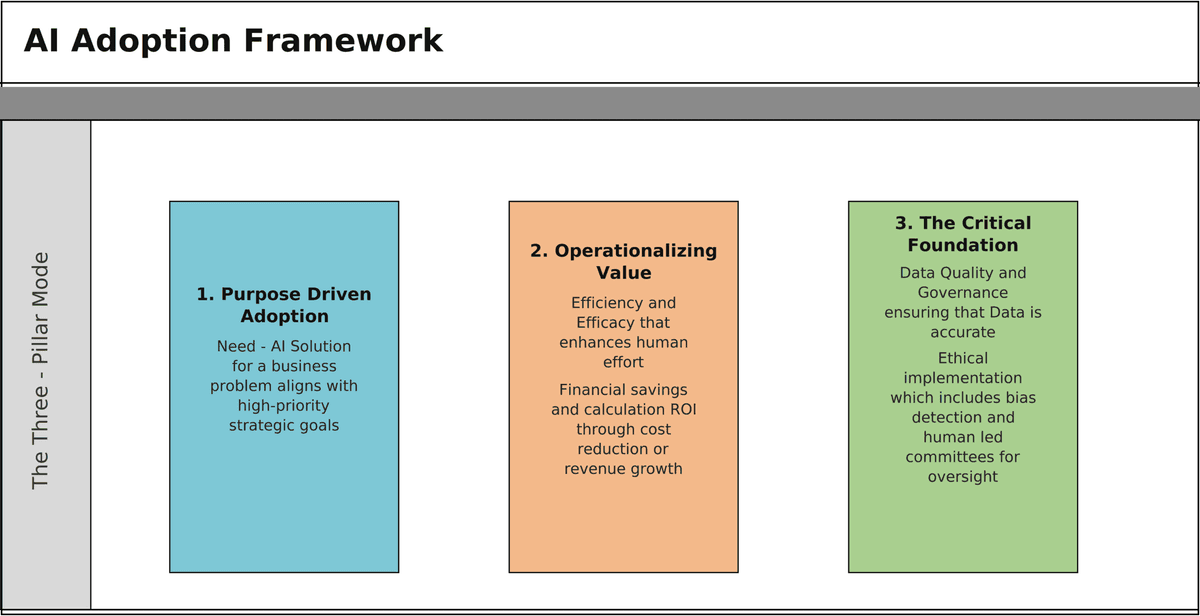
Figure 1: The Three-Pillar Model for Responsible AI Adoption
Building a Value-Based Foundation for AI Adoption
The Three-Pillar Model provides a framework for developing a successful, sustainable, and responsible AI adoption strategy that balances potential returns with risk. In an era of rapid technological change, this model can provide a strategic anchor for responsible AI adoption.
By linking strategic need to operational and financial value, data governance, and ethical implementation, organizations can navigate the complexities of AI adoption without sacrificing integrity. This framework provides the structural discipline needed for long-term success and a value-based foundation for responsible AI adoption that is both viable and ethically sound.



 Elevate Your Personal Brand