
What Is a Chief Data Officer in 2026? Many people working within the data industry are saying the same thing: the role of the Chief Data Officer (CDO) has changed – but how? CDO Magazine began an expert survey to find out. We recent...
2026 CDO Report: Meet the Modern Data Team New survey of VP & C-level data and AI leaders confirms what’s stalling AI transformation.
Generative + Agentic AI: Moving From Experimentation to Enterprise Scale Generative and agentic AI are making their way into enterprise production, bringing new questions for Chief Data Officers (CDOs) and other data and AI leaders responsible for making these technologies...
AI Governance
The Relevance Imperative: Governing the Information AI Relies On

Written by: Justin Heller | Executive Advisor & Experienced Chief Data Officer
Updated 10:00 AM EDT, October 22, 2026

(This article originally appeared in CDO Magazine’s Trend Report, Generative + Agentic AI Moving From Experimentation to Enterprise Scale.)
For Chief Data Officers (CDOs), ROI in the age of GenAI can no longer be measured exclusively as Return on Investment. It must also be measured as Relevance of Information. As AI systems consume larger volumes of structured and unstructured information, the greatest risk is not simply inaccurate output, but contextually irrelevant output delivered with high confidence. AI can amplify outdated assumptions, stale information, and flawed interpretations at machine scale. The challenge, therefore, is not only whether AI has access to accurate information, but whether that information remains relevant to the context in which it is being used.
This is where the conversation around Human-in-the-Loop (HITL) becomes critically important.
Many executives still frame HITL as a governance safeguard or compliance checkpoint. That interpretation is too narrow. HITL is also an operating model for determining where human judgment, oversight, and direct intervention add value as AI assumes greater autonomy.
The False Assumption of Autonomous Intelligence
There is a dangerous narrative emerging in enterprise AI that autonomy itself is the end state. The assumption is that the more decisions AI can make independently, the greater the organizational value.
That assumption ignores an important reality: AI systems do not reason the way humans reason.
They predict.
Even the most sophisticated large language models (LLMs) operate through probabilistic pattern generation based on statistical relationships across training data and prompts. Humans, by contrast, apply interpretation, judgment, and contextual reasoning. AI systems can simulate aspects of these dimensions, but they do not possess institutional memory, strategic accountability, or situational awareness in the human sense.
This is why the future operating model is not “human versus machine,” but human-guided machine acceleration, with the level of human involvement determined by the context, consequences, and risk of the activity.
Relevance Is the New Quality Metric
Historically, enterprise data quality programs focused on structured data accuracy, ensuring records were complete, standardized, and governed appropriately. Those disciplines remain important, but GenAI introduces a different challenge centered on the relevance of unstructured information.
Approximately 80 percent of enterprise data is unstructured, residing across sources such as documents, emails, collaboration platforms, and document repositories. The challenge is no longer simply whether information is accurate, but whether it remains contextually relevant when AI consumes it.
An AI system may retrieve outdated strategy documents, compliance interpretations, operational processes, or product architectures. Technically, the information may still be historically correct. Operationally, however, it may be dangerous because it no longer reflects the organization’s current context or intent. Determining relevance therefore requires contextual validation: whether information still aligns with current strategy, reflects current regulatory obligations, and accurately represents the organization’s operating reality. Without that validation, AI systems can confidently use information that is accurate in isolation but no longer appropriate to the context in which it is being applied.
Human Judgment as a Strategic Operating Capability
Organizations often underestimate the sophistication required for effective human oversight.
Human-in-the-loop is not merely approving AI outputs after the fact. It requires organizations to cultivate critical thinking capabilities that many enterprises have unintentionally deprioritized during years of process automation and operational optimization.
GenAI may increase the importance of disciplines traditionally associated with the social sciences and classical reasoning.
Effective AI-enabled organizations will need to strengthen hypothesis formation, evidence evaluation, source validation, and contextual interpretation. In many ways, this resembles the Platonic dialectic: challenging assumptions, evaluating evidence, and arriving at reasoned conclusions rather than accepting machine-generated outputs at face value.
AI can accelerate information synthesis, but determining whether that information is relevant to a particular decision requires judgment grounded in organizational context. That distinction becomes a foundation of enterprise trust.
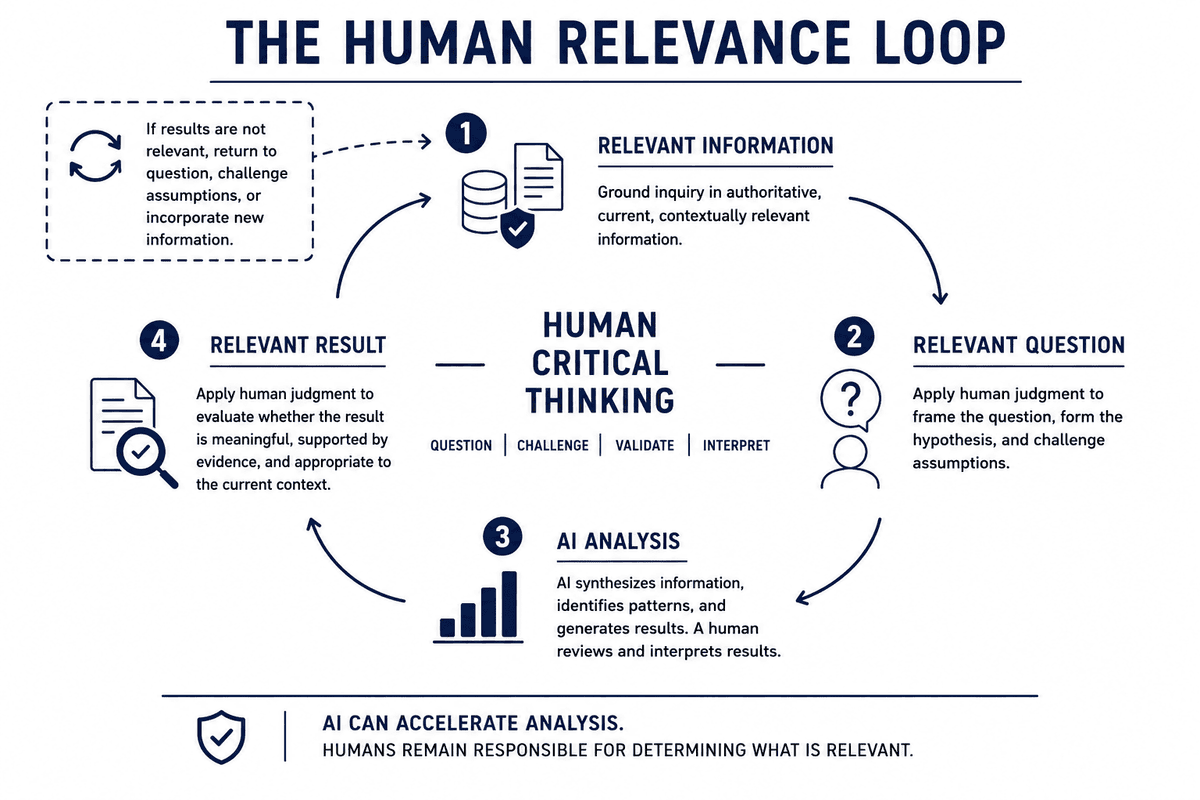
Figure 1: The Human Relevance Loop
Where Human Oversight Is Most Critical
Not every AI interaction requires the same level or type of human involvement. Leadership teams should calibrate human judgment, oversight, and direct intervention to the potential business significance of an AI-enabled decision or action, concentrating the greatest scrutiny where errors could create material financial, operational, regulatory, or reputational consequences.
Strategic, financial, operational, and regulatory decisions are among the clearest examples. AI can summarize trends, model scenarios, and accelerate analysis, but the appropriate level of human review should increase when ambiguity or potential consequences create material business risk. Organizations cannot delegate accountability for strategy, risk appetite, capital allocation, regulatory interpretation, or other consequential decisions simply because AI contributed to them.
Organizations must apply oversight to information lifecycle management itself. As enterprises deploy retrieval-augmented generation architectures and enterprise knowledge copilots, they need mechanisms to determine which information remains authoritative, which knowledge artifacts are obsolete, and whether the information available to AI still reflects current organizational reality. This makes relevance governance foundational to AI trustworthiness because the quality of an AI-generated output depends not only on the accuracy of the information it retrieves, but also on whether that information remains appropriate to the context in which it is being used.
When Intervention Should Occur
Organizations can design HITL processes too late in the lifecycle, reviewing outputs only after AI-generated decisions have already been operationalized.
Effective oversight cannot occur only after generation. Human judgment should inform the design of governance boundaries and source constraints, ongoing oversight should identify contextual drift during execution, and direct human intervention should be reserved for circumstances where the significance, uncertainty, or potential consequences of an AI-enabled decision warrant it.
Human-in-the-loop is therefore not a single checkpoint, but a risk-based operating discipline that determines when and how human judgment, oversight, or intervention should be applied.
The Leadership Shift Ahead
The organizations that succeed with AI will not necessarily be those with the largest models, the fastest deployments, or the highest levels of automation. Emerging evidence suggests that sustainable AI advantage depends increasingly on how organizations redesign their operating models, workflows, governance, and human capabilities around the technology.
For years, digital transformation efforts emphasized automation, efficiency, and scale. AI extends those capabilities while introducing a different leadership challenge: organizations must govern not only how information is generated and consumed, but whether the information informing AI-enabled decisions remains authoritative, current, and relevant to its intended use.
AI governance can no longer remain within technology teams alone. It must become an enterprise operating discipline spanning legal, compliance, risk, operations, information management, and executive leadership. Each has a role in establishing the boundaries and responsibilities needed to ensure the information informing AI-enabled decisions remains authoritative, current, and appropriate to its intended use.
Human-in-the-loop should not be viewed as friction slowing down automation. Properly designed, it provides a risk-based mechanism for challenging assumptions, identifying when information has lost relevance, and escalating decisions when their potential consequences warrant human involvement. The objective is not to constrain AI autonomy, but to prevent organizations from scaling flawed assumptions and contextually irrelevant information into consequential business actions.
In the age of GenAI, competitive advantage will not come solely from computational power or automation scale. It will come from an organization’s ability to scale AI while preserving the relevance of the information it relies upon, challenging the assumptions that shape its decisions, and maintaining accountability for the consequences.
NEW CDO MAGAZINE TREND REPORT
This is just one perspective.
Explore the bigger picture.
You’ve just read one executive’s perspective on the challenges of scaling AI. Discover what the research reveals and what other data and AI leaders are saying about governance, security, context, and the move from experimentation to enterprise scale.
Generative + Agentic AI: Moving From Experimentation to Enterprise Scale



 Elevate Your Personal Brand


