
2026 CDO Report: Meet the Modern Data Team New survey of VP & C-level data and AI leaders confirms what’s stalling AI transformation.
What Is a Chief Data Officer in 2026? Many people working within the data industry are saying the same thing: the role of the Chief Data Officer (CDO) has changed – but how? CDO Magazine began an expert survey to find out. We recent...
The 6-Layer Operational Framework for Enterprise AI Agility What does AI agility mean? AI agility refers to how fast an AI system—and the organization behind it—can adapt to shifting data and market conditions. AI agility is all about speed and adaptability. I...
AI Governance
The Public-Sector CDO’s Playbook for Agentic AI: Governance Lessons from Modernizing State Enterprise Systems

Written by: Gopichand Mannava | Chief Data Architect, State of Connecticut & Independent Researcher
Updated 10:00 AM EDT, August 19, 2026

Most agentic AI conversations today center on private enterprises worried about revenue leakage or brand exposure. The public sector operates under a different weight of consequence. When a state agency lets an autonomous agent write to a benefits database, a tax ledger, or a vendor master, the failure modes are not quarterly earnings misses. They are wrongful denials, audit findings, and occasionally litigation.
Private-sector governance patterns do not translate cleanly into government. Yet the reverse is quietly true: the disciplines public-sector Chief Data Officers (CDOs) have mastered for decades — auditability, records retention, procurement law, and civil-rights review — are exactly what enterprises now need as agentic AI moves from pilot to production. Public agencies were doing “explainable decisioning” before the phrase existed.
The shift that many leaders keep underestimating is this: traditional governance assumed AI recommended and a human decided. Agentic AI removes that trigger. When an agent pulls data, calls a downstream system, and commits a change without a person reviewing each step, the organization is no longer governing an output. It is governing a decision-maker. That reframing is what public-sector CDOs have to internalize first.
After years of leading enterprise data and analytics work in a large state government, I have watched the same governance mistakes repeat. Those experiences have shaped the five principles that follow. Together, they form the playbook I wish every public-sector data leader had before their first autonomous agent went live.
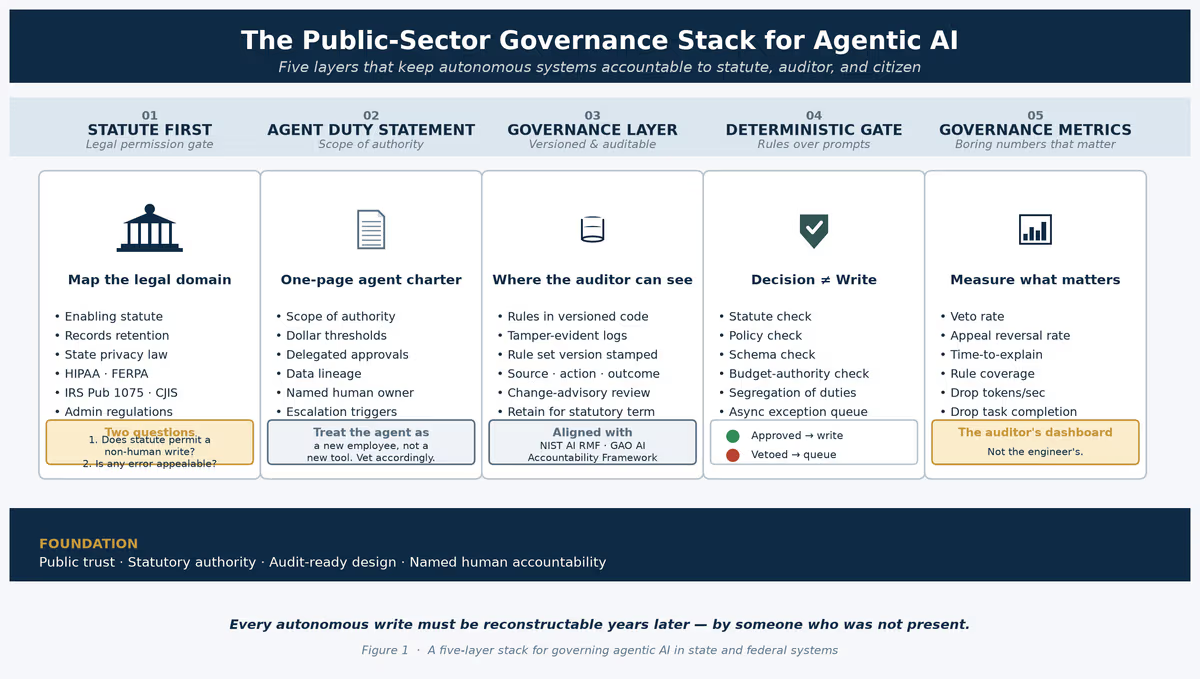
1. Start with the statute, not the model
Private-sector CDOs pick a use case and then ask counsel to review it. Public-sector CDOs must invert that. Before any agent gets write access, map the legal instruments already governing the data domain: the enabling statute, records-retention schedules, state privacy law, federal cross-cutting requirements (HIPAA, FERPA, IRS Publication 1075, and CJIS), and the agency’s own administrative regulations.
Two questions determine whether an agent belongs anywhere near a system:
- Does the statute permit a non-human actor to originate or alter this record?
- If the agent errs, is the mistake curable through an existing administrative appeal, or does it create an unappealable harm?
If the first answer is unclear, the agent stays read-only. If the second is “unappealable,” the agent does not touch that domain, regardless of throughput gains. A misrouted enterprise service request costs a few minutes. The same misrouting in a state benefits queue can push a claim past a statutory deadline, making the technical failure and the legal failure one and the same. Design for the harder case first.
2. Treat the agent as a new employee, not a new tool
Government hiring exists because public trust demands vetting. Agentic AI deserves the same discipline. Every autonomous agent should carry documentation equivalent to a position description: scope of authority, dollar thresholds, delegated approvals, data lineage, and a named human owner accountable when it misfires.
I encourage teams to write a one-page “duty statement” for every agent before writing a single line of code. It forces clarity about what the agent may decide, what it must escalate, and what it must never touch. Tie each item to a role in the HR system of record rather than a person, so accountability survives turnover. Auditors love it because it answers their first question: “Who owned this decision?”
Oversight should scale with consequence, not become a blanket rule that slows every action or gets quietly bypassed under delivery pressure. A read-only agent that summarizes published meeting minutes does not need the same review as one that proposes an eligibility change. Classifying agents by reversibility and impact — the way autonomous-vehicle systems define levels of driving autonomy — lets the CDO say yes to the low-risk work and no to the rest.
3. Build the governance layer where the auditor can see it
Enterprise governance too often lives inside model prompts, vendor consoles, or opaque orchestration platforms. That approach will not survive a Freedom of Information request or a legislative post-audit. Every material decision made through an AI agent must be reconstructable years later, often by someone who was not present.
Concretely:
- Governance rules live in versioned code inside the agency’s own repositories, not a vendor’s black box.
- Every agent-initiated write produces a durable, tamper-evident log naming the agent, the rule set version, the source data, the proposed action, and the outcome.
- Sensitivity and permitted-use metadata travel with the data end to end, so that downstream dashboards, integration jobs, and self-service applications inherit the restriction automatically.
- Rule changes follow the same change-advisory process that the agency uses for its systems of record. No exceptions for AI.
The NIST AI Risk Management Framework offers a workable structure, and GAO’s reviews of federal AI use illustrate the consequences of weak governance. Every unfavorable finding follows the same pattern: undocumented decisions, missing lineage, no owner. The fix is architecture that makes the right action the default and the wrong one take deliberate, visible effort.
4. Separate the decision from the write
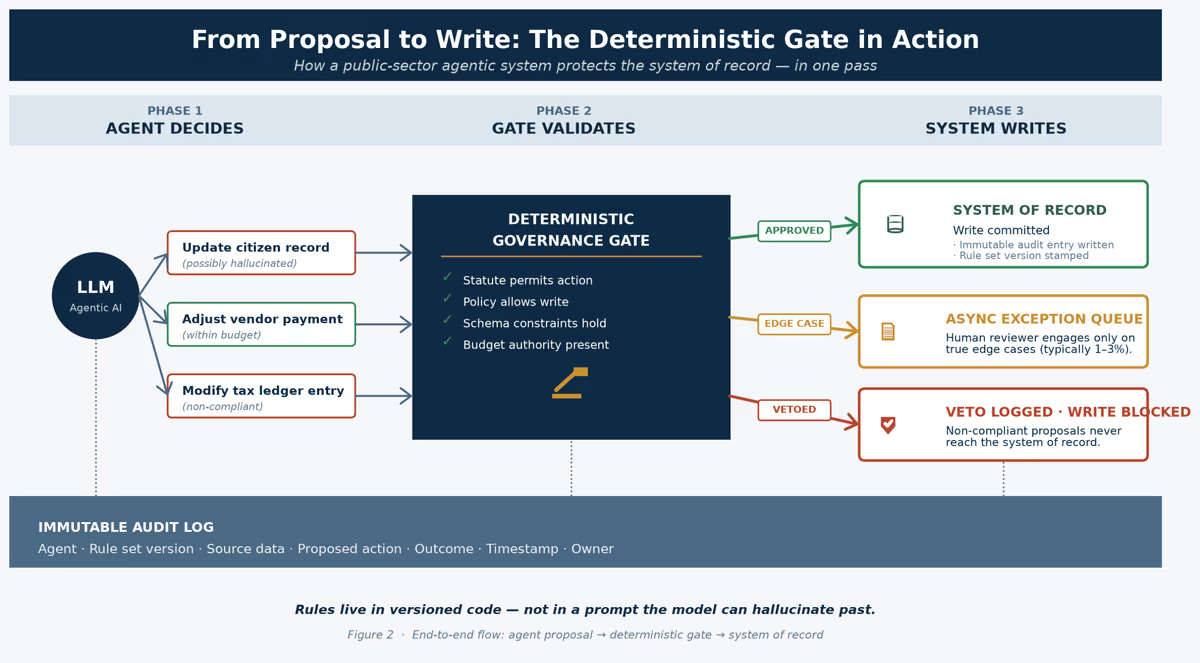
The most useful architectural move I have seen in public-sector agentic pilots is a deterministic gate between what the agent decides and what the system of record accepts. The agent proposes; a rules layer disposes. If the proposed action violates statute, policy, schema, or budget authority, it is rejected before the database hears about it.
This is the segregation-of-duties principle finance offices have enforced for a century, ported into code. What is new is velocity: the gate has to clear thousands of proposals per minute without becoming a bottleneck.
In a typical state ERP-and-analytics environment, the pieces are usually already there:
- Row-level security at the database tier,
- Sensitivity metadata carried through the integration layer,
- BI dashboards that inherit those restrictions, and
- Thin, versioned rule endpoints an agent must call before any write.
The agent cannot self-limit its way past controls that live in the platform.
Modernization work that strengthens data architecture, master data management, and identity controls is agentic AI governance work — even when it is not framed that way.
5. Measure the boring things
Executive AI dashboards still feature tokens processed, tasks completed, and cost per interaction. None of those keep a public-sector CDO out of a hearing room. The ones that do include:
- Veto rate: How often the governance layer blocks a proposed action, and whether that rate is drifting
- Appeal reversal rate: When a citizen or vendor challenges an agent-influenced decision, how often the agency changes course
- Time-to-explain: How long it takes to reconstruct why the agent did what it did, from a cold start
- Rule coverage: What percentage of the legal and policy requirements bound to the data domain are expressed as executable rules
If those numbers are not on the CDO’s monthly report, the agent is not governed; it is merely running. A drifting veto rate is the earliest warning that policy and behavior have diverged. A rising time-to-explain warns the audit trail is degrading faster than anyone is fixing it. These are the metrics that let a CDO walk into a legislative hearing with a straight answer instead of a promise to follow up.
The larger opportunity
Public-sector data leaders have a rare chance to shape what “responsible agentic AI” means in practice — not because government moves faster than industry, but because the constraints are tighter, the consequences more visible, and the accountability more personal. Governance that satisfies a state auditor will satisfy anyone. The organizations that earn the public’s trust with autonomous systems will not be the ones with the largest models. They will be the ones whose governance is legible, testable, and boring in the best possible way, because the answer to who was accountable for what the agent decided already exists in the system before anyone thinks to ask.



 Elevate Your Personal Brand