
What Is a Chief Data Officer in 2026? Many people working within the data industry are saying the same thing: the role of the Chief Data Officer (CDO) has changed – but how? CDO Magazine began an expert survey to find out. We recent...
2026 CDO Report: Meet the Modern Data Team New survey of VP & C-level data and AI leaders confirms what’s stalling AI transformation.
Generative + Agentic AI: Moving From Experimentation to Enterprise Scale Generative and agentic AI are making their way into enterprise production, bringing new questions for Chief Data Officers (CDOs) and other data and AI leaders responsible for making these technologies...
AI Governance
Agentic AI Is Turning a Decade of Enterprise Data Debt Into Operational Risk

Written by: Raghuvar Karthik Durga | Strategic CTO & Senior Account Technology Strategist, Microsoft
Updated 10:00 AM EDT, October 13, 2026

For most of the past decade, enterprises have carried a kind of debt that never appears on a balance sheet: enterprise data debt. Finance, operations, and sales may each define a metric like “on-time delivery” differently. Policy libraries hold current guidance beside versions retired years ago. Permissions outlast the projects that justified them. Whole data domains have nobody clearly answerable for what the data means or who may use it.
Organizations learned to live with these inconsistencies. Analysts reconciled conflicting numbers the night before an executive review. Veteran operators knew which of two documents was the real one. Managers supplied the context the systems lacked. The process was inefficient, but it held, because a person almost always stood between ambiguous data and a consequential action.
Agentic AI removes that person from the process. An agent can interpret a goal, retrieve information, pick a tool, and act across several systems without pausing. Chief Data Officers (CDOs) and other data and AI leaders may now find themselves asking whether their organizations can safely allow an AI-generated answer to become an action.
Most organizations, in my experience, do not have an AI problem so much as an action-readiness problem. Agentic systems are exposing years of unresolved data debt by turning ambiguity into operational exposure.
The debt was always there, but the buffer is what changed
Traditional analytics tolerated ambiguity because people absorbed it. When finance and operations defined “on-time delivery” differently, a leader could stop, compare the two, and decide which definition to use. An autonomous system may never notice the disagreement. It retrieves both documents, assembles a plausible reading, and proceeds. Nothing has to hallucinate for the result to be wrong. Every source can be accurate on its own terms and still be the wrong basis for a particular decision, because the version, jurisdiction, effective date, or business context never traveled with it.
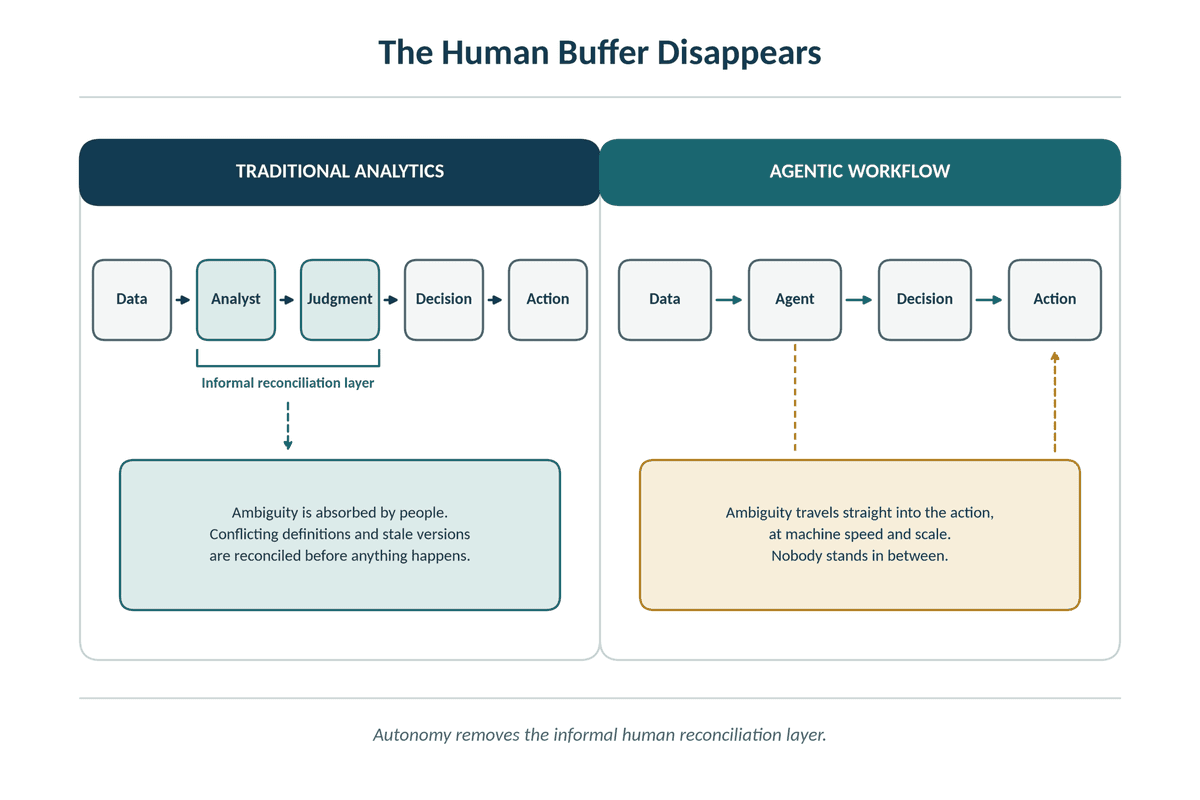
Figure 1: When an agent moves straight from data to action, the informal reconciliation that people used to provide goes with it.
In industrial settings, the difference between human oversight and autonomous decision-making is not academic. A technician can review a maintenance recommendation before acting. An agent, however, can change a production schedule, reroute inventory, or adjust a supplier order without human review. A forecast error can be argued about the next morning. An automated commitment may already have created cost, delay, or a contractual obligation.
This is why the data-quality disciplines CDOs have spent years building are necessary but no longer sufficient. Accuracy, completeness, consistency, and timeliness describe the data. They say nothing about whether this agent may use it for this purpose, who owns the result, or whether a bad action can be stopped. Access has the same gap. Technical permission is not a legitimate purpose, and an agent that inherits a user’s broad entitlements can combine information and invoke tools in ways no governance committee ever discussed.
So I would not call an enterprise agent-ready on the strength of a platform migration or an aggregate quality score. Readiness belongs to a specific decision, a specific data product and a specific action path.
CLEAR: An agentic AI readiness test at the decision level
To make that judgment repeatable, I ask five questions about any workflow before allowing an agent to act on its own. I call this approach the CLEAR Autonomy Readiness Framework: Context, Lineage, Entitlements, Accountability, and Reversibility. I developed CLEAR while advising data and technology executives at large industrial enterprises on when agentic systems could be trusted to act. This article introduces the framework publicly for the first time.
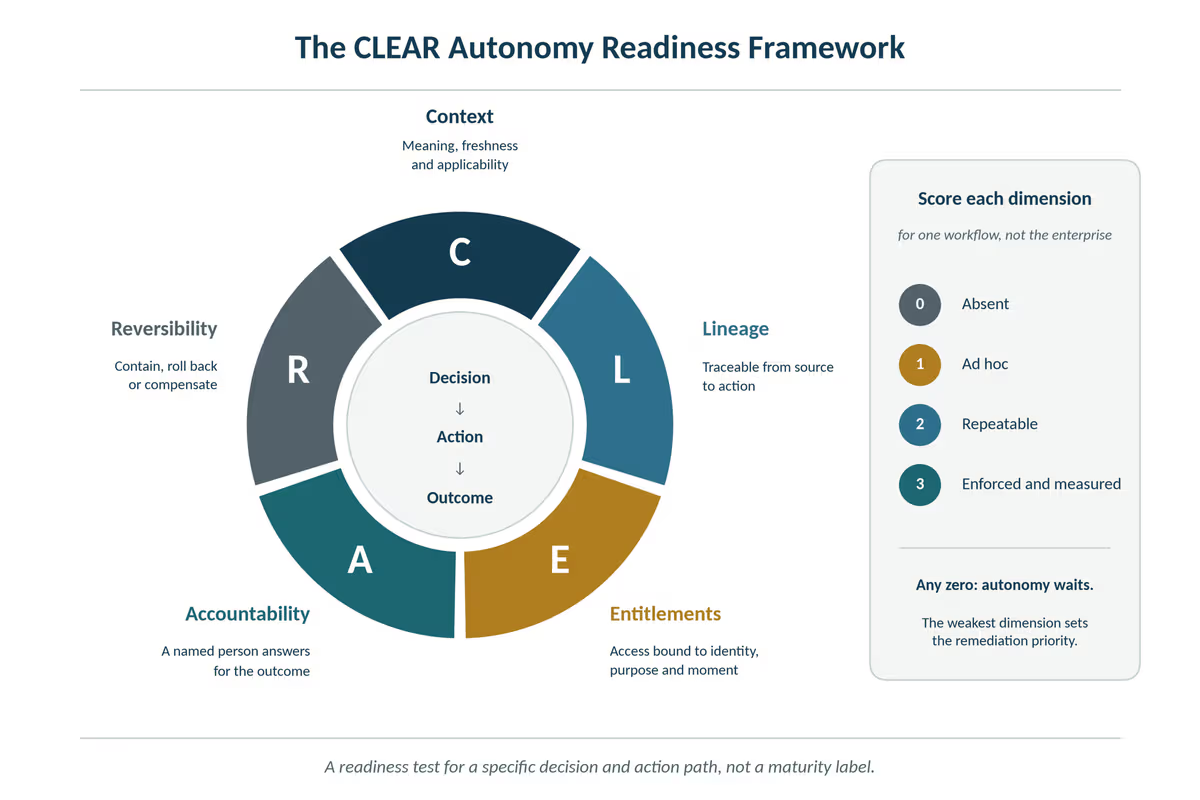
Figure 2. CLEAR tests whether a particular decision and action path are ready for a given level of autonomy. It is not an enterprise maturity score.
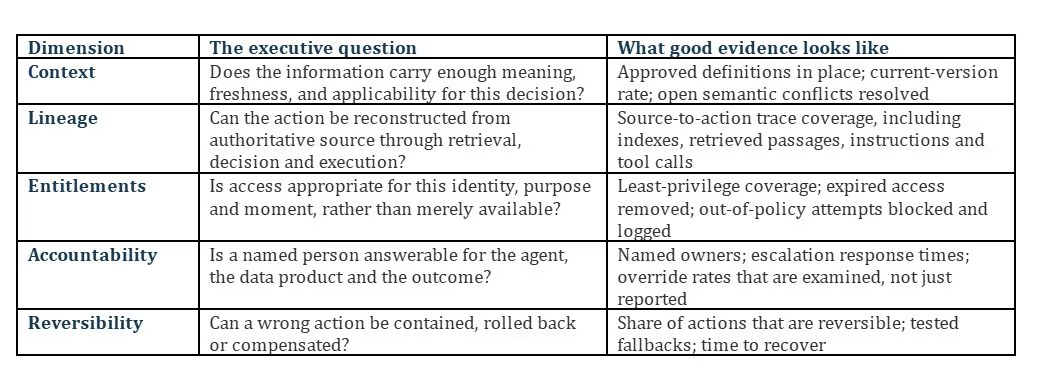
Two of these dimensions deserve a further word because they are where programs most often fall short. First, lineage usually ends at a report or a model. For an agent, it has to run on through document versions, indexes, retrieved passages, the instructions the agent was given, the policy checks it passed, and the tool it finally called. Otherwise, a company can know where a field came from and still be unable to explain why the agent acted. Secondly, accountability needs evidence rather than a box on a process diagram. A very low override rate can mean the agent is excellent, or that reviewers are rubber-stamping, and the operating model has to be able to tell the difference.
CLEAR is not a maturity label. A data product can be ready to support a recommendation and not ready to support a transaction. I score each dimension from zero to three for the workflow in question: absent, ad hoc, repeatable, or enforced and measured. If any dimension sits at zero, more autonomy waits. The weakest dimension sets the remediation priority.
Matching agentic AI autonomy to consequence and recovery
Autonomy is not a switch. The right level depends on how bad an error would be and how hard it would be to undo. A low-impact, easily reversed action can usually run with monitoring. A consequential but recoverable one may justify bounded autonomy inside defined limits. Where recovery is hard, a human’s approval earns its place. Where both consequence and recovery difficulty are great, the action should be prohibited or require an explicit executive exception.
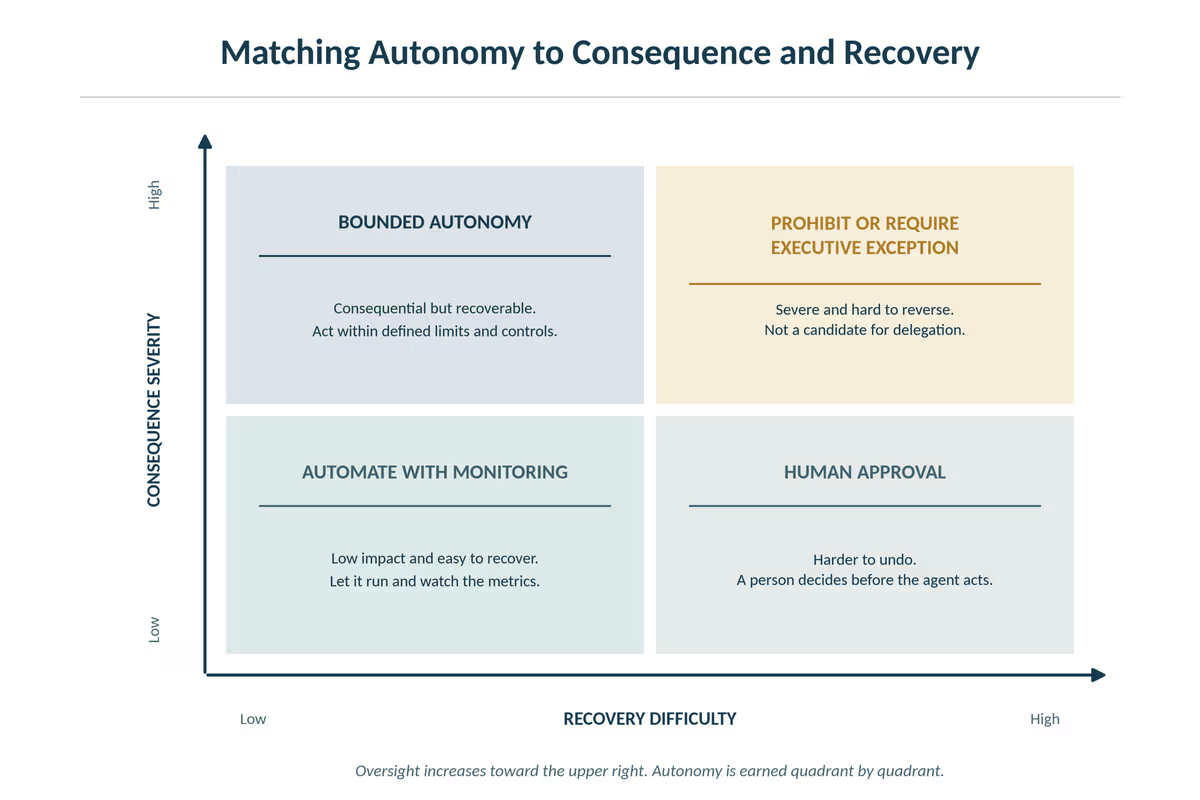
Figure 3. Oversight should rise with both the severity of a possible outcome and the difficulty of recovering from it.
Matching the level of autonomy to the consequences of an action avoids two familiar failures:
- Over-control, where every step needs approval, and the agent becomes an expensive search box
- Over-delegation, where broad access and vague objectives let an agent operate past the point where anyone can observe or recover
The useful middle is to encode boundaries so that routine, reversible actions proceed, and uncertain or irreversible ones meet deliberate friction at the moment the agent retrieves context, requests access, or calls a tool. Governance moves from data at rest to decisions in motion.
Public guidance supports the need for ongoing governance of AI systems and their actions. The NIST AI Risk Management Framework treats governance as a cross-cutting function infused throughout risk management rather than a gate passed once. Singapore’s Model AI Governance Framework for Agentic AI ties the risk of an agent’s actions to their scope, their reversibility, and the agent’s level of autonomy.
The practical way to encode those boundaries is an action contract attached to each consequential data product. The contract states which decisions may use the product, which identities may consume it, and the freshness and confidence it requires. It also specifies which actions are prohibited, what conditions trigger escalation, and how mistakes are recovered. The unit of readiness becomes a trusted data product, a bounded decision and an observable action path, rather than the whole data estate.
What governing agentic AI asks of the CDO
Pilots succeed when they are narrow, curated, and closely watched. Moving into production introduces shared data, real permissions, changing policies, and downstream consequences. This is where many programs stall. The scaling problem is organizational before it is technical.
Three accountabilities have to connect:
- Domain teams own meaning, quality, and business rules for their data products.
- Enterprise data and technology teams provide shared standards, identity, lineage, and controls.
- Risk, security, legal, and operations leaders set tolerances, evidence requirements, and escalation conditions.
Federate the governance if that suits the company, but put a name on every accountability.
The executive dashboard has to change as well. Counting agents, pilots, and generated outputs measures activity, not whether the company could defend a delegated action. I would track the share of consequential actions running on CLEAR-qualified data products, along with source-to-action trace coverage and out-of-policy attempts. Human overrides and time to contain and recover would also be important measures. The dashboard should show how many consequential actions the enterprise can explain, defend, and reverse.
CDOs can follow a sequence of steps to address enterprise data debt and expand AI autonomy. First, make the debt visible: inventory consequential decisions, write-capable workflows, agent identities, and permission paths, and score readiness by decision rather than by department. Then productize trust, so that owned data products with context, lineage, policy-aware access and action contracts become the default path for new workflows instead of something each team rebuilds. Expand autonomy only after that, where the evidence supports it, and retire agents that do not earn their keep.
The leadership choice
Instead of aiming for maximum autonomy, CDOs and other data leaders should focus on appropriate autonomy. That is the highest degree of delegated action an organization can justify for a particular decision and its consequences.
Agentic AI is a stress test. It finds the definitions still in dispute, the ownership that is nominal, the permissions that are excessive, the lineage that stops too early, and the recovery plan that exists only on paper. If you treat those governance gaps as a technology backlog, the organization will cycle through impressive demonstrations that never survive production. Treat them as action-readiness debt, and governance becomes an operating advantage.
The companies that lead in this era will not be the ones with the most agents. They will be the ones that know, decision by decision, when their data, their controls, and their people are trusted enough to act.
Author note
The views expressed are the author’s own. The article does not identify or rely on confidential customer information.



 Elevate Your Personal Brand